Why the Ford F-150 Is the Right Work Truck for Your Pressure Washing Business in Greer, SC
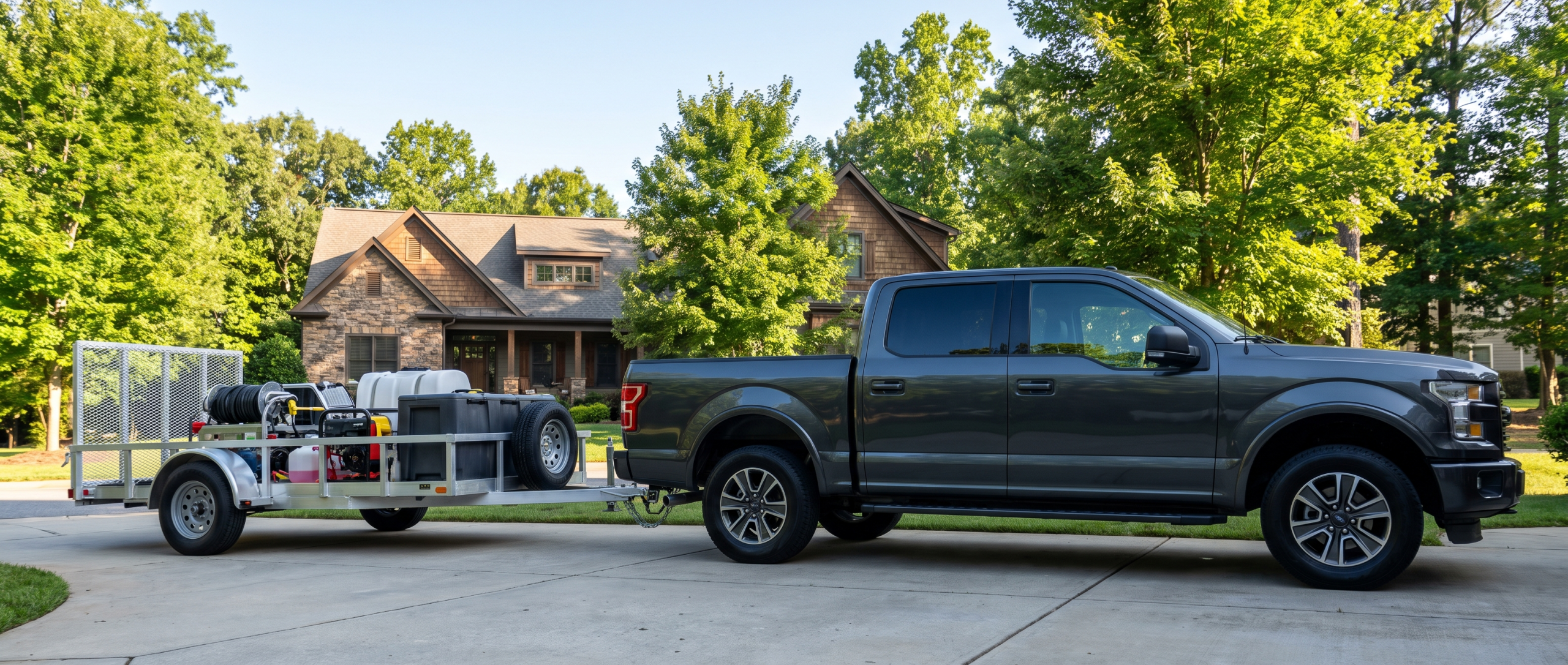
Running a pressure washing business in Greer, SC means putting serious miles on your truck every single week. Between loading up a 200-gallon buffer tank, towing a trailer with dual surface cleaners, and making back-to-back stops across the Upstate, your truck is not just transportation – it is the backbone of your operation. The Ford F-150® has earned its place as one of the most widely used work trucks for service businesses across South Carolina, and if you are building or growing a pressure washing operation, understanding exactly what it brings to your workflow is worth your time.
What Pressure Washing Businesses Actually Need from a Truck
The demands of a pressure washing business are different from most trades, and your truck needs to match them.
A plumber parks and works. A painter loads up once and heads to the job. Pressure washing operators are in and out of the truck 15 to 25 times a day, loading and unloading hose reels, adjusting trailer connections, hauling chemical totes, and driving routes that can span from Greer’s established neighborhoods near Tyger River to residential streets outside Spartanburg, SC and into Greenville, SC. The truck does not stop working until you do.
Here is what actually matters for this business model:
- Payload capacity to carry buffer tanks, chemical drums, and equipment in the bed
- Towing capacity for a dedicated pressure washing trailer rig
- Cab space for a crew of two when the jobs require it
- Fuel range to handle a full day of multi-stop routes without interruption
- Bed dimensions that accommodate standard 48-inch equipment widths
A truck that checks only two or three of these boxes creates friction every day. The F-150 addresses all of them in one package.
How the Ford F-150 Handles Payload and Towing for This Industry
The F-150 is capable of hauling over 2,000 pounds of payload in properly configured trims, which matters directly when you are carrying a 200-gallon water buffer tank.
Water weighs approximately 8.34 pounds per gallon. A full 200-gallon tank comes in at roughly 1,668 pounds before you add the tank itself, hose reels, chemical containers, and any additional gear. That kind of load puts pressure washing operators in a category most pickup truck owners never approach. The F-150’s available 3.5-liter EcoBoost engine, paired with the right payload package, gives you the margin you need to run full loads without stressing the suspension or exceeding the truck’s limits.
On the towing side, properly equipped F-150 configurations can tow up to 13,000 pounds. If you are running a 16-foot trailer with a hot water unit and a surface cleaner setup, you are likely in the 3,500 to 6,500 pound range depending on your rig. The F-150 handles that range with room to spare.
Choosing the Right F-150 Configuration for Pressure Washing Work
Not every F-150 is built for the same job, and choosing the wrong configuration creates problems you will deal with daily.
| Configuration | Best For | Trade-Off |
|---|---|---|
| Regular Cab, 8-ft Bed | Solo operators, maximum bed length, no trailer | Less passenger capacity |
| SuperCab, 6.5-ft Bed | Solo with occasional crew passenger needs | Middle ground on space |
| SuperCrew, 6.5-ft Bed | Two-person crews, equipment in bed + trailer | Slightly shorter bed than 8-ft |
| SuperCrew, 5.5-ft Bed | Crew hauling, primarily trailer-based setups | Bed space limited to smaller loads |
For most pressure washing operators in the Greer area running a trailer rig, the SuperCrew with a 6.5-foot bed tends to hit the most practical balance. You get full rear seating for a helper, enough bed space to carry chemical totes and hose reels, and the towing capacity to pull a properly loaded trailer without issue.
If you are a solo operator who keeps everything in the bed with no trailer, the Regular Cab with an 8-foot bed gives you the most usable flat surface.
Engine Options and Real-World Performance on Upstate SC Routes
Driving Greer’s roads is not the same as flat highway miles, and your engine choice reflects that.
The Upstate region has rolling terrain – not mountains, but enough elevation change on routes between Greer, Taylors, SC, and Duncan, SC that a loaded truck feels every grade. The 3.5-liter EcoBoost V6 is the engine most commercial operators gravitate toward because it delivers V8-level torque output (up to 570 lb-ft in high-output form on certain configurations) while maintaining reasonable fuel economy during the stop-and-go reality of residential service routes.
The 5.0-liter V8 is still a solid option for operators who prefer naturally aspirated power and plan to tow heavier rigs. It runs clean, it is easy to understand, and it delivers consistent pulling power without the complexity of turbocharger maintenance concerns.
The 2.7-liter EcoBoost is worth mentioning for operators with lighter setups – smaller trailers, soft wash systems without heavy tanks, or primarily flatwork with minimal equipment. It returns better fuel economy and still provides enough capability for mid-range loads.
Bed and Storage Setup Considerations for Service Operators
Your F-150’s bed is a workstation, not just a storage area, and setting it up right saves time on every job.
Pressure washing businesses in the Greer area typically configure their F-150 beds in one of two ways. The first is a full equipment carry setup – buffer tank, chemical drum rack, hose reel mount, and tool storage all in the bed. This works well for solo operators on residential contracts in neighborhoods near Paris Mountain State Park or Riverside High School, where driveways are long enough to pull up without a separate trailer rig.
The second is a bed support + trailer primary setup – chemical totes and supply inventory in the bed, with the machine and surface cleaner on a dedicated trailer. This splits the weight better and keeps the trailer hitch connection clean.
Useful add-ons operators often pair with the F-150 for this work:
- Bed liner (spray-in) to protect against chemical spill damage over time
- Toolbox mounted at the cab wall to keep nozzles, fittings, and small parts organized
- Tie-down rail upgrades for securing tank straps properly
- Gooseneck or fifth-wheel prep if you are planning to upsize your trailer in the future
Check out our new inventory if you want to see which F-150 configurations are currently available with factory bed utility packages already included.
Why Greer, SC Operators Rely on Trucks Built for Year-Round Work
South Carolina’s climate is not gentle on equipment or vehicles, and Greer sits in a zone that sees enough humidity, heat, and occasional freezing conditions to test your whole operation.
Summer in the Upstate means hauling equipment in 90-plus-degree heat, running pumps hard, and dealing with water that arrives at higher temperatures from sun-baked tanks. The F-150’s towing and cooling systems are designed to handle sustained load in high ambient temperatures – not just quick highway pulls. Fall and winter bring occasional freezing nights, which matter for operators managing water in tanks and hoses.
The F-150’s available four-wheel drive is a legitimate consideration for Greer pressure washers who take on commercial accounts in industrial areas near the Inland Port or residential jobs on unpaved or steep driveways. When you show up to a property after a rain and the driveway grade is working against you, 4WD turns a frustrating situation into a non-issue.
A full day running jobs from Greer toward Simpsonville, SC and back puts 60 to 80 miles on the truck easily. The F-150’s fuel range on the 3.5L EcoBoost configuration – typically in the 18 to 22 MPG combined range depending on load – is meaningful when you are running those routes five or six days a week.
Making the Case for the F-150 vs. Larger Super Duty Options
Some operators wonder whether they should step up to the Super Duty line – the F-250SD™ or F-350SD – instead of staying with the F-150.
Here is the honest answer: if your trailer exceeds 10,000 pounds gross vehicle weight, or if you are running a hot water industrial rig that tops 7,000 pounds loaded, a Super Duty is the right choice. The F-250SD and F-350SD are built for sustained commercial towing at weights that exceed what the F-150 is designed to handle daily.
But the majority of residential and light commercial pressure washing businesses in Greer are running setups well within the F-150’s range. The F-150 is more maneuverable in tight residential driveways, easier to park in shopping center lots when you have supply pickups to make, and carries a lower operating cost over time in fuel and maintenance.
- Handles 85% of residential and light commercial trailer setups
- More maneuverable on tight residential streets and driveways
- Better fuel economy than Super Duty equivalents under the same load
- Wider service interval options under normal operating conditions
- Strong resale value in the Upstate SC market
- Not the right tool for heavy industrial rigs above 10,000 lbs GVW
- Payload varies significantly by trim and configuration – requires careful selection
- Some bed length configurations limit in-bed tank size options
Common Questions About the Ford F-150 for Pressure Washing Businesses in Greer, SC
What F-150 engine is best for a pressure washing business in Greer, SC?
The 3.5-liter EcoBoost V6 is the most practical choice for pressure washing operators in Greer. It delivers up to 400 horsepower and strong torque output that handles loaded towing on the Upstate’s rolling terrain, while returning better fuel economy than the V8 during the stop-and-go nature of residential service routes. Operators with lighter soft wash setups may find the 2.7-liter EcoBoost sufficient for their daily needs.
How much can a Ford F-150 tow when pulling a pressure washing trailer?
A properly configured Ford F-150 can tow up to 13,000 pounds, which far exceeds the capacity needed for most pressure washing trailer setups. Standard residential pressure washing trailers with a hot water machine, surface cleaner, and 100-gallon tank typically fall between 3,000 and 6,500 pounds fully loaded. Always confirm the specific tow rating on your chosen configuration since cab style, bed length, and engine selection all affect the final number.
Is the Ford F-150 reliable enough for daily commercial use in the Greer, SC area?
The F-150 has consistently earned strong marks from J.D. Power for reliability in the full-size truck segment. For commercial operators running daily routes in Greer and surrounding Upstate communities, the key to long-term reliability is maintaining oil change intervals and keeping up with scheduled service – particularly important when the truck is working at or near its payload capacity regularly.
Can a Ford F-150 carry a 200-gallon buffer tank in the bed?
A 200-gallon water tank weighs approximately 1,668 pounds when full, which sits within payload range for F-150 configurations with a max payload package. However, you must account for the tank’s own weight, any additional equipment, and the driver and passenger weight when calculating your total payload. Choosing an F-150 with a dedicated payload package and verifying the specific payload rating on the window sticker is essential before committing to this setup.
What F-150 cab and bed configuration works best for a two-person pressure washing crew in Greer?
For a two-person crew operating in Greer and surrounding areas like Taylors, SC or Duncan, SC, the SuperCrew cab with a 6.5-foot bed is a practical configuration. You get full rear seating for a helper without sacrificing too much bed length, and the setup accommodates chemical totes and supply storage while still connecting to a trailer for the main equipment rig.
Where can I find a Ford F-150 configured for work use near Greer, SC?
D&D Ford Motors serves the Greer, SC area with a selection of F-150 trims suited for commercial and work use. Visiting the dealership in person lets you confirm exact payload ratings, bed configurations, and towing packages before you make a decision – all of which matter specifically for pressure washing business applications.
Ready to Put Your Pressure Washing Business Behind the Right Truck
The F-150 does not get its reputation by accident. For pressure washing operators in Greer, SC running daily routes, hauling tanks, pulling trailers, and building a business worth being proud of, it covers the practical requirements without asking you to overspend on truck you do not need or undersell yourself with a truck that cannot keep up.
The team at D&D Ford Motors understands what working trucks need to do and can help you match the right F-150 configuration to your actual equipment and route demands. Come in, look at what is on the lot, and have a real conversation about what your business needs from a truck.
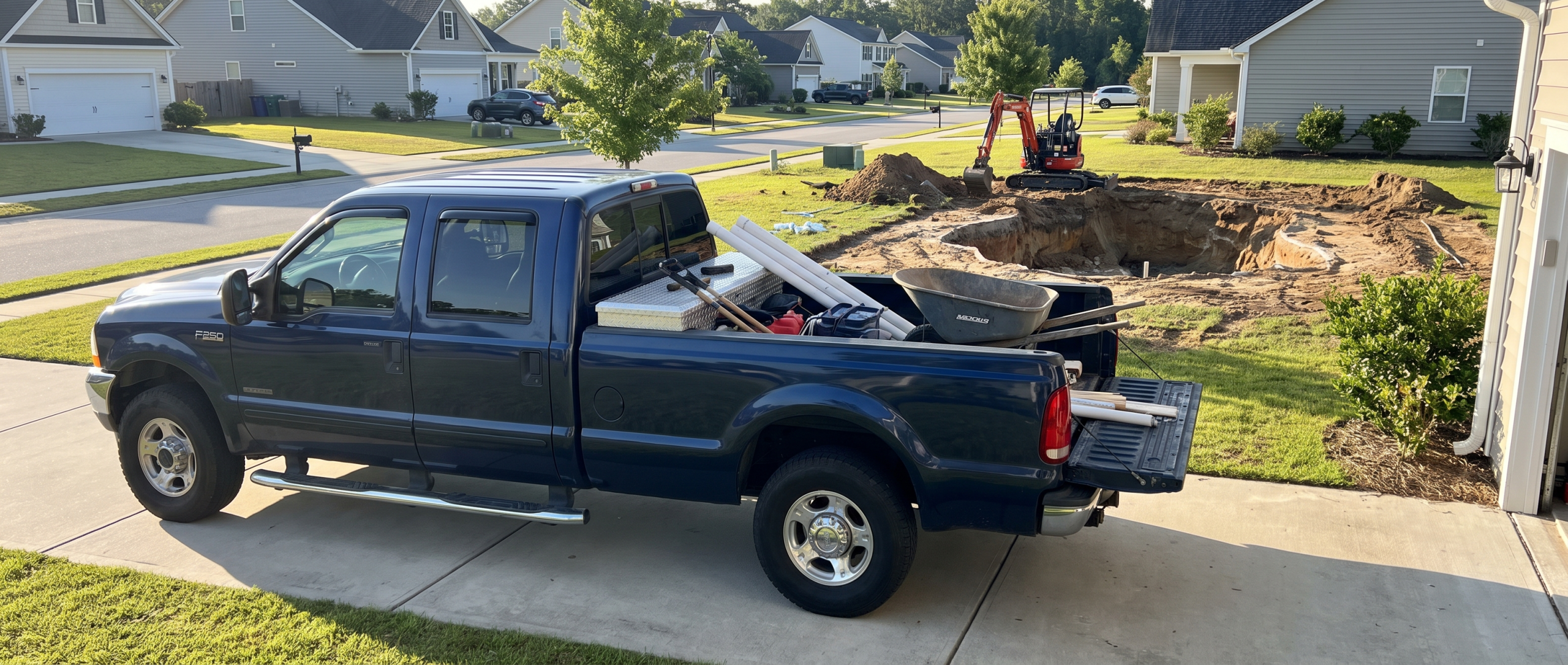
Pool contractors in Spartanburg County log serious miles – and that’s before the workday even starts. Between hauling excavation equipment to a new build near Lake Bowen, delivering chemical supplies to a service route in Greer, SC, and towing a trailer full of pumps and filtration systems across town, the wrong vehicle doesn’t just slow you down. It costs you money. The right Ford® work truck or van pays for itself through dependability, payload capacity, and the ability to handle whatever a South Carolina job site throws at it.
Why Spartanburg County Pool Contractors Have Specific Vehicle Needs
Pool work in this region is more demanding than most people outside the trade realize. Spartanburg County’s mix of established neighborhoods, new residential developments, and rural properties with long gravel driveways means your vehicle needs to handle suburban cul-de-sacs and rough dirt access roads on the same day.
Summer heat in the Upstate pushes well past 90°F for weeks at a stretch, which matters for both your crew and your engine. Work vehicles idling at job sites, running A/C hard while parked, and hauling heavy loads under that heat need cooling systems and tow ratings that won’t fade. Add the fact that pool season here runs roughly from late March through October, and you’re looking at some of the highest annual mileage demands of any residential trade contractor in the Southeast.
Here’s what pool contractors in this area are typically moving on any given day:
- Excavation and skimmer equipment
- Concrete, gunite, or fiberglass shell components
- Pumps, filters, and plumbing fittings
- Chemical supply stock (often in significant volume)
- Service tools and cleaning equipment for maintenance runs
- Trailers carrying small equipment or finished materials
A vehicle that can’t support that list reliably isn’t a work truck – it’s a liability.
The Ford F-250 Super Duty: Built for the Heaviest Pool Jobs
The F-250 Super Duty™ is the vehicle most experienced pool contractors in Spartanburg County gravitate toward, and the reason is straightforward: it handles the jobs that lighter trucks simply can’t.
With a max towing capacity of up to 22,800 pounds when properly equipped and payload capacity up to 4,260 pounds, the F-250 gives excavation-focused pool contractors the room they need. When you’re pulling a trailer with a skid steer to a new build off Highway 29 or hauling a full load of concrete forms, that rated capacity isn’t a number on a spec sheet – it’s the difference between completing a job in one trip or two.
The Super Duty’s available 6.7-liter Power Stroke diesel engine is worth particular attention for contractors doing high daily mileage. Diesel’s torque curve is ideal for towing under load, and for contractors running service routes across multiple neighborhoods near Boiling Springs or Duncan, the fuel efficiency under heavy use is noticeably better than gas alternatives in comparable configurations.
Strengths
- Highest towing and payload capacity in the Ford truck lineup
- Available diesel engine built for sustained towing workloads
- Crew Cab and SuperCab configurations for crew transport
- Available upfitter switches and work-ready electrical capacity
- Proven durability for multi-year commercial use
Considerations
- Higher starting price point than lighter trucks
- Larger footprint may be a factor in tight residential driveways
- Diesel fuel availability and service intervals require planning
Ford F-150: The All-Around Workhorse for Service-Route Contractors
Not every pool contractor needs maximum tow ratings every day. For businesses focused on maintenance routes – the weekly chemical checks, filter cleanings, and equipment inspections across dozens of residential pools – the F-150™ hits a balance that many contractors find hard to argue with.
Did you know? The Ford F-150 has been the top-selling vehicle in the United States for over 47 consecutive years. That kind of volume means parts availability, service support, and resale value that no other truck can match.
The F-150 with a 5.0-liter V8 or the high-output 3.5-liter EcoBoost gives service contractors enough tow capacity for a well-stocked trailer while delivering noticeably better fuel economy than a heavy-duty truck on routes that don’t require max-rated loads. When your crew is covering neighborhoods around Woodfin Ridge or running out toward Inman three days a week, that fuel savings accumulates quickly over a season.
Payload on the properly equipped F-150 reaches up to 2,440 pounds – more than sufficient for chemical stock, service equipment, and a full crew cab. The available Pro Power Onboard system, which generates up to 7.2 kW of exportable power from the bed, is genuinely useful for contractors who run power tools at job sites without a separate generator.
| Work Scenario | Recommended Configuration |
|---|---|
| New pool excavation and build | F-250 Super Duty, diesel, Crew Cab |
| Mixed service and light hauling | F-150 with 5.0L V8 or 3.5L EcoBoost |
| Chemical and equipment delivery | Transit-250 or Transit-350 cargo van |
| Multi-crew transport + trailer | F-350 Super Duty, Crew Cab |
| Solo service technician routes | F-150 Regular or SuperCab |
Ford Transit Cargo Vans: The Option Most Pool Contractors Overlook
There’s a strong case for adding a Transit™ van to a growing pool contractor’s fleet, and it’s one that doesn’t get made often enough in conversations about work vehicles.
Consider what a Transit-250 or Transit-350 cargo van offers that a truck bed cannot:
- Lockable, weatherproof cargo storage for chemical supplies, tools, and equipment that shouldn’t sit exposed in an open bed
- Standing room height options that make loading and unloading faster on long service days
- Full cargo separation from the cab, which matters when transporting chemicals
- Route efficiency – organized interior shelving systems mean less time searching for the right fitting on a job site
For a pool service business running maintenance contracts across Spartanburg County neighborhoods, a well-organized Transit cuts down wasted time significantly. Pool chemicals are heavy, temperature-sensitive, and require secure transport – an enclosed van handles that better than any open truck bed.
Pro tip: The Transit-350 is available with a high-roof configuration that provides 81.5 inches of interior standing height. For contractors building out interior shelving systems for tools, chemicals, and parts, that additional height can make a meaningful difference in how much you can organize and carry per trip.
The Transit lineup is also available with Ford’s commercial upfit prep packages, which simplify adding shelving, partition systems, and other work-specific configurations either through Ford directly or through an authorized upfitter.
F-350 and F-450 for Pool Contractors Running Heavy Equipment
Some pool contractors in Spartanburg County operate at a scale where even the F-250 starts to feel like a compromise. Contractors who regularly move heavy trailers – think a dedicated equipment trailer carrying a full excavator or multiple pieces of powered equipment – should be evaluating the F-350 Super Duty™ or F-450 Super Duty™.
The F-350 bumps available payload to over 7,850 pounds in certain configurations, while the F-450 pushes conventional towing to 37,000 pounds when properly equipped. For a contractor operating near Lake Blalock or covering larger rural property builds where a single excavation job might require multiple heavy equipment hauls, these are the numbers that matter.
Both trucks are available in dually configurations (dual rear wheels), which improves stability when hauling wide, heavy trailers. If your business has grown to the point where you’re regularly moving equipment that would challenge a consumer pickup, the F-350 and F-450 are where Ford’s commercial capability really becomes apparent.
The F-600 Super Duty™ is worth mentioning for larger pool construction operations that have crossed into medium-duty hauling territory, offering chassis cab configurations that support specialized flatbed or service body builds for equipment-heavy fleets.
Matching Your Business Stage to the Right Ford Work Vehicle
One of the most common mistakes pool contractors make is buying a vehicle for the business they have today rather than the business they expect to operate in two years. Here’s a practical framework for matching your operation to the right platform:
Starting out or solo operation: The F-150 with a work-oriented trim and appropriate tow package handles most service-focused pool work efficiently. Lower overhead, strong resale value, and manageable running costs make it a solid foundation.
Growing service business with a small crew: A Crew Cab F-150 or an F-250 Super Duty gives you crew transport capability without committing to a heavy-duty truck on every route day. Consider a used F-250 if you want Super Duty capacity while managing cash flow during growth.
Established contractor with build and service operations: An F-250 or F-350 for excavation and build jobs paired with a Transit cargo van for service routes is a combination that many mid-size pool companies find hits the right operational balance. Browse our new inventory to see current work truck and van configurations available at the dealership.
Large construction operation: F-450 or F-550 Super Duty with a purpose-built service body or flatbed configuration, alongside multiple crew vehicles. At this scale, fleet purchasing through Ford Pro makes sense to explore with the finance team.
Common Questions About Ford Vehicles for Pool Contractors in Greer, SC
What Ford truck is best for towing a pool equipment trailer in Spartanburg County?
The F-250 Super Duty with the 6.7-liter Power Stroke diesel is the strongest choice for regular trailer towing in Spartanburg County. It handles trailer loads up to 22,800 pounds when properly equipped, manages South Carolina’s summer heat under sustained towing conditions, and delivers better fuel efficiency under load than comparable gas configurations. For lighter trailers under 10,000 pounds, a well-equipped F-150 with a tow package is sufficient.
Is a Ford Transit van practical for a pool chemical supply route in Greer, SC?
Yes – a Ford Transit-250 or Transit-350 is well-suited for pool chemical routes in Greer, SC. The enclosed cargo area keeps chemicals secure, organized, and separated from the cab. Transit vans in mid-roof or high-roof configurations support aftermarket shelving systems that improve route efficiency. For businesses running 10 or more weekly maintenance stops, the organized interior space of a Transit pays off in time savings.
How much payload does a Ford F-150 have for pool service equipment?
A properly configured Ford F-150 offers up to 2,440 pounds of payload capacity. For most pool service routes carrying chemical stock, tools, and moderate equipment, this is more than adequate. Contractors hauling heavier loads consistently – pumps, filtration units, or larger service equipment – should evaluate the F-250 Super Duty, which offers significantly higher payload ratings.
Can a Ford F-150 tow a pool trailer in Spartanburg County?
Yes, a properly equipped Ford F-150 can tow up to 13,500 pounds, which is sufficient for most service and light construction trailers used in pool work. For heavier excavation equipment trailers common on new pool builds across Spartanburg County, the F-250 or F-350 Super Duty provides the higher-rated towing capacity and structural strength those loads require.
Where can I find Ford work trucks for my pool business near Greer, SC?
D&D Ford Motors in Greer, SC serves pool contractors and other trades businesses throughout Spartanburg County, including contractors working in Boiling Springs, Duncan, and surrounding areas. The team can help match your specific payload, towing, and crew transport needs to the right truck or van configuration.
Does Ford offer commercial fleet options for pool contractors with multiple vehicles?
Ford’s commercial vehicle program through Ford Pro offers fleet purchasing options, upfit support, and telematics for businesses operating multiple work vehicles. Pool contractors in Spartanburg County looking to equip more than one truck or add a van to an existing truck fleet can ask about current commercial vehicle availability and fleet account options.
The Right Work Truck Changes How You Operate
Pool contractors who run the right vehicle for their operation don’t just get through the day – they run tighter schedules, carry more in fewer trips, and spend less time dealing with equipment that wasn’t built for the job. Whether you’re a solo service technician covering neighborhoods near Lake Bowen or running a full construction crew on new builds across Spartanburg County, Ford’s lineup has configurations that match the real demands of pool work in the Upstate. The team at D&D Ford Motors understands what trades contractors need from a work vehicle and can help you sort through the options without wasting your time.
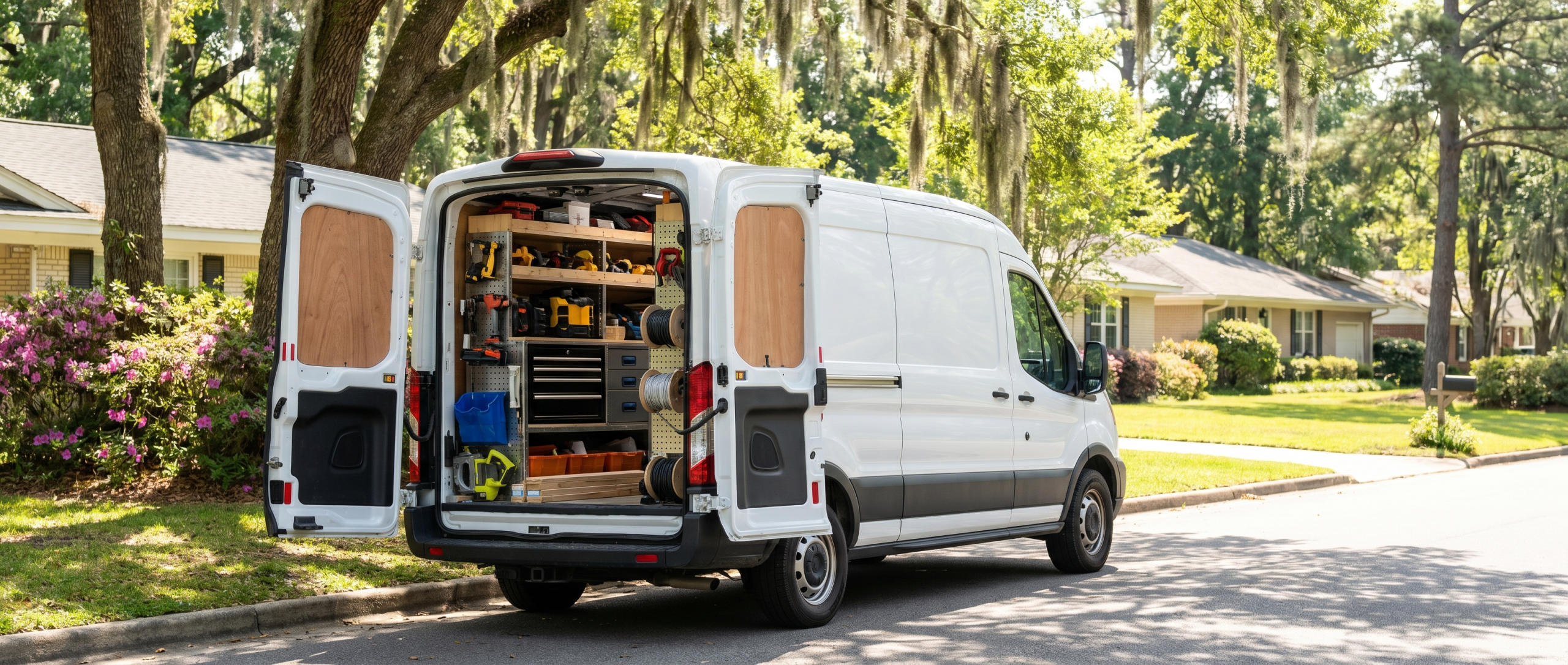
Summer in Greenville County is peak season for every trade that keeps homes and businesses running – and your work van is either helping you close more jobs or costing you time before you even arrive. Ford® commercial vans have been the choice of service contractors across Greer, SC and the surrounding Upstate region for good reason: they are built around the idea that the vehicle itself is part of the job. This guide breaks down which Transit configuration fits your operation, what to watch in the South Carolina heat, and why the right van setup matters more in summer than any other time of year.
Why Summer in Greenville County Is the True Test for Any Work Van
South Carolina summer heat does things to a work van that most spec sheets never account for. Greer and the broader Greenville County area regularly sees heat indices above 100°F from June through August, and that sustained heat puts pressure on every system your van depends on – from the cooling system and tires to cargo temperatures and driver comfort.
Contractors running HVAC, plumbing, electrical, and landscaping routes through areas like Simpsonville, SC or Taylors, SC understand this well. A van that idles at a job site for 45 minutes while a technician works inside a home is a van that needs a reliable cooling system, a strong alternator to support added electrical load, and enough cargo organization to get in and out fast before the next call.
The driving patterns in this region also matter. Service routes that run from Greer out toward Woodruff Road, or south along I-85 toward Duncan, SC, involve a mix of highway miles and stop-and-go neighborhood driving. That kind of cycle is harder on brakes, fuel systems, and engines than steady highway work – and it is exactly what a purpose-built commercial van is designed to handle.
Matching the Right Ford Transit Configuration to Your Trade
The Ford Transit™ lineup is not a single product – it is a platform with enough variation to fit almost any service trade operating in Greenville County. Getting the configuration right from the start saves money, improves daily workflow, and reduces wear over the life of the vehicle.
Here is a practical breakdown by use case:
| Trade Type | Recommended Transit Config | Why It Fits |
|---|---|---|
| HVAC / Refrigeration | Transit-250 Medium Roof | Balances payload with interior standing room for bulky equipment |
| Plumbing | Transit-350 High Roof | Extra vertical clearance for pipe stock and hands-free ladder storage |
| Electrical | Transit-150 Low Roof | Lighter payload needs, easier parking in tight residential areas |
| General Contractor | Transit-350 High Roof Extended | Maximum cargo volume for mixed tool and material loads |
| Mobile Equipment Repair | Transit-350 Dual Rear Wheel | Increased payload rating for heavy parts and service equipment |
The Transit-150™ works well for lighter electrical and tech service companies running smaller crews with organized bin systems. Move up to the Transit-250™ if your crew regularly carries refrigerant tanks, water heaters, or HVAC equipment that demands more payload capacity. The Transit-350™ – particularly the high-roof version – is where contractors dealing with tall inventory or who want a built-out shelving system tend to land.
One thing worth noting for summer specifically: all Transit configurations with the available 3.5L EcoBoost® V6 offer a strong combination of towing capacity and thermal management, which matters when you are working a loaded van through August heat across the Upstate.
What the South Carolina Heat Actually Does to Your Work Van
Thermal stress is a real maintenance factor for any commercial vehicle running continuous service routes from May through September in Greenville County.
Cooling system demand increases significantly. When a van is loaded to near its payload rating and running stop-and-go routes in 95°F ambient temperatures, the engine cooling system works harder than its baseline specs were tested at. Regular coolant checks and thermostat inspections before summer starts are not optional maintenance for high-mileage service vehicles.
Tire pressure fluctuates with temperature. For every 10°F rise in ambient temperature, tire pressure increases by roughly 1 PSI. A Transit-250 or Transit-350 loaded with tools and parts and running summer routes around Lake Robinson or the neighborhoods near Greer City Park needs tires inflated to spec at the start of the day – not the previous evening when temperatures were cooler.
Cargo temperatures affect materials. Sealants, adhesives, paints, and certain plumbing compounds have temperature-sensitive storage requirements. A cargo van sitting in direct sun can reach interior temperatures of 150°F or higher within minutes of shutdown. Contractors dealing with temperature-sensitive materials often invest in insulated cargo panels or auxiliary ventilation fans as part of their van build-out.
Upfitting Your Transit for Summer Service Efficiency
The van you drive off the lot is a starting point. The van you run service calls in is a purpose-built tool – and summer is the right time to evaluate whether your current setup is actually working for you.
A well-upfitted Transit for Greenville County summer service should address these priorities:
- Organized cargo access – Shelving and bin systems that let technicians pull the right part in under 60 seconds reduce time at every stop
- Electrical capacity – An upgraded aux battery or dual-battery setup handles the draw from power tools, inverters, and diagnostic equipment without straining the charging system
- Driver comfort – Extended idling with the A/C running is fuel-intensive; a powered vent or cab divider with a rear vent fan keeps the cargo area livable without maxing out the climate system
- Ladder and pipe rack integration – External ladder racks rated for the Transit’s roof load capacity keep interior space clear for more valuable cargo
- Fleet identification – Lettering, magnetic signs, or vinyl wraps are not just marketing; they create accountability in neighborhoods where homeowners are watching for service vehicles
Ford’s commercial van platform supports a wide range of certified upfitter solutions, and many Upstate South Carolina contractors work with regional upfitter shops to spec out their vehicles before putting them into rotation. Buying the right base vehicle – with the correct roof height, wheelbase, and engine configuration – makes the upfit more effective and less expensive.
Take a look at our new inventory if you are starting fresh with a Transit build or replacing an aging vehicle in your service fleet.
Fleet Considerations for Multi-Van Service Operations in Greenville County
Contractors running two or more vans out of the Greer area have additional considerations that single-vehicle operators do not face.
Standardized configurations simplify training. When every technician drives the same Transit configuration with the same upfit layout, cross-training is faster and parts inventory is easier to manage. Technicians know exactly where every tool is regardless of which van they are assigned.
Preventive maintenance scheduling across a fleet requires planning. Summer is when service demand peaks, and it is also when deferred maintenance becomes a problem. A Transit that goes down mid-July during your busiest billing period is more expensive than the PM visit you skipped in May.
Fuel efficiency matters across a fleet. The Transit-150 with the 3.5L EcoBoost engine offers a solid payload-to-efficiency ratio for lighter trades work. For heavier operations, the Transit-350 with the available 3.5L EcoBoost pulls more weight efficiently compared to comparable configurations in previous generations.
Ford’s Commercial Vehicles team offers fleet ordering programs worth exploring if you are adding multiple units. The structure of those programs is something the commercial team at a Ford dealership can walk you through directly.
Common Questions About Ford Commercial Vans for Service Calls in Greer, SC
Which Ford Transit size is right for HVAC service work in Greenville County?
The Transit-250 medium or high roof is the most practical option for HVAC contractors running routes across Greenville County. It offers enough payload capacity for refrigerant cylinders and air handler components while keeping overall vehicle dimensions manageable in residential neighborhoods. If your crew regularly carries large ductwork sections, the Transit-350 high roof extended length provides additional cargo volume.
How does the South Carolina summer heat affect Ford Transit maintenance schedules?
High ambient temperatures accelerate wear on cooling systems, belts, and tires in any commercial van. Ford recommends following the severe-duty maintenance schedule for vehicles that operate primarily in extreme temperatures or heavy stop-and-go driving – both of which describe a Greenville County summer service route. Coolant, transmission fluid, and brake fluid should all be inspected at the start of the season.
Can I get a Ford Transit upfitted locally near Greer, SC?
Yes. The Upstate South Carolina region has commercial upfitter shops that work with Ford Transit platforms and can build out shelving, electrical systems, ladder racks, and custom storage to your trade specifications. Starting with the correct base vehicle configuration – roof height, wheelbase, drivetrain – makes the upfit process more straightforward and typically less expensive.
Is the Ford Transit-350 capable enough for dual rear wheel payload demands in summer?
The Transit-350 in dual rear wheel (DRW) configuration is rated for a maximum payload of up to 4,530 lbs according to Ford’s official specifications, making it one of the more capable full-size cargo van options for heavy-service trades. That rating is for a properly configured vehicle – payload capacity varies by engine, wheelbase, and roof height, so confirming the specific configuration with your dealer matters before you commit to a build.
What Ford commercial van is best for a solo electrician running service calls near Greer, SC?
Solo electricians and light service technicians often find the Transit-150 low or medium roof to be the most practical daily driver. It is easier to park in tight residential driveways near areas like Taylors, SC or the neighborhoods around Greer City Park, it burns less fuel on shorter service routes, and its lighter empty weight helps with maneuverability. With a proper bin and shelving system, it carries everything a solo tech needs without unnecessary bulk.
Does Ford offer commercial van financing options for small contractors?
Ford Motor Company has commercial vehicle purchasing and fleet programs designed for small businesses, which your dealer’s commercial sales team can explain in detail. Exploring financing options specific to commercial vehicles – separate from standard retail financing – can sometimes provide more favorable structures for business-use vehicles. A conversation with the commercial team is the right starting point.
Making the Right Van Choice Before Summer Gets Busy
The window between spring slow-down and summer peak is short in Greenville County – and contractors who get their equipment right before the heat arrives have a real advantage over those scrambling to replace or repair mid-season. Whether you are a solo tradesperson running calls between Greer and Simpsonville or managing a multi-van operation with routes across the Upstate, the Transit lineup has a configuration that fits the work.
The team at D&D Ford Motors in Greer, SC understands commercial vehicle needs in this market and can help you match the right Transit configuration to your specific trade, payload requirements, and summer service demands. It does not have to be complicated – and getting it right the first time is always easier than fixing it later.
The Ford Transit Passenger Van: Reliable Group Transportation for Church Communities in Greer, SC
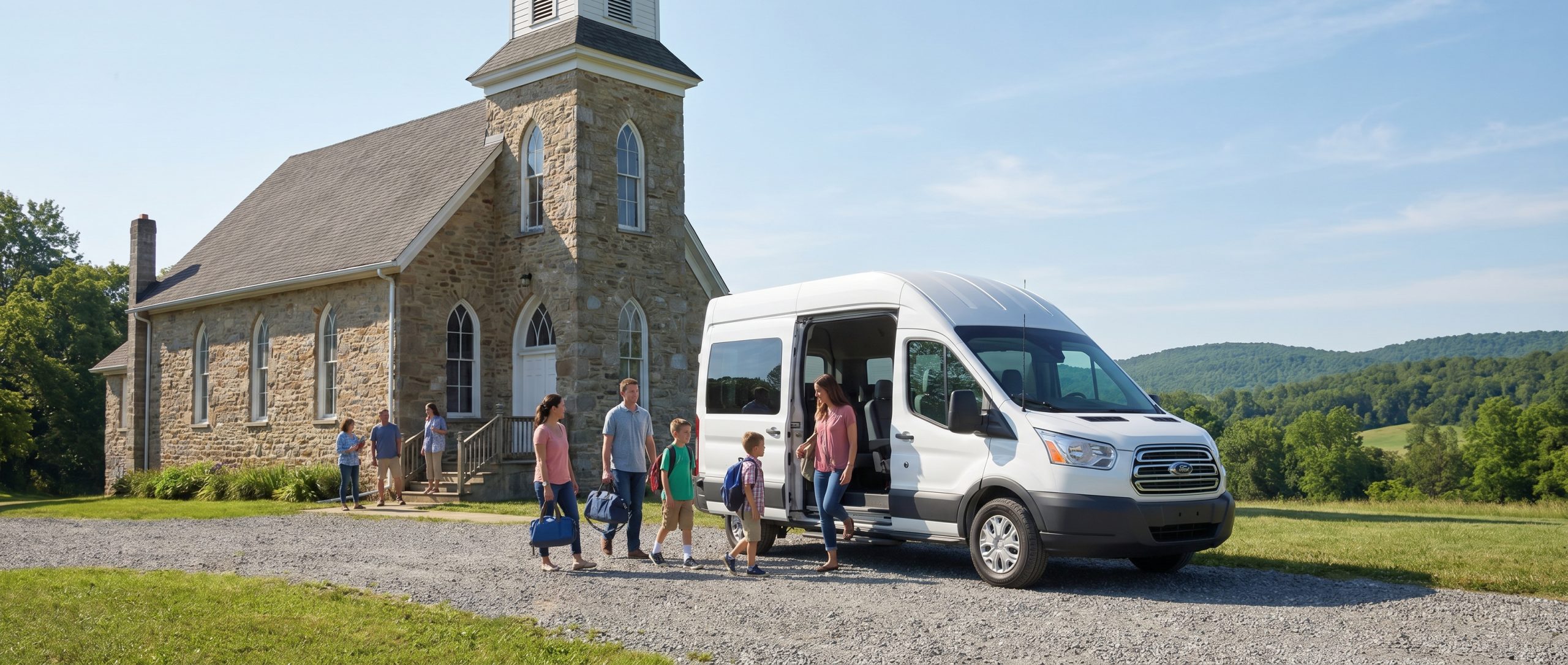
Coordinating transportation for a church group is no small task – and the wrong vehicle can turn a meaningful trip into a logistical headache before you even leave the parking lot. The Ford Transit Passenger Van for church groups in Greer, SC has become the go-to choice for congregations that need dependable, high-capacity transportation without the complexity of a full-size charter bus. Whether your ministry is heading to a retreat at Paris Mountain State Park, shuttling seniors to a midweek service, or organizing a youth mission trip, the Transit is built around exactly that kind of recurring, purpose-driven use.
Why High-Capacity Passenger Vans Matter More Than Most Churches Realize
Most congregations outgrow their transportation options faster than they plan for. A 12-passenger van works fine until your youth group grows, your senior shuttle list expands, or your church partners with a neighboring ministry for a joint event. The Ford Transit Passenger Van addresses this directly – it’s available in configurations that seat up to 15 passengers, which means one vehicle can replace the coordination burden of two smaller options.
That matters a lot in Greer, SC, where your routes might include everything from a quick run down Wade Hampton Boulevard to a longer drive toward the Blue Ridge Mountains for a weekend retreat. With a single, well-chosen vehicle, one driver handles the whole group, fuel costs stay manageable, and the logistics stay simple.
Here’s something worth knowing: the Transit has been the top-selling full-size van in America for more than 40 consecutive years. That kind of sustained presence in the market reflects reliability that church transportation directors can count on – not just in the short term, but across years of ministry service.
Understanding Transit Configurations: Matching the Van to Your Ministry’s Needs
Not every Transit is built the same, and choosing the right configuration is where most church buyers benefit from thinking carefully. Ford offers the Transit in multiple roof heights and body lengths, and the passenger van versions come in distinct weight classes that affect seating capacity, towing capability, and overall payload.
Here’s a clear breakdown of how the Transit lineup relates to common ministry scenarios:
| Transit Model | Max Passenger Seats | Best For |
|---|---|---|
| Transit-150 Passenger | Up to 8 | Small group shuttles, senior transport |
| Transit-350 Passenger | Up to 15 | Youth groups, mission trips, large shuttles |
| Transit-350 HD (High Roof) | Up to 15 + cargo room | Mixed passenger and gear transport |
For most church groups in the Greer, SC area that need serious capacity, the Transit-350 is where the conversation usually starts. It offers the most flexibility – especially if your ministry hauls equipment like sound gear for outdoor events, folding tables for community service days, or luggage for extended retreats.
If your congregation primarily serves smaller groups or operates multiple targeted shuttles (seniors on Tuesday mornings, youth on Sunday evenings), the Transit-150 keeps things manageable without unnecessary vehicle size.
What Makes the Transit a Strong Fit for Regular Ministry Use in Greer
Church transportation is not recreational use. These vehicles run consistent, scheduled routes – often with drivers who aren’t professional operators and passengers who range from young children to elderly members. That reality shapes what the Transit needs to deliver, and it delivers in the right areas.
Comfort for all ages is one of the Transit’s genuine strengths. The high-roof versions offer stand-up interior height, which makes boarding dramatically easier for seniors and passengers with limited mobility. Steps are manageable, headroom is genuine, and the seating layout doesn’t feel cramped the way some commercial vans do.
Key comfort and usability features that matter for ministry transport:
- Multiple sliding door configurations for easy entry and exit
- Forward-facing seating with seatbelts for all passengers
- Available rear air conditioning for Greer’s humid summer months
- Large windows for natural light and visibility
- Flat floor design that accommodates mobility aids and wheelchairs more easily
Driver confidence is the other side of this. Many church drivers are volunteers. The Transit is designed to feel approachable – the driving position is familiar, visibility is strong, and modern driver assistance features like a rear-view camera, lane-keeping alert, and automatic emergency braking (standard on newer models) reduce the pressure on less experienced drivers.
Take a look at our new inventory if your congregation is actively planning this purchase – having the specific configuration in front of you makes the decision much clearer than comparing spec sheets alone.
Fuel Efficiency and Operating Costs Over the Long Haul
Church transportation budgets are real constraints. A van that’s inexpensive to acquire but costly to operate can strain a ministry’s resources quickly – especially if it’s running multiple trips each week across Greenville County.
The Transit Passenger Van is available with a 3.5L EcoBoost® V6 engine, which balances power and fuel efficiency more effectively than older, larger engines in previous van generations. For church groups doing primarily highway driving – heading up I-85 toward Charlotte for a conference or taking Highway 14 toward Travelers Rest for an outdoor retreat – the EcoBoost delivers solid efficiency at highway speeds where you’ll spend most of your miles.
Ford also offers the Transit with a 3.5L naturally aspirated V6, which some fleet buyers prefer for its lower maintenance complexity. The tradeoff is slightly less power for hilly terrain – something worth considering given that the Upstate South Carolina landscape between Greer and the Blue Ridge foothills involves more grade changes than flat coastal routes.
A few practical cost considerations for ministry fleet planning:
- Scheduled maintenance intervals on the Transit are straightforward and well-documented, which matters when volunteers manage the upkeep
- Ford’s fleet support programs are designed for exactly this kind of organizational buyer – your church may qualify for fleet pricing or purchasing programs worth asking about
- Fuel costs can be budgeted more predictably because the Transit’s EPA estimates are consistent across normal operating conditions
Planning Specific Ministry Trips from Greer, SC
Context matters. The Transit performs differently on different trip types, and understanding how it handles your actual routes helps set realistic expectations.
Sunday shuttle routes around Greer: Short-distance, high-frequency trips within the city – picking up members from neighborhoods near the Greer City Park area or running between satellite parking and the church campus. For this use case, the Transit’s tight turning radius relative to its size is genuinely useful. It’s not a city bus, but it navigates parking lots and surface roads with more maneuverability than you’d expect.
Youth retreats toward Paris Mountain State Park or Lake Robinson: Longer routes with a full passenger load and gear in the rear. This is where the Transit-350 with the EcoBoost earns its keep. The engine pulls confidently on grades, and 15-passenger capacity means most youth groups can travel together rather than splitting across two vehicles.
Senior outings and medical transport: The high-roof Transit’s step height and interior clearance make it genuinely more accessible than low-roof alternatives. If your senior ministry frequently assists members with walkers or limited mobility, this configuration is worth prioritizing over base models.
Mission trip departures for longer drives: Whether your group is heading toward Charlotte, NC, Asheville, NC, or across state lines, the Transit handles extended highway miles well. The available cruise control and driver assistance features reduce fatigue on longer corridors, which matters when you’re relying on volunteer drivers.
The Case for Buying vs. Renting for Your Church
Some congregations manage group transportation through rental agreements or partnerships with charter services. That approach works situationally, but it carries consistent drawbacks for ministries with predictable, recurring transportation needs.
Ownership advantages for active church programs:
- Scheduling freedom – your van is available when your ministry needs it, not when a rental company has inventory
- Branding and consistency – a dedicated church vehicle builds familiarity with members and community
- Long-term cost efficiency – for groups running multiple trips per month, ownership typically becomes more cost-effective within the first few years
- Driver familiarity – volunteer drivers who know a specific vehicle become more confident and capable operators over time
When renting still makes sense:
- Occasional, once-or-twice-a-year events where full-time ownership isn’t justified
- Very small congregations without the administrative capacity to manage fleet maintenance
- Churches that already own a smaller van and only need supplemental capacity a few times annually
For most growing churches in Greer, SC – especially those with active youth, senior, or outreach ministries – the math and the logistics tend to favor ownership once transportation frequency passes a threshold of about 4-6 organized trips per month.
Common Questions About Ford Transit Passenger Vans for Church Groups in Greer, SC
How many passengers does the Ford Transit Passenger Van hold for church groups in Greer, SC?
The Ford Transit Passenger Van seats up to 15 passengers depending on the configuration. The Transit-350 is the model most commonly used by church groups needing full capacity, while the Transit-150 accommodates up to 8 passengers for smaller ministry programs. For most congregations in Greer, SC, the 15-passenger Transit-350 offers the most flexibility across different trip types.
Is the Ford Transit Passenger Van easy for volunteer drivers to operate?
Yes, the Transit is designed with driver accessibility in mind. Modern versions include a familiar driving position, strong outward visibility, a standard rear-view camera, and available driver assistance features like lane-keeping alert and pre-collision assist. These features reduce the pressure on volunteer drivers who may not have commercial vehicle experience, making the Transit a practical choice for church fleets.
What Ford Transit configuration works best for a church with seniors in Greer, SC?
For senior ministry transportation in Greer, SC, the Transit-350 with the high-roof option is typically the strongest choice. The additional interior height allows passengers to board without ducking, and the flat floor design makes it easier to accommodate mobility aids. The lower step-in height compared to larger commercial vehicles is also a meaningful comfort factor for older passengers.
How does the Ford Transit handle longer ministry trips from Greer toward the mountains or Charlotte?
The Transit handles extended highway routes well, particularly with the 3.5L EcoBoost V6 engine. For drives from Greer toward Asheville or Charlotte, the engine manages grades confidently, and available cruise control reduces driver fatigue. The ride is composed at highway speeds, and the Transit’s size allows it to park in standard spaces at rest areas and destination venues where a full charter bus would not fit.
Does D&D Ford Motors in Greer work with churches or organizations on Transit purchases?
Yes, organizational buyers including churches are a natural fit for Transit purchases at D&D Ford Motors. Fleet and organizational buyers may qualify for specific purchasing programs, and the sales team can walk church leadership through configuration choices, seating options, and practical considerations specific to ministry transportation needs.
What’s the difference between the Ford Transit-150, Transit-250, and Transit-350 for passenger use?
The Transit-150, Transit-250, and Transit-350 differ primarily in payload capacity and available configurations. For passenger van use specifically, the Transit-350 is the most relevant because it supports the 15-passenger seating configuration. The Transit-150 is capped at lower passenger counts but works well for smaller group programs. The Transit-250 is more commonly chosen in cargo configurations. For church groups prioritizing maximum passenger capacity, the Transit-350 is the standard starting point.
Making the Right Transportation Decision for Your Ministry
Church transportation decisions carry real weight – because the people riding in that van are your congregation, your community, and in many cases, people your ministry has made a commitment to serve. The Ford Transit Passenger Van gives Greer, SC churches a vehicle that’s practical to own, comfortable to ride in, and honest about what it does well.
It’s not a luxury vehicle. It doesn’t need to be. What it is, is dependable, well-supported, and built to handle the kind of consistent, purposeful use that ministry transportation demands year after year. The team at D&D Ford Motors understands the specific needs of organizational buyers and can help your church leadership navigate configuration choices and purchasing options without unnecessary complexity.
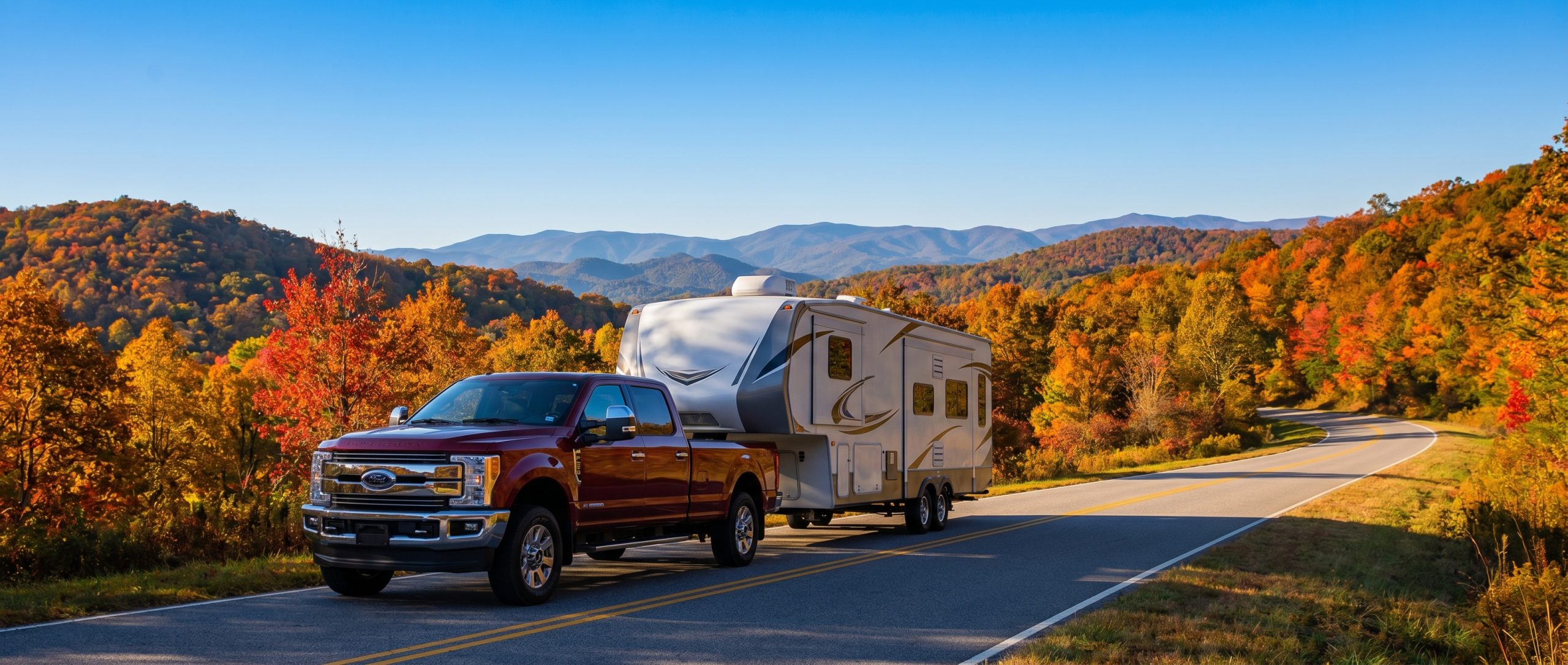
Most people underestimate what mountain towing actually demands from a truck – until they’re climbing a 6% grade somewhere between Asheville and the Tennessee border with a 14,000-pound fifth wheel swaying behind them. If you’re planning to tow a camper through the Blue Ridge Mountains from Greer, SC, the Ford® Super Duty™ isn’t just a capable option – it’s built specifically for the kind of sustained, high-stress towing that mountain terrain creates. This guide breaks down exactly what makes the Super Duty worth serious consideration before your next trip north into the hills.
What Mountain Towing Actually Does to Your Truck
Pulling a camper on flat ground and pulling one through the Blue Ridge Mountains are completely different mechanical challenges. On mountain terrain, your engine, transmission, brakes, and cooling system are all working at maximum output simultaneously – and they need to sustain that effort for miles at a time, not just seconds.
When you’re climbing from the Upstate South Carolina foothills toward destinations like Caesars Head State Park or continuing north toward the parkway, elevation gain is gradual but relentless. Grades of 5-8% are common on mountain approach roads, and those grades don’t let up. Your truck’s engine is fighting gravity the entire time. Downhill runs are equally demanding – braking a loaded trailer on a long descent generates serious heat in your braking system.
A truck that handles towing in flat conditions can struggle badly in this environment. Engine temperature spikes, transmission hunting between gears, and inadequate trailer brake integration are all real concerns on routes that matter to Greer-area campers. The Super Duty was engineered around exactly this kind of sustained stress.
How the Super Duty’s Powertrain Handles Sustained Grades
The Ford Super Duty’s towing capability starts with what’s under the hood, and the numbers behind these engines reflect serious engineering work.
The available 6.7L Power Stroke® Turbo Diesel V8 produces up to 1,050 lb-ft of torque – which is the figure that actually matters when you’re climbing. Horsepower tells you how fast a truck accelerates on flat ground. Torque tells you whether it can maintain speed and composure while pulling thousands of pounds uphill. That torque rating makes the Super Duty one of the most capable options available for mountain towing in its class.
The 10-speed SelectShift® automatic transmission works alongside that engine by finding the right gear ratio for the grade you’re on and staying there. Mountain roads punish transmissions that constantly hunt between gears. The Super Duty’s transmission calibration is designed to read load conditions and hold gears intelligently rather than cycling up and down searching for efficiency at the wrong moment.
For drivers weighing their options, the powertrain choice matters based on how they’ll use the truck:
| Powertrain | Best For | Max Towing (approx.) |
|---|---|---|
| 6.7L Power Stroke Diesel | Long mountain hauls, heavy fifth wheels, frequent towing | Up to 40,000 lbs (depending on config) |
| 7.3L Gas V8 | Occasional towing, lighter travel trailers, mixed use | Up to 18,500 lbs (depending on config) |
| 6.2L Gas V8 | Light-duty camper trailers, around-town flexibility | Lower range, lighter loads |
The diesel is the choice for serious Blue Ridge Mountain towing. For lighter pop-up campers or smaller travel trailers, the 7.3L gas engine handles the work without the added diesel maintenance considerations.
Integrated Towing Technology: More Than Raw Power
Raw towing capacity matters, but the technology built around it is what separates a truck that can tow from one that feels controlled and confident doing it.
The Super Duty’s Pro Trailer Backup Assist™ is one of the more useful real-world features for campers. Backing a large trailer into a mountain campsite – often on uneven terrain, between trees, sometimes at the end of a long driving day – is genuinely difficult. This system lets you steer the trailer with a knob rather than counter-steering the wheel, which takes a skill most occasional towers haven’t had time to develop.
Trailer sway control is another feature worth understanding before heading into the mountains. At highway speeds on mountain approach roads, crosswinds and road surface changes can introduce trailer sway. The system detects the oscillation early and applies selective braking to individual wheels to bring the rig back into line – before the driver even feels the sway begin.
Additional towing features on the Super Duty include:
- Trailer Brake Controller – integrated directly into the cab, not an aftermarket add-on
- Trailer Tire Pressure Monitoring – monitors trailer tires, not just the truck’s tires
- Hill Start Assist – prevents rollback on steep inclines when moving from brake to throttle
- Exhaust Brake – on diesel models, uses engine compression to slow the truck on descents without riding the brakes
- Ford Towing Technology Suite – camera system that provides views around the trailer, including side cameras and a hitch view
That exhaust brake feature deserves specific mention for mountain routes. On a long downhill stretch heading back toward Greer on I-26 or winding down from the higher elevations, riding your service brakes for miles builds up heat that can lead to brake fade. The exhaust brake carries much of that load instead, keeping your service brakes fresh for when you actually need them.
Choosing the Right Super Duty Configuration for Your Camper
The Super Duty family includes the F-250SD™, F-350SD™, F-450SD™, and F-550SD™ – and the right choice depends on what you’re towing, not just on general preference.
Payload capacity is the figure most campers overlook. Towing capacity tells you how much a truck can pull. Payload tells you how much weight can be loaded into the truck itself – including passengers, gear, and the tongue weight of your trailer. A fifth-wheel hitch places 15-25% of the trailer’s weight directly onto the truck’s bed as tongue weight. If your trailer’s tongue weight exceeds your truck’s payload, you’re overloaded even if you’re within towing limits.
Here’s a practical framework for matching truck to camper:
- F-250SD – Strong choice for travel trailers and lighter fifth wheels under approximately 15,000 lbs
- F-350SD – Better for heavier fifth wheels and gooseneck trailers; Dual Rear Wheel (DRW) option adds stability
- F-450SD – For serious fifth wheels in the 18,000-22,000 lb range; substantially higher payload capacity
- F-550SD – Commercial towing applications and the largest recreational rigs
Cab and bed configurations also matter practically. A crew cab with a short bed provides passenger comfort but requires a sliding fifth-wheel hitch to clear the cab during turns. A regular or extended cab with a long bed simplifies fifth-wheel setup. For families heading from Greer out toward Lake Hartwell for a launch point before heading north, or camping near Oconee State Park, the crew cab usually wins on comfort for longer drives.
The Blue Ridge Mountain Routes Greer Drivers Actually Use
Understanding the roads is part of understanding what your truck needs to handle. Greer, SC sits at roughly 900 feet of elevation. The Blue Ridge Parkway runs at elevations between 2,000 and 6,000 feet. That’s a significant climb across relatively short distances, depending on your route.
Common approaches from Greer include:
- US-25 North through Greenville toward Hendersonville, NC – A steady grade with moderate traffic; manageable but not forgiving with a poorly matched truck and trailer
- I-26 West toward Asheville, NC – Higher speeds on the approach, significant grade changes through the mountains, popular with campers heading to the Asheville area
- SC-11 (Cherokee Foothills Scenic Highway) – Lower elevations but excellent for accessing Caesars Head State Park and Table Rock State Park before pushing higher
- US-276 toward the parkway – Steeper and more technical; a real test of towing setup on the mountain approach sections
Table Rock State Park and Caesars Head State Park are popular staging areas for Greer-area families before pushing deeper into the mountains. Both involve roads that benefit from a truck with good low-end torque and reliable braking on the return.
Explore our new inventory if you want to see which Super Duty configurations are currently available before planning your next mountain trip.
Real-World Ownership Considerations for Mountain Towers
Buying the right truck is only part of the equation. Maintaining it properly for mountain towing keeps it performing the way it was designed.
Diesel engines in towing applications benefit from more frequent oil changes than the standard interval if you’re doing regular mountain pulls. The sustained high-load operation is harder on engine oil than typical highway driving. Ford’s recommended service intervals are a starting point, but serious towers often go shorter on intervals when they’re putting the truck through consistent heavy use.
Transmission fluid deserves attention after mountain trips. Extended high-load towing, especially on steep grades, runs transmission fluid temperatures higher than normal driving. Checking fluid condition and following Ford’s heavy-duty towing service schedule keeps the transmission healthy long-term.
Brake inspection after mountain trips is worth adding to your routine. If you’re using the exhaust brake properly on a diesel, your service brakes should be in good shape – but it’s worth confirming, especially on the front axle.
Tire condition and inflation are factors many campers overlook:
- Check both truck and trailer tire pressures before mountain trips – cold inflation pressures change at altitude
- Inspect tires for sidewall cracking and uneven wear before long hauls
- Understand your truck’s recommended tire pressures for loaded versus unloaded conditions
Common Questions About Ford Super Duty Towing in Greer, SC
What Super Duty model is the right choice for towing a travel trailer through the Blue Ridge Mountains from Greer, SC?
For most travel trailers in the 8,000-15,000 lb range, the F-250SD is a strong starting point for Blue Ridge Mountain towing from Greer. If your trailer is a larger fifth wheel above 15,000 lbs or you’re frequently running full loads with passengers and gear, the F-350SD or F-450SD provides more payload capacity and stability on sustained mountain grades. Always verify payload limits before purchase.
Does the Ford Super Duty diesel handle mountain grades better than the gas engine?
Yes, for sustained mountain towing, the 6.7L Power Stroke diesel outperforms the gas options in practical terms. The diesel’s torque curve is designed for high-load, low-rpm situations – exactly what long mountain grades demand. The exhaust brake feature on the diesel is also a significant advantage on descents, reducing reliance on service brakes during long downhill runs near areas like Caesars Head or the Blue Ridge Parkway.
How do I calculate whether my Super Duty can safely tow my camper in the mountains?
Start with the truck’s payload sticker in the driver’s door jamb. Calculate your tongue weight (typically 15-20% of trailer weight for travel trailers, or 20-25% for fifth wheels). Add that to the weight of passengers and gear in the truck. If that total exceeds the payload rating, the truck is overloaded regardless of towing capacity numbers. Mountain towing puts more stress on these limits than flat-road towing.
What Ford towing technology is most useful for mountain campground navigation near Greer, SC?
Pro Trailer Backup Assist is particularly valuable for mountain campgrounds, where sites are often tighter and less forgiving than flat-terrain parks. Trailer sway control is critical for the switchback sections and road conditions around the Upstate SC and western NC mountain routes. The integrated trailer brake controller also outperforms aftermarket units in terms of calibration and response.
How should I maintain my Ford Super Duty after mountain towing trips from Greer?
After mountain towing trips, inspect brake wear and fluid condition, particularly if you’ve been running long descents. Check transmission fluid condition and consider shorter service intervals if you’re towing mountains regularly. The diesel engine benefits from consistent oil change intervals rather than extended ones when under frequent high-load use. Ford’s heavy-duty towing maintenance schedule applies to regular mountain towers.
Is the Ford F-350SD significantly better than the F-250SD for the Blue Ridge Mountain routes near Greer, SC?
The F-350SD‘s main advantage is higher payload capacity, not just higher towing capacity. On mountain routes from Greer, payload matters because fifth-wheel tongue weight and passenger loads can push an F-250 close to its limits on heavier trailer setups. The F-350SD also offers a Dual Rear Wheel configuration that improves stability under heavy loads – a real benefit on the narrower mountain approach roads north of Greer.
Planning Your Mountain Trip Starts with the Right Truck
The Blue Ridge Mountains reward preparation. The routes heading north from Greer, SC toward the parkway, Caesars Head, and beyond are some of the most scenic drives in the Southeast – and they’re also genuinely demanding on a tow vehicle. The Ford Super Duty earns its reputation on roads exactly like these, where sustained grades, loaded weight, and long descents leave no room for a truck that’s underpowered or under-equipped.
The team at D&D Ford Motors understands what Greer-area campers need from a truck, and they’re well-positioned to help you match the right Super Duty configuration to your specific trailer and routes.
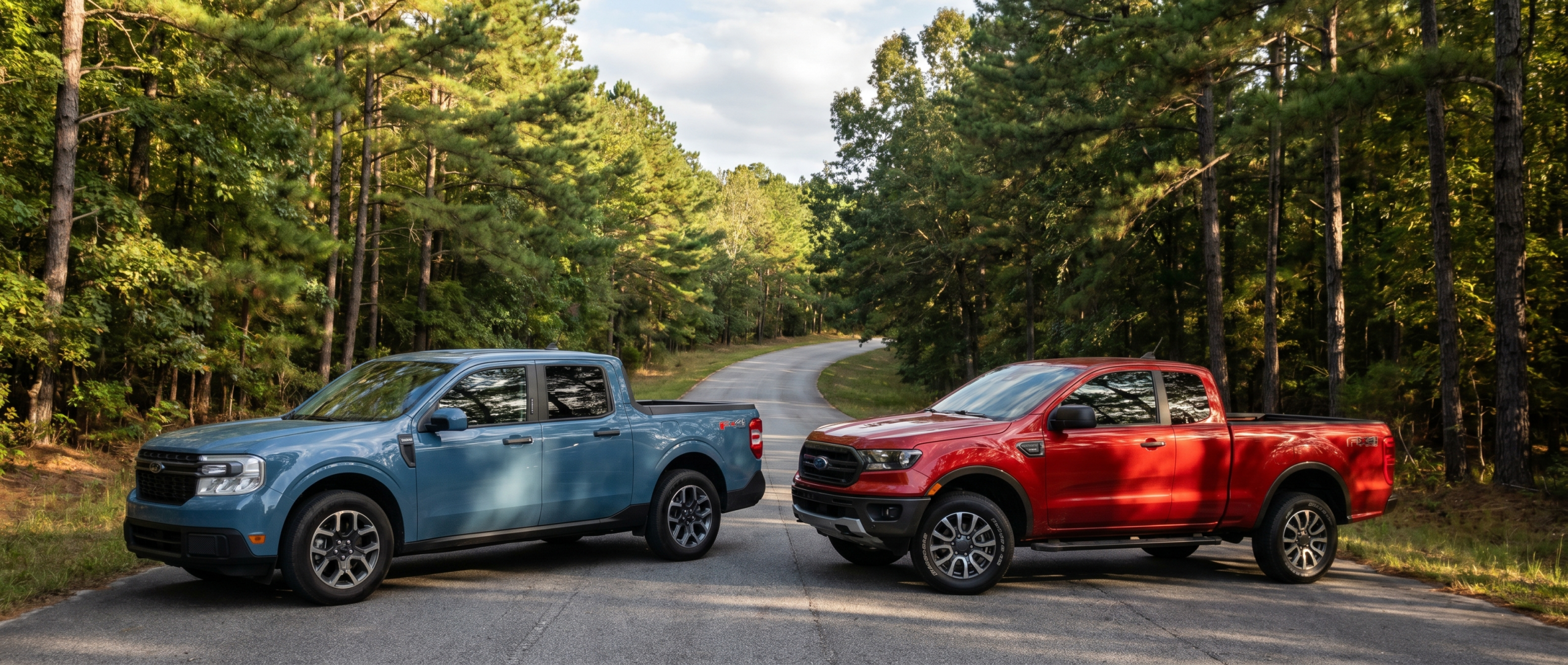
Two trucks. Both Ford®. Both capable. And yet they’re built for completely different lives. If you’ve been going back and forth between the Ford Maverick™ and Ford Ranger™ trying to figure out which one belongs in your driveway in Greer, SC, you’re asking exactly the right question – because choosing the wrong one means living with a truck that never quite fits. Here’s what you actually need to know to make a confident call.
They’re More Different Than They Look
Most shoppers assume the Maverick and Ranger are just different sizes of the same truck. That assumption leads to a lot of second-guessing after the purchase.
The Maverick is a compact unibody pickup – built more like a car underneath than a traditional truck. That matters for fuel economy, ride comfort, and day-to-day usability in tight spaces. The Ranger is a traditional body-on-frame midsize pickup, designed with towing, off-road durability, and heavier hauling in mind. Both wear the Ford oval, but they were engineered with very different drivers in mind.
Here’s a quick look at how the two stack up on the numbers that matter most:
| Category | Ford Maverick | Ford Ranger |
|---|---|---|
| Body Style | Unibody (car-based) | Body-on-frame |
| Standard Powertrain | 2.5L Hybrid (front-wheel drive) | 2.3L EcoBoost (4×2 or 4×4) |
| Max Towing Capacity | Up to 4,000 lbs | Up to 7,500 lbs |
| Max Payload | Up to 1,500 lbs | Up to 1,860 lbs |
| Bed Length | 4.5 feet | 5 feet |
| Fuel Economy (est.) | Up to 42 city / 33 highway (Hybrid) | Up to 23 city / 30 highway |
| Drive Configurations | FWD or AWD | 4×2 or 4×4 |
Looking at those specs side by side tells you a lot – but specs alone don’t answer the real question, which is what your daily driving life actually demands.
Who the Maverick Is Really Built For
The Maverick earns its place not by doing everything, but by doing the right things remarkably well for a specific type of driver.
If you’re someone who needs a truck bed for occasional hauling – weekend mulch runs to a local garden center, moving a piece of furniture, transporting bikes or kayaks for a day out at Lake Robinson – but you spend most of your time navigating everyday errands and commuting, the Maverick fits that life without compromise. It parks in a standard space, gets genuinely impressive fuel economy, and rides more like a car than a work truck.
Greer’s mix of suburban neighborhoods and quick access to Greenville and Spartanburg makes the Maverick a strong choice for drivers who want truck utility without the size penalty. If you’re covering I-85 corridors regularly or hopping on US-29, the Hybrid powertrain rewards that kind of driving.
The Maverick tends to be the right call when:
- Fuel costs are a real priority and you want to minimize fill-ups
- Most of your truck use is light-duty: groceries, gear, small hauls
- Parking in tight lots or congested areas is a daily reality
- You want a truck that drives with the ease of a crossover
- Occasional towing under 4,000 lbs covers everything you need
One thing worth knowing: the standard Maverick Hybrid is front-wheel drive. If you’re planning regular off-pavement adventures or need 4×4 confidence for rural roads, that’s a meaningful limitation – and one that points you toward either the Maverick’s optional AWD EcoBoost engine or an entirely different truck.
Who the Ranger Is Really Built For
The Ranger is built for people who need their truck to carry real weight – physically and figuratively.
With up to 7,500 pounds of towing capacity and a body-on-frame structure, the Ranger handles boat launches on Lake Hartwell, loaded trailers for a weekend at Paris Mountain State Park, and contractor-level hauling without flinching. It’s also the more capable choice if you venture onto unpaved terrain – available 4×4 configurations, higher ground clearance, and a suspension designed for punishment make a real difference when you leave the pavement.
The Ranger’s 2.3L EcoBoost engine delivers the kind of pulling power and torque that Maverick buyers will never need – but Ranger buyers will use consistently.
The Ranger makes the most sense when:
- You tow a boat, camper, or trailer with any regularity
- Your work demands hauling heavy tools, materials, or equipment
- You explore off-road trails or unpaved paths around Upstate South Carolina
- You need a 4×4 system you can rely on for genuine traction in rough conditions
- A longer bed (5 feet vs 4.5) makes a practical difference for what you carry
Drivers coming from Spartanburg or Simpsonville who head toward the Blue Ridge foothills on weekends will find the Ranger gives them flexibility the Maverick simply cannot match once the terrain gets serious.
How Greer’s Roads and Lifestyle Shape the Decision
Greer, SC is an interesting place to own a truck because it sits at the intersection of several different driving realities.
You’ve got suburban neighborhoods and retail corridors near Pelham Road where the Maverick’s compact footprint and fuel efficiency make daily life easier. Then you’ve got quick access to Lake Robinson, Paris Mountain, and trails along the Blue Ridge where having a capable, confident truck becomes genuinely useful rather than theoretical.
The question isn’t which truck is better. It’s which version of your life dominates your week.
If you’re spending most of your time in town – school pickup, grocery runs, the Home Depot parking lot on Saturday morning – and heading outdoors occasionally with light gear, the Maverick handles Greer’s everyday tempo well. Browse our new inventory to see current Maverick trims and available configurations.
If weekends regularly mean launching a boat, loading up a trailer, or exploring fire roads near the Cherokee Foothills Scenic Highway, the Ranger earns its keep every time. Drivers heading in from Taylors, SC or making runs toward Anderson, SC for work or recreation will feel the Ranger’s capability advantage in real, tangible ways.
Ownership Considerations Worth Thinking Through
Both trucks are solid ownership propositions, but they come with different cost profiles.
The Maverick Hybrid’s fuel economy advantage compounds over time. For someone putting 15,000-18,000 miles per year on a truck that spends most of its time in mixed city and highway driving, the savings at the pump add up in a meaningful way. Routine maintenance on the Hybrid system follows a standard schedule and doesn’t require anything unusual.
The Ranger’s ownership costs reflect its more capable architecture. It’s a heavier truck, uses more fuel, and has the kind of drivetrain components that genuine capability requires. For drivers who actually need that capability, the trade-off is entirely reasonable. For drivers who don’t, they’re paying for capacity they’ll rarely use.
A straightforward ownership comparison:
| Factor | Ford Maverick | Ford Ranger |
|---|---|---|
| Fuel Costs | Lower (especially Hybrid) | Higher (EcoBoost) |
| Parking Ease | Easier (compact size) | Moderate |
| Off-Road Capability | Limited (esp. FWD Hybrid) | Strong (4×4 configs) |
| Towing Practicality | Light-duty use | Regular and heavy-duty use |
| Daily Driving Comfort | Car-like ride | Truck-like feel |
| Bed Utility | Smaller (4.5 ft) | More versatile (5 ft) |
Common Questions About Ford Maverick vs Ford Ranger in Greer, SC
Can the Ford Maverick handle light towing in Greer, SC?
The Ford Maverick can tow up to 4,000 pounds when properly equipped with the optional EcoBoost engine. For most Greer drivers hauling a small trailer, jet ski, or utility trailer, that capacity covers the job. If you’re regularly pulling a full-size boat or loaded camper, the Ranger’s 7,500-pound tow rating gives you significantly more margin.
Is the Ford Ranger overkill for everyday driving around Greer?
Not necessarily, but it depends on your actual needs. Drivers who only use light truck capability – occasional hauling and no serious towing or off-roading – may find the Ranger’s fuel consumption and larger size unnecessary for their daily routine in Greer’s suburban corridors. If you’re unsure, list your three most common uses for a truck and match those to the specs.
Does the Ford Maverick Hybrid work well for commuters in the Greer, SC area?
The Maverick Hybrid is one of the stronger choices for Greer-area commuters covering stop-and-go sections of US-29 or I-85 regularly. Hybrid systems recoup energy during braking, which means city driving actually improves efficiency rather than hurting it. For daily commuters prioritizing fuel savings, the Hybrid powertrain is a genuine advantage.
Which Ford truck is better for exploring trails near Greer, SC?
For serious off-pavement use near Paris Mountain State Park or along routes toward the Cherokee Foothills Scenic Highway, the Ranger’s available 4×4 system, higher ground clearance, and body-on-frame durability make it the more capable choice. The Maverick’s standard FWD Hybrid is better suited to paved roads and light gravel, not sustained off-road use.
Can I get a trade-in estimate before deciding between the Maverick and Ranger?
Yes – and it’s worth doing before you commit to either truck. Get a trade-in estimate for your current vehicle so you understand your full budget picture. Knowing your trade value can help clarify whether the cost difference between the two trucks changes your decision, especially when you’re comparing the Maverick’s lower starting point against the Ranger’s broader capability.
Which Ford truck holds its value better?
Both the Maverick and Ranger have performed well in the used truck market relative to their segments. The Maverick’s fuel economy has driven consistent demand, while the Ranger’s capability profile appeals to a broad buyer pool. Consulting Kelley Blue Book’s current market data for your specific trim and configuration gives you the most accurate picture for your situation.
The Right Truck Is the One That Fits Your Actual Life
Neither the Maverick nor the Ranger is the wrong answer – but one of them is a better fit for how you actually use a truck in Greer, SC. If fuel efficiency and everyday usability top your list, the Maverick earns serious consideration. If real towing capacity, 4×4 confidence, and a more traditional truck experience matter more, the Ranger delivers.
The team at D&D Ford Motors knows Greer drivers and the kinds of demands Upstate South Carolina places on a truck. Stop in, talk through how you use your truck, and find out which one makes the most sense for your daily life.
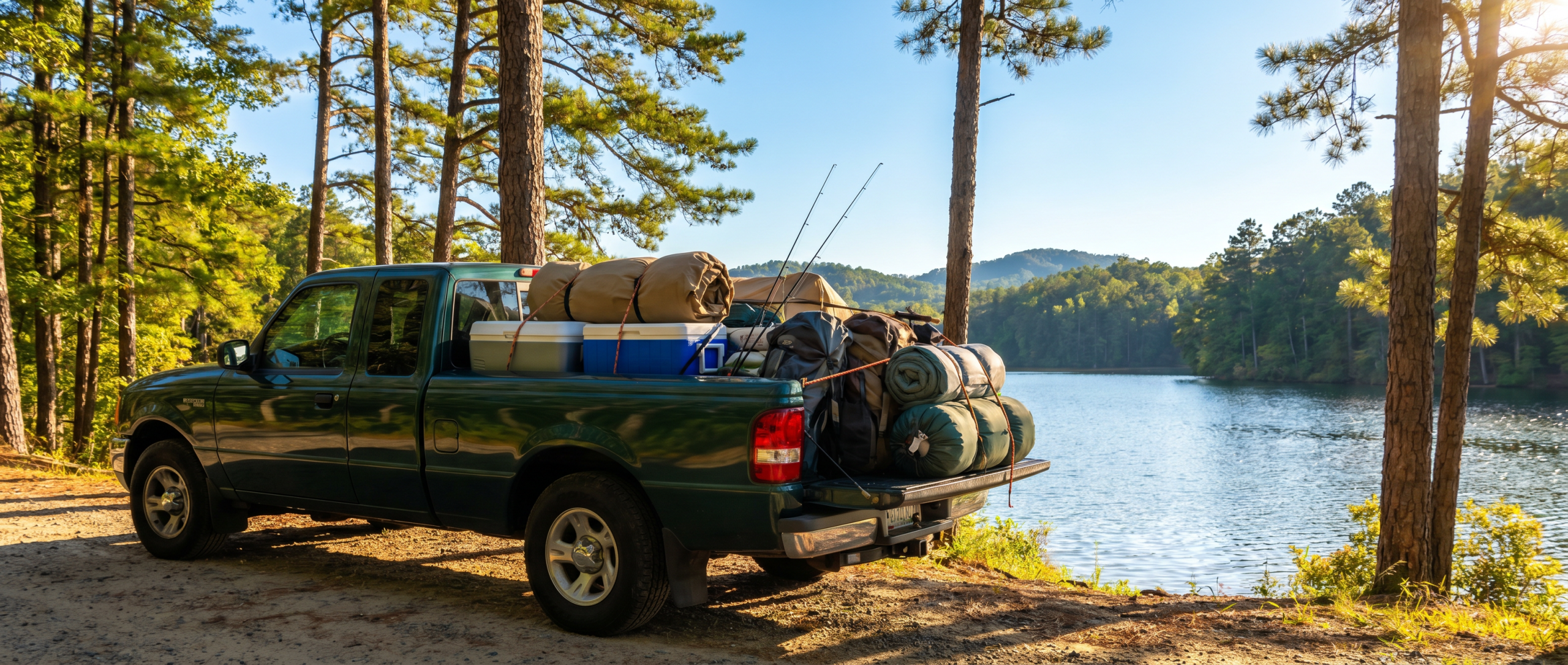
Most truck owners are surprised to learn that overloading a pickup bed does more damage than a fender bender – and summer is the season when it happens most. If you’re hauling kayaks to Lake Cunningham, loading up the bed for a weekend at Paris Mountain State Park, or stacking camping gear before a run down I-85, your Ford Ranger® has a specific payload limit that deserves your attention before you start loading. This guide breaks down exactly how to maximize your Ranger’s capability without crossing the line between capable and overloaded.
What “Payload” Actually Means for Your Ranger
Payload is the total weight your truck can carry in the bed and cab combined – including passengers, cargo, and any accessories you’ve added. The 2024 Ford Ranger is rated for up to 1,625 pounds of payload, depending on configuration. That number includes the weight of everyone sitting in the cab, which surprises a lot of first-time truck owners who assume payload only refers to what’s in the bed.
Your Ranger’s specific payload limit is printed on a sticker inside the driver’s door jamb. That number is calculated for your exact build, not a general estimate. Check it before every heavy haul – it takes about ten seconds and can save you from a blown suspension component or, worse, a handling situation on the highway.
Calculating Your Summer Load Before You Throw It In
Eyeballing a truck bed full of gear is not a reliable strategy. A pair of kayaks can weigh 50 to 80 pounds each. A full cooler with ice hits 60 to 80 pounds easily. Add a generator, two mountain bikes, tent gear, and three passengers in the cab, and you can approach your limit faster than expected.
Here’s a simple pre-loading approach that works well:
- Check your door jamb sticker for your Ranger’s specific payload rating
- Subtract passenger weight from that number (a cab with three adults at 175 pounds each removes 525 pounds from your available cargo capacity)
- Weigh your gear before loading – a bathroom scale handles most individual items
- Total your cargo weight and compare it against your remaining capacity
- Leave a buffer of 100-150 pounds to account for anything you may have forgotten or underestimated
This takes about five minutes at home and protects your truck, your passengers, and your summer plans.
The Best Way to Distribute Weight in the Ranger’s Bed
Staying under your payload limit is only half the equation. Where you place that weight inside the bed changes how the truck handles on everything from I-85 to the winding roads near Caesars Head State Park.
| Load Placement | Effect on Handling | Best For |
|---|---|---|
| Low and centered | Best stability, balanced steering | Heavy coolers, generators |
| Forward, near cab | Reduces bed bounce, improves control | Long items, lumber, kayaks |
| Rear of bed only | Raises front end, reduces steering feel | Avoid when possible |
| Uneven side-to-side | Creates pull and instability | Never recommended |
The general rule is straightforward: keep heavy items low and as close to the cab as possible. Flat, heavy objects like toolboxes and coolers should sit on the bed floor. Lighter gear like sleeping bags and dry bags can stack on top. Avoid letting weight shift to the tailgate end of the bed.
Securing Your Gear Properly on South Carolina Roads
Unsecured cargo is a legal issue in South Carolina and a road safety concern for every driver behind you. SC Code Section 56-5-4030 requires that cargo be secured to prevent it from falling or shifting while in motion. A loose kayak or sliding gear bin is not just inconvenient – it can create liability for you as the driver.
Here’s what a properly secured Ranger bed looks like for a summer haul:
- Tie-down straps rated for the load – not bungee cords for anything heavier than a suitcase
- Anchor points used correctly – the Ranger has four built-in tie-down hooks in the bed corners; use all of them when possible
- Cam buckle or ratchet straps for heavy items like generators, large coolers, and bikes
- Load nets for smaller items that might shift under acceleration or hard braking
- Tailgate fully closed or secured if load extends beyond it
If your gear arrangement requires the tailgate down, make sure the tailgate is secured in the horizontal position with the factory support cables – don’t rely on cargo weight to hold it level.
How Greer’s Summer Heat Affects Your Ranger’s Performance Under Load
Hauling a full payload in upstate South Carolina summer heat is genuinely harder on your truck than doing the same job in March. Ambient temperatures regularly push into the mid-to-upper 90s in Greer, SC between June and August, and that affects a few things worth knowing about.
Tire pressure rises in heat. Tires gain roughly 1 PSI for every 10 degrees Fahrenheit of temperature increase. If you inflate to spec in the morning and load the truck at noon after it’s been sitting in the sun, your tires will be at higher pressure than intended. Check tire pressure before loading, ideally when tires are cool.
Engine cooling works harder under payload. The Ranger’s 2.3-liter EcoBoost engine handles heat well, but towing or hauling at or near maximum payload on a 95-degree day while climbing grades will stress the cooling system more than typical driving. Make sure your coolant level is topped off and your radiator is clean before a heavy summer haul.
Brake performance requires more attention. A loaded Ranger weighs significantly more than an empty one, which means stopping distances increase. Add summer heat and repeated braking on the descents around Paris Mountain and you have a scenario where brake fade becomes a real consideration. Check your brake fluid condition and pad thickness before summer hauling season.
Browse our new inventory if you’re still shopping for the right Ranger configuration for your outdoor lifestyle – cab size, bed length, and trim level all affect payload and capability.
Accessories That Help (and Some That Hurt)
Not all truck accessories are equal when it comes to managing a summer payload. Some genuinely improve your hauling experience. Others eat into your payload capacity without adding much value.
Accessories that add real utility:
- Bed liner (spray-on or drop-in) – protects the bed and keeps cargo from sliding
- Tonneau cover – improves aerodynamics and protects gear from afternoon storms
- Bed extender – useful for kayaks and bikes without adding much weight
- Quality cargo tie-down anchors – adds more anchor points for varied loads
Accessories that quietly eat your payload:
- Heavy aftermarket steel bumpers (can add 50-100+ pounds)
- Large toolboxes bolted to the bed (quality steel units often weigh 80-120 pounds when empty)
- Lift kits and oversized wheels – add unsprung weight that affects ride and handling under load
The Ranger’s payload sticker accounts for the truck as it left the factory. Every pound of accessories you add comes directly out of your available cargo capacity. If you’ve added a heavy toolbox and a steel front bumper, recalculate your available payload before loading the bed for summer trips.
Common Questions About Ford Ranger Payload Tips in Greer, SC
What is the payload capacity of the 2024 Ford Ranger?
The 2024 Ford Ranger offers a maximum payload rating of up to 1,625 pounds, though the exact number varies by cab configuration, bed length, and drivetrain. Your specific truck’s payload limit is listed on the certification label inside the driver’s door jamb. That number already accounts for fuel weight and a standard driver, so subtract passenger weight to find your actual cargo capacity.
Can I haul kayaks and camping gear in my Ranger without exceeding the limit?
Yes, with proper planning. Two average kayaks weigh roughly 100-160 pounds combined. A loaded camping setup with cooler, tent, and gear typically runs 100-200 pounds depending on what you’re bringing. Add two passengers at average weight and you’re using perhaps 600-700 pounds of capacity – well within the Ranger’s rating for most configurations. The key is to calculate before loading, not guess.
Does hauling a full payload in Greer’s summer heat damage my Ranger?
Operating near maximum payload in high heat isn’t inherently damaging if the truck is well-maintained and you’re monitoring key systems. Check tire pressure, coolant level, and brake condition before heavy summer hauls. Avoid sustained maximum-payload driving on steep grades during the hottest part of the day if possible, and give your engine time to cool between demanding trips.
Where can Greer, SC drivers go to check whether their Ranger needs service before summer hauling?
D&D Ford Motors serves Greer, SC and the surrounding Upstate South Carolina area including drivers coming in from Spartanburg and Greenville. If your Ranger is due for an oil change, brake inspection, or tire rotation before summer hauling season, you can schedule service through the dealership’s service department to get everything checked before you load up.
How do I know if I’m overloading my Ranger?
Common signs of overloading include the rear of the truck sagging noticeably, the front end feeling light or steering feeling less responsive, and a rougher-than-normal ride even on smooth roads. If you notice any of these, stop and redistribute or remove weight. Chronically overloading a truck causes premature wear to leaf springs, shock absorbers, and wheel bearings – repairs that are far more costly than renting a trailer.
Does adding a tonneau cover affect my Ranger’s payload rating?
A tonneau cover itself reduces payload by however much the cover weighs – typically 50-100 pounds for a hard cover, less for a soft roll-up. So yes, it counts against your payload rating. However, a tonneau cover also provides real value by protecting gear from South Carolina afternoon thunderstorms and reducing aerodynamic drag on highway runs to destinations like Table Rock State Park. Most Ranger owners find the trade-off worthwhile.
Load Smart, Haul Confidently All Summer
Knowing your Ranger’s payload rating and working within it isn’t about limiting what you can do – it’s about making sure every summer trip actually goes the way you planned it. A well-loaded truck handles predictably, protects your gear, and comes home in the same condition it left. Whether you’re heading to the Swamp Rabbit Trail area or loading up for a long weekend in the mountains, taking ten minutes to plan your load makes every mile better. The team at D&D Ford Motors is here to help you get your Ranger ready for whatever Greer, SC summers throw at it – from pre-season service to finding the right truck configuration that fits your hauling needs from the start.
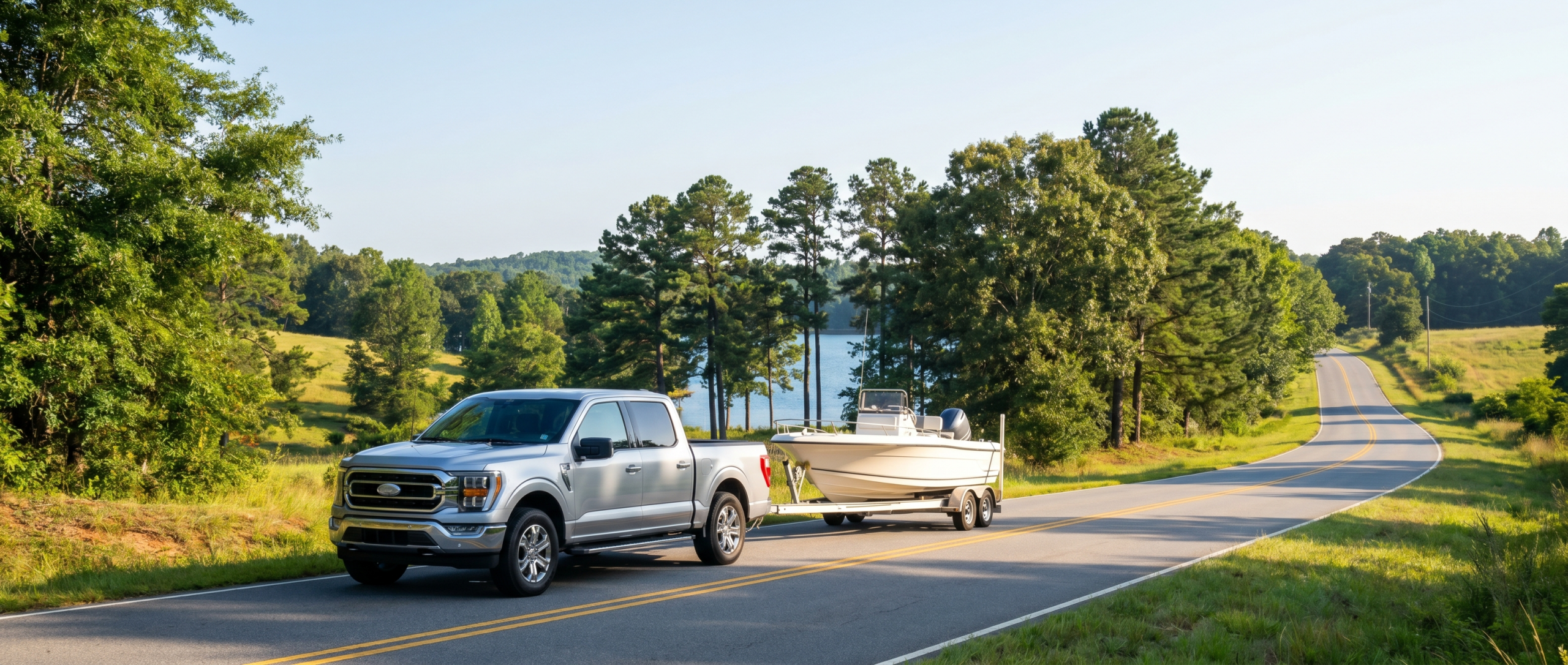
Plenty of truck owners find out the hard way that hauling a boat is a completely different experience than hauling gear – and Lake Keowee has a way of making that lesson feel urgent at the worst possible time. If you’re planning regular trips from Greer, SC out to one of Upstate South Carolina’s most popular lakes, your Ford® F-150™ is more than capable of handling the job. The key is knowing how to set it up correctly before you ever hook up a trailer.
This guide covers what you need to know: towing capacity, trailer setup, driving technique on mountain-grade roads, and what to check before and after every lake run.
Know Your F-150’s Real Towing Capacity Before You Load Up
The F-150’s maximum tow rating and your F-150’s actual tow rating are two different numbers – and confusing them is one of the most common mistakes lake-bound truck owners make. The 2024-2025 F-150 can tow up to 13,500 lbs when properly configured, but that figure depends on your specific engine, axle ratio, cab configuration, and whether you have the Max Trailer Tow Package. A base-trim F-150 with the standard 2.7L EcoBoost and a 3.31 axle ratio will have a noticeably lower rating.
Before you commit to a boat and trailer combination, locate the yellow sticker inside your driver’s door jamb. That sticker lists your truck’s specific Gross Combined Weight Rating (GCWR) and Gross Vehicle Weight Rating (GVWR). These are the numbers that actually govern what your truck can safely handle – not the marketing headline.
Here’s a quick reference for the most common F-150 powertrain configurations and their approximate tow ratings:
| Engine | Approx. Max Tow Rating | Best For |
|---|---|---|
| 2.7L EcoBoost V6 | Up to 8,200 lbs | Smaller fishing boats, jon boats |
| 3.5L EcoBoost V6 | Up to 13,500 lbs | Bass boats, pontoons, ski boats |
| 5.0L Ti-VCT V8 | Up to 11,100 lbs | Mid-size fishing and ski boats |
| 3.5L PowerBoost Full Hybrid | Up to 12,700 lbs | Larger boats with onboard power needs |
If your setup falls close to your truck’s limit, step down – not up. Running at 90-95% of rated capacity on rolling terrain taxes your drivetrain, brakes, and cooling system far harder than flat interstate driving would suggest.
Setting Up Your Trailer Hitch the Right Way
A correct hitch setup makes the difference between a controlled tow and a white-knuckle experience, especially on the grades you’ll encounter heading out of Greer toward Oconee County. The route to Lake Keowee takes you through some of Upstate South Carolina’s hillier terrain, and a poorly loaded trailer will make those grades feel much steeper than they are.
Follow these setup steps before every haul:
- Match your hitch class to your load. A Class III hitch handles up to 8,000 lbs, a Class IV up to 10,000 lbs. Know which is installed on your truck and verify it matches your trailer’s tongue weight requirements.
- Set the ball mount to the right height. Your trailer should ride level when connected – not nose-up or nose-down. A nose-down angle shifts weight off your front axle and reduces steering control.
- Use a weight-distribution hitch if your trailer tongue weight exceeds 600 lbs. Most pontoons and larger bass boats will cross that threshold when fully loaded.
- Check tongue weight. Tongue weight should be 10-15% of total trailer weight. Too little and the trailer sways; too much and your rear axle takes a beating.
- Torque your lug nuts on the trailer after the first 25-50 miles of towing. New trailers and freshly serviced trailers are notorious for loosening up on first use.
- Connect safety chains in a crossed X-pattern under the hitch coupler so they cradle the coupler if it separates.
- Test all trailer lights before leaving your driveway. Burned brake lights or turn signals are a moving violation and a real safety issue on two-lane roads.
How to Drive an F-150 While Towing a Boat on SC Roads
The roads between Greer and Lake Keowee are not freeway-flat. Highway 11, the Cherokee Foothills Scenic Highway, rolls through stretches of genuine hill country, and the approach roads to several Lake Keowee access points involve grade changes that will work your transmission and brakes hard if you’re not prepared.
Engage Tow/Haul Mode every single time. This is not optional. Tow/Haul Mode adjusts your F-150’s transmission shift points, activates engine braking, and when equipped, coordinates trailer sway control. It takes about two seconds to activate and makes a measurable difference in how the truck behaves under load.
On descending grades, use engine braking rather than riding your brake pedal. Repeated brake application on a long downhill with a loaded trailer generates significant heat and can fade your braking effectiveness just when you need it most.
Follow these driving adjustments for towing:
- Increase your following distance to at least 4-6 seconds. A loaded trailer significantly increases stopping distance.
- Avoid abrupt lane changes. Sudden steering inputs at highway speed can initiate trailer sway.
- If trailer sway starts, do not brake suddenly. Gradually reduce throttle and hold the steering wheel firmly straight. The F-150’s Trailer Sway Control will activate automatically to help stabilize.
- Allow extra distance for passing maneuvers. Your combined length with a boat trailer is substantially longer than your truck alone.
- Watch your mirrors constantly. What’s happening at the back of your trailer tells you a lot about how stable your load is.
Speed management matters more than most drivers realize. At 65 mph, stopping a loaded F-150 with a full trailer takes significantly longer than stopping the truck empty. Build time and distance into every maneuver.
Pre-Trip Checklist Before You Leave Greer for the Lake
The boat ramp at Lake Keowee State Park is a popular launch point, and on a busy Saturday morning, the last thing you want is to discover a mechanical issue in the parking lot with six other trucks waiting behind you. Running through a quick pre-trip check at home takes about ten minutes and prevents the majority of common towing problems.
- ✓ Tires inflated to recommended pressure on both truck and trailer (check cold, before driving)
- ✓ Trailer coupler locked and safety latch secured
- ✓ Safety chains connected in X-pattern
- ✓ Trailer lights tested – brake, turn, and running lights
- ✓ Wheel bearings on trailer last serviced within the recommended interval
- ✓ Boat drain plug installed (yes, this one still gets people every year)
- ✓ Boat and motor properly secured – tie-downs tight, prop guard on
- ✓ F-150 coolant and engine oil at proper levels
- ✓ Side mirrors adjusted to clear both sides of the trailer
- ✓ Brake controller calibrated if equipped
If your F-150 hasn’t been serviced recently and you’re planning a full season of Lake Keowee runs, it’s worth getting ahead of it now. Browse our new inventory if you’re also considering upgrading to a better-configured tow rig for the summer ahead.
Backing Down the Boat Ramp Without the Stress
Backing a trailer is a skill that takes practice, and the boat ramps around Lake Keowee – including access points near Keowee-Toxaway State Natural Area – can get crowded on weekends. The good news is that the F-150 has several features specifically designed to reduce the anxiety of this moment.
Pro Backing Tips for F-150 Owners:
- Place your hand at the bottom of the steering wheel when reversing. Moving your hand left moves the trailer left; moving it right moves it right. This inverted logic clicks for most people immediately.
- Use Trailer Backup Assist (if equipped) to let the truck steer automatically – you manage speed with the brake only.
- Use your mirrors, not just your camera. The wide-angle camera helps, but your side mirrors give you the full picture of trailer angle.
- Back in slowly. There’s no award for being fast. Patient, deliberate movements are far easier to correct.
- Stage your approach by pulling forward past the ramp, then reversing in a straight line to minimize correction angles.
- If you overshoot the angle, pull forward and reset. Every experienced boater has done this.
The Ford Expedition and F-250SD are also worth considering if you regularly haul multiple watercraft or larger pontoon setups, but for most recreational fishing boats and ski boats typical at Lake Keowee, a properly configured F-150 is more than enough truck.
Post-Trip Care for Your F-150 After a Day on the Water
What you do after the boat is back on the trailer matters just as much as your pre-trip prep. A day of towing in South Carolina heat puts real stress on your F-150’s drivetrain components, and catching small issues early prevents larger ones later.
After returning from Lake Keowee, take a few minutes to:
- Check your trailer hitch and coupler for wear, play, or loosening hardware
- Inspect your trailer tires for sidewall bulging or uneven wear that developed during the trip
- Let your truck’s transmission cool before parking in a garage – a short idle period after a long tow helps
- Check your brake fluid level if you noticed any sponginess on descending grades
- Rinse the trailer frame and bunks if they contacted the water during launch or retrieval
- Note any new warning lights that appeared during towing – most F-150 systems will flag issues as they develop
If the F-150 you’re currently running has high mileage or hasn’t been through a full service in a while, it’s smart to schedule service before summer towing season kicks into full swing in the Upstate SC area.
Common Questions About F-150 Towing Tips for Boats Near Lake Keowee, SC
What F-150 configuration is best for towing a boat to Lake Keowee from Greer, SC?
The best F-150 configuration for towing a boat to Lake Keowee from Greer, SC is the 3.5L EcoBoost V6 paired with the Max Trailer Tow Package and a 3.55 or higher axle ratio. This configuration unlocks the F-150’s top tow rating of 13,500 lbs and adds equipment like a factory-integrated brake controller and upgraded cooling. For most bass boats and pontoons common on Lake Keowee, this setup provides significant headroom above the typical load weight.
How do I know if my F-150 is rated to tow my boat safely?
Check the yellow Tire and Loading Information sticker inside your driver’s door jamb for your truck’s specific GCWR and payload rating. Weigh your loaded trailer at a certified truck scale, then compare that number to your truck’s configuration-specific tow rating found in your owner’s manual. Never rely solely on the advertised maximum tow rating – it applies only to the most capable configuration.
Is Tow/Haul Mode necessary on the roads between Greer and Lake Keowee?
Yes, Tow/Haul Mode is strongly recommended any time you’re towing, and especially on the hilly terrain of Highway 11 and the approach roads to Lake Keowee in Oconee County. This mode adjusts the F-150’s transmission to hold lower gears on grades, activates engine braking on descents, and coordinates trailer stability systems. It reduces drivetrain stress and significantly improves control on rolling terrain.
What is a safe tongue weight for my F-150’s hitch when towing a boat?
Tongue weight should be 10-15% of your total loaded trailer weight for stable towing. For a 5,000 lb boat and trailer combination, that means 500-750 lbs of tongue weight. Exceeding 600 lbs generally requires a weight-distribution hitch on the F-150 for proper axle loading. Too little tongue weight is equally problematic – it causes trailer sway, particularly at highway speeds on longer open stretches of Upstate SC roads.
How often should I service my F-150 if I tow to Lake Keowee regularly throughout the summer?
If you’re making regular weekend tows throughout the Upstate SC summer, plan to check your F-150’s engine oil, transmission fluid, and coolant at least once mid-season. Ford recommends more frequent oil changes under severe duty conditions, which include regular towing. Have your brakes, hitch components, and trailer wiring inspected at each service visit. A well-maintained F-150 will handle season after season of lake runs without issue.
Can a standard F-150 handle the boat ramp grades at Lake Keowee State Park?
Yes, a standard F-150 handles the boat ramp grades at Lake Keowee State Park without issue when properly configured. The key is engaging Tow/Haul Mode, keeping tires properly inflated, and ensuring your brake controller (if equipped) is calibrated for your trailer’s weight. The ramp surfaces at most Keowee access points are manageable with a capable truck and an operator who controls speed carefully during entry and exit.
Ready to Make Every Lake Run a Confident One
A well-prepared F-150 and a driver who understands their setup can handle every trip from Greer out to Lake Keowee without stress. The lake is only about 45 miles from Upstate SC’s core, and with the right truck configuration and habits in place, it should feel like a straightforward drive rather than a test of nerves. The team at D&D Ford Motors is here to help you figure out which F-150 trim and package makes the most sense for your towing needs – whether you’re hauling a jon boat for a morning of fishing or a full pontoon for a family weekend on the water.
Hello world!
Welcome to WordPress. This is your first post. Edit or delete it, then start writing!
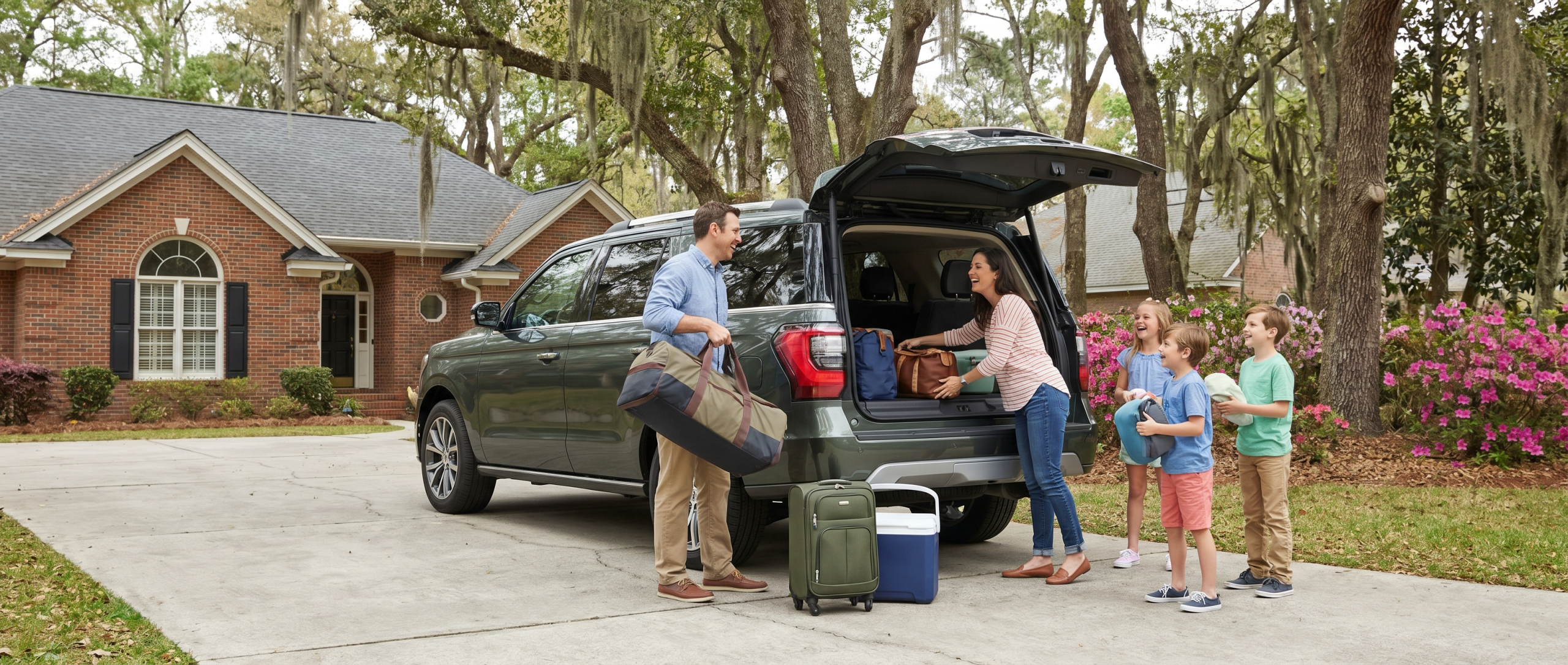
Planning a Disney World trip from Greer, SC means you already know what’s coming: seven-plus hours on I-85 and I-4, a minivan’s worth of luggage, overpacked snack bags, and kids who will ask “are we there yet?” somewhere around Gaffney. The question isn’t whether a Ford® SUV can handle the drive – it’s which one fits your family best. The Ford Expedition™ and Ford Explorer™ both make strong cases, and the right answer depends on how many people you’re hauling, how much gear you need, and what makes that drive feel manageable rather than miserable.
Why the Drive from Greer Changes the Equation
The trip from Greer to Walt Disney World is roughly 620 miles each way, and that matters when you’re choosing between these two SUVs.
Families heading south from the Upstate are used to stretches of highway driving – whether that’s the daily commute toward Greenville or weekend runs down to Spartanburg. But a Disney haul is a different animal. You’ll spend real time on I-85 through Atlanta traffic, cruise I-75 into Georgia, then merge onto I-4 through Central Florida. Hours in the vehicle means comfort, legroom, and cargo space become non-negotiable.
Here’s what that drive actually demands from your SUV:
- Enough seating so no one is folded into an uncomfortable middle row for six hours
- Cargo room for strollers, suitcases, park bags, and the inevitable impulse buys on the way home
- A smooth, quiet cabin so adults can actually talk and kids can watch something without the road noise drowning it out
- Fuel range that doesn’t require stopping every hour and a half through Georgia
Both the Expedition and Explorer deliver on these points – but in meaningfully different ways.
The Ford Explorer: Right-Sized for Most Greer Families
The Explorer is the more popular choice among families in the Greer area, and it’s not hard to see why once you look at the numbers.
Seating up to seven passengers across three rows, the Explorer handles the standard family configuration – two adults, two or three kids, and a reasonable amount of gear – without feeling oversized for everyday driving around Greer or Highway 29. It fits in a normal garage. It parks at Haywood Mall without drama. And it delivers solid EPA-estimated fuel economy for a three-row SUV, which matters when you’re logging over 1,200 miles round-trip.
Where the Explorer earns its place on a Disney trip:
- Third-row access is better than most competitors, which means less wrestling to get younger kids buckled in the back
- Cargo area behind the third row holds enough for a family of four to five traveling lean – think soft duffels rather than hard-shell luggage towers
- Tech features like Ford’s SYNC system, wireless Apple CarPlay and Android Auto, and available rear-seat entertainment help make seven hours feel shorter
- Ecoboost engine options keep the trip fuel-efficient without sacrificing the power you need to merge confidently onto I-4’s chaos
The honest consideration: if you’re traveling with five or more people and everyone needs full luggage, the Explorer’s cargo space behind the third row is tight. Families of five with a full set of suitcases will find themselves playing Tetris in a parking lot.
The Ford Expedition: Built for the Full Disney Haul
If the Explorer is right-sized, the Expedition is built for the family that doesn’t compromise.
With standard seating for eight and a cabin that genuinely fits adults in all three rows, the Expedition changes the calculus for larger families. Grandparents coming along? Extended family road trip with a cousin or two? The Expedition handles it without the awkward shuffle of asking someone to volunteer for the cramped third row.
The Expedition’s advantage for the Greer-to-Orlando run shows up in a few specific ways:
| Feature | Ford Explorer | Ford Expedition |
|---|---|---|
| Passenger Capacity | Up to 7 | Up to 8 |
| Max Cargo Space | ~87 cu. ft. | ~121+ cu. ft. |
| Third-Row Comfort | Suitable for children | Fits adults comfortably |
| Towing Capacity | Up to 5,600 lbs. | Up to 9,300 lbs. |
| Best Suited For | Families of 4-5 | Families of 6-8 |
Pulling a small trailer with bikes or sports gear? The Expedition handles it without breaking a sweat, which is something families near Lake Robinson or Tryon who already own recreational equipment appreciate.
The tradeoff is real, though. The Expedition is a large vehicle. Parking in Walt Disney World’s sprawling lots is manageable, but hotel parking garages can be tighter. And its fuel economy – while improved over previous generations – is lower than the Explorer’s, meaning more fuel stops on that I-75 stretch through Georgia.
What Greer Families Actually Prioritize
Spending time with families from the Greer area – and the broader Upstate region – reveals some consistent priorities that shape this decision.
Many households here are active families. Soccer tournaments at Carolina Alliance Park, weekend runs to Glassy Mountain, outdoor days at Lake Cunningham – these families already push their vehicles. A Disney trip is just the biggest expression of something they already do regularly. They’re not looking for a vehicle that only shines once a year. They want something that handles the trip but also earns its keep every other week of the year.
That’s where the Explorer tends to win for most households. It’s the vehicle that makes a Disney trip comfortable and handles the school pickup line and Saturday errands without feeling like you’re captaining a ship.
But for families who consistently travel with six or more people – or who already own an Expedition for hauling and work purposes – doubling that vehicle for a Disney run makes complete sense. You don’t need to rent something bigger. You don’t need to beg a relative for their van. You leave from Greer with everyone comfortable and arrive in Orlando the same way.
Browse our new inventory to see which Expedition and Explorer trims are currently available and how they’re configured for families.
Packing Strategy by Vehicle: Making the Most of Your SUV
Choosing the right SUV is only half the equation. How you pack it matters just as much, especially for a week-long Disney stay.
If you’re taking the Explorer:
- Pack soft-sided luggage – it compresses and fits into irregular spaces better than hard shells
- Use a rooftop cargo bag for lighter items like pool gear and extra jackets (bulkier park items you won’t need until mid-trip)
- Assign each passenger a personal item that stays at their feet rather than in the cargo area
- Load the cargo area with the biggest bag first, laid flat, then layer
If you’re taking the Expedition:
- You have room for full hard-shell luggage – don’t sacrifice it
- Keep the cargo area organized by day-of-use: gear you’ll need at check-in up front, rest of the week deeper in
- Use the third row’s underfloor storage area if your configuration includes it
- A stroller, pack-n-play, or bulky baby gear fits without the frantic rearranging
Common Questions About Ford Expedition vs Explorer for Disney Trips in Greer, SC
Which Ford SUV is better for a family of five traveling from Greer, SC to Disney World?
For a family of five traveling from Greer to Disney World, the Ford Explorer typically offers the right balance of space and practicality. Five passengers fit comfortably across three rows, and a family traveling with standard luggage can manage the cargo area effectively. The Explorer’s better fuel economy also helps on a 620-plus-mile drive each way. Families with a lot of gear or a baby with bulky equipment may want to consider the Expedition.
Does the Ford Expedition fit in Disney World parking garages?
The Ford Expedition fits in Disney World’s main surface parking areas without issue. Disney’s large surface lots at Magic Kingdom, EPCOT, Hollywood Studios, and Animal Kingdom were designed for full-size vehicles. If your hotel has a multi-level parking garage, check the clearance height before assuming the Expedition fits – some structures have lower clearance that may require adjustment.
How many miles is the drive from Greer, SC to Walt Disney World?
The drive from Greer, SC to Walt Disney World in Orlando is approximately 615 to 640 miles depending on your exact route and destination hotel. Most families take I-85 South through Atlanta, then I-75 South, and connect to I-4 East into the Orlando area. Expect 8 to 10 hours driving time depending on traffic through Atlanta and the I-4 corridor.
Is the Ford Explorer’s third row comfortable enough for adults on a long road trip?
The Ford Explorer’s third row is most comfortable for children and younger teens on extended trips. Adult passengers in the third row on a seven-plus-hour drive from Greer to Orlando will feel the tighter legroom. If your travel group includes adults who will need to sit in the third row, the Ford Expedition’s third row is a more comfortable option, with noticeably more headroom and legroom.
What Ford SUVs does D&D Ford Motors carry for families planning road trips?
D&D Ford Motors carries multiple Ford SUV models suited for family road trips, including various trims of the Explorer and Expedition. Availability changes frequently based on new arrivals and in-transit inventory. Visiting or contacting the dealership directly gives you the most accurate picture of what’s currently on the lot and which configurations match your family’s needs.
How does Greer, SC’s location affect the best SUV choice for Disney trips?
Greer’s location in the South Carolina Upstate puts it at the northern edge of a manageable one-day drive to Disney World. The 8-to-10-hour trip is long but very doable without an overnight stop, which most families in the area prefer. That distance makes interior comfort and cargo management particularly important – you’ll be in this vehicle all day. Both the Explorer and Expedition handle the I-85 and I-75 corridor well, but larger families will feel the Expedition’s advantage most on trips of this length.
Making the Right Call Before You Leave Greer
The right SUV for your Disney trip from Greer isn’t about which vehicle is objectively better – it’s about which one fits your specific crew and how you travel.
Four or five passengers with standard luggage? The Explorer handles that trip without excess. Six or more passengers, bulky baby gear, or family members who need real third-row space? The Expedition earns every inch. Think about this honestly: a comfortable family arriving in Orlando is going to have a better first day in the parks than a cramped one that spent the last hour rearranging luggage at the hotel. The D&D Ford Motors team in Greer can walk you through both options, let you sit in both cabins, and help you make the call that’s right before you ever turn south on I-85.


