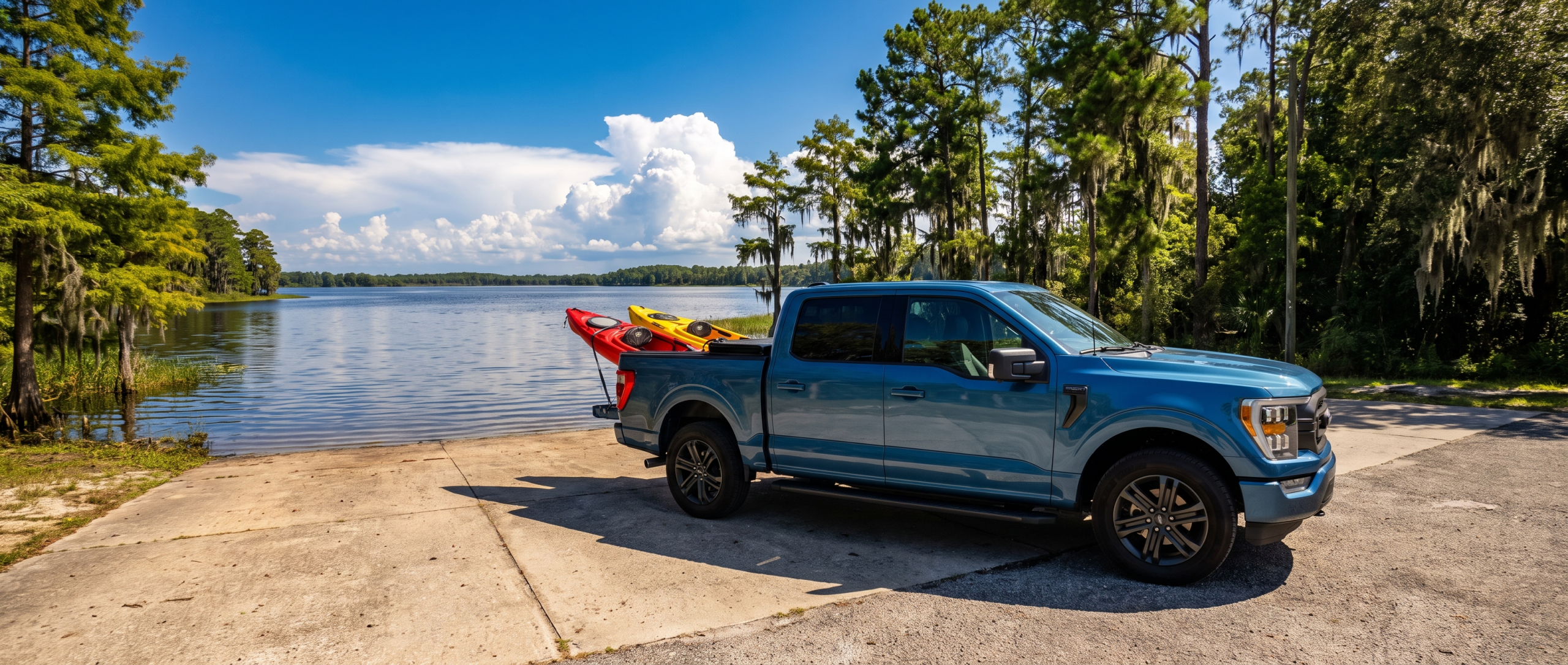
The 2026 Ford F-150 already comes ready for Upstate SC. The accessories you bolt on, though, decide whether the truck works for you in July or against you. So you’re protecting the bed from cargo damage and afternoon downpours, keeping gear from baking in 95-degree heat, and, if you’re headed to Lake Hartwell for the weekend, actually powering the cooler, fan, or camp lights without dragging a separate generator along.
The Upstate doesn’t play nice in summer. The National Weather Service has recorded heat indices up to 105 degrees Fahrenheit at Greenville-Spartanburg International Airport in July. Those conditions steer more of the choice than you’d think. They affect which tonneau cover material holds up, whether a drop-in bed liner creates a moisture trap against your aluminum bed, and whether your trim level’s Pro Power Onboard output covers what you’re planning.
Let’s walk through each call.
- Tonneau cover first: it handles both the UV damage to your cargo and Upstate SC’s near-daily afternoon thunderstorms; soft roll-up is the flexible pick, hard tri-fold is the security pick
- Bed liner second: spray-in bonds permanently and won’t trap moisture against your aluminum bed; drop-in is fine for occasional use but must match your exact bed length (5.5′, 6.5′, or 8′)
- Pro Power Onboard: available on most non-XL trims; the PowerBoost hybrid unlocks 7.2 kW (enough to run a portable fridge, box fan, and job-site tools simultaneously)
- Bed extender: makes Lake Hartwell kayak runs doable without a trailer; pairs best with a soft roll-up cover you can retract
- Running boards: concrete on longer days when you’re loading and unloading gear repeatedly in summer heat
What actually matters when choosing F-150 summer accessories?
Three things drive every accessory decision for an Upstate SC summer, and they’re weather protection, fitment precision, and power availability, so nail all three and the truck earns its keep, but miss even one and you’ve bought the wrong gear for the season. We’ll walk each one below and where it earns its place in the Upstate.
| Accessory | Best For | Key Spec / Detail | Tradeoff |
|---|---|---|---|
| Soft roll-up tonneau | Lake runs, mixed cargo, frequent access | Heat-resistant reinforced vinyl; rolls fully toward cab for full bed access | Lighter security than hard cover; not completely waterproof in driving rain |
| Hard tri-fold tonneau | Security, daily work use, cleaner look | Sits under half an inch above bed rails (weatherproof channel seals) | Limits bed height for taller cargo; higher cost |
| Spray-in bed liner | Work hauling, permanent protection | Bonds to aluminum bed; no gap for moisture or grit to collect | Permanent (you can’t remove it); requires professional installation |
| Drop-in HDPE bed liner | Light hauling, lease trucks, flexibility | Lifts out without tools; must match 5.5′, 6.5′, or 8′ bed exactly | Can trap moisture underneath if not routinely removed and dried |
| Pro Power Onboard (2.0 kW) | Charging tools, phones, small fan | Standard on most non-XL gas trims; outlets in cab and bed | Not enough for a full-size compressor fridge and tools simultaneously |
| Pro Power Onboard (7.2 kW) | Camp power, job site, fridge + fan + lights | Available on PowerBoost Full Hybrid trims | Requires PowerBoost powertrain; not available on XL |
| Bed extender | Kayaks, lumber, bikes without a trailer | Folds flat when not in use | Reduces usable bed depth for boxed cargo |
| Step bars / running boards | Frequent loading in summer heat | Reduces step-in height; keeps foot placement stable when wet | Adds width; not ideal if tight parking is a daily concern |
Tonneau Covers: the one accessory the Upstate makes mandatory
An afternoon thunderstorm in Greer can drop over two inches of rain in a single event, so a tonneau cover ranks first for summer here, and the piece that decides whether your cargo stays dry is a cover you can close before the sky opens. The SC State Climatology Office has documented that pattern in July, and the rain tends to arrive with about 20 minutes’ notice. A cover that’s a pain to close in a hurry won’t get closed.
Soft roll-up covers stay popular here for a practical reason. Browse the F-150s we have in stock if you’re working from a new truck baseline. For an existing truck, it comes down to how often you need the full bed open.
If the answer is weekly, go soft roll-up. The reinforced vinyl on a quality cover stays flexible in extreme temperatures (no warping in July heat), and it rolls all the way toward the cab, so you get full bed access for oversized loads like kayaks, coolers, and lumber when you need it. A hard tri-fold sits less than half an inch above the bed rails and gives you a tighter weather seal, but it caps what you can haul tall and adds noticeable weight to the fold sections.
There’s a tradeoff worth naming out loud. A soft cover isn’t a security solution. If you regularly leave tools or valuables in the bed overnight, the hard tri-fold or a retractable aluminum cover wins on that count, no question.
Bed Liners: the fitment trap nobody talks about
Bare aluminum beds scratch fast, so a liner isn’t optional on a working F-150, and the choice comes down to spray-in versus drop-in rather than whether to run one at all, since either one beats a bare bed. Our service team sees it up close. Ford builds the F-150’s bed from high-strength military-grade aluminum alloy, so it doesn’t rust the way a steel bed does, though it still shows surface damage quickly when you’re sliding kayak paddle shafts, lumber, or concrete blocks across it.
Spray-in bed liners bond directly to the aluminum surface. They cover every contour, close off any gap where moisture or grit can collect underneath, and they don’t shift under load. The tradeoff is permanence. Once it’s on, it’s on.
Drop-in HDPE liners cost less and lift out without tools, which is genuinely useful when you want to hose down the bed after a weekend at Lake Hartwell. The fitment catch is real, though. A drop-in liner that doesn’t match your exact bed length leaves exposed gaps at the edges that collect standing water (a particular problem in summer, when afternoon rain gets followed by 95-degree heat and humidity, cooking anything trapped beneath the liner).
Pros / Cons: Spray-In vs Drop-In Bed Liner
| Pros | Cons |
|---|---|
| Spray-in: No moisture gap; conforms to all contours | Spray-in: Permanent; requires professional install |
| Spray-in: Doesn’t shift under load | Spray-in: Higher upfront investment |
| Drop-in: Removable; easy to clean | Drop-in: Must match exact bed length or leaves gaps |
| Drop-in: Lighter installation burden | Drop-in: Can trap moisture under liner in humid SC summers |
| Drop-in: Lower initial outlay | Drop-in: Can shift on hard stops |
Match the gear to how you actually drive
The simplest way through this is to match the gear to your summer routine, so picture the three or four ways you’ll use the truck between now and September and let that shape the short list. Overthinking is the usual trap, and we’d rather keep it plain.
If you’re mostly hauling to a job site off I-85 and back, start with a spray-in liner and a hard tonneau cover. Everything else can wait.
Running Lake Hartwell most weekends, or looking at an F-150 that’s already set up for outdoors use? Then the priority is bed access (soft roll-up) plus real power (Pro Power Onboard). Ford lists the 2026 F-150’s PowerBoost Full Hybrid V6 as available across all trim levels. The 7.2-kilowatt output means you can run a compressor fridge and a box fan and still keep overhead for lights or a phone charger, all without a separate generator sitting in the bed taking up room. For a two-night camp at the lake, that’s a meaningful capability a non-hybrid F-150’s 2.0 kW output can’t match.
Step bars are worth adding if you’re getting in and out of the truck repeatedly through the day. Loading a kayak onto a bed extender when the asphalt is 120 degrees and you’ve already made three trips to the water is when a solid step earns its keep. None of it’s glamorous, but it works.
We’d skip a few things for now. Roof racks, elaborate lighting kits, and auxiliary fuel tanks are all real accessories with real applications, but they’re overkill for a South Carolina summer unless your use case specifically calls for them. Start with the layer that protects the bed and the layer that powers your weekend. Add from there.
Frequently Asked Questions
Will a soft tonneau cover warp or crack in Upstate SC summer heat?
A quality soft tonneau cover built from double-coated reinforced vinyl won’t warp in South Carolina heat. The vinyl formulation used in commercial-grade covers is designed to stay flexible in extreme temperatures. The larger concern in the Upstate isn’t heat damage to the cover itself (it’s making sure the cover creates a real seal against the tailgate and side rails so afternoon thunderstorms don’t push water into the bed at the seams).
Does Pro Power Onboard work with a tonneau cover installed?
Yes. Ford places Pro Power Onboard outlets in the bed at a position accessible even with most tonneau covers in place, and the cab-side outlets work completely independently of any bed accessory. For high-demand use at a campsite (running a compressor fridge or power tools), the bed outlets on the PowerBoost 7.2-kilowatt configuration are the ones to use. If you’re pairing Pro Power with a hard tri-fold cover, just confirm with our team that your specific cover’s panel geometry clears the outlet position on your bed configuration.
4 Best Ford Work Trucks for Contractors Near I-85
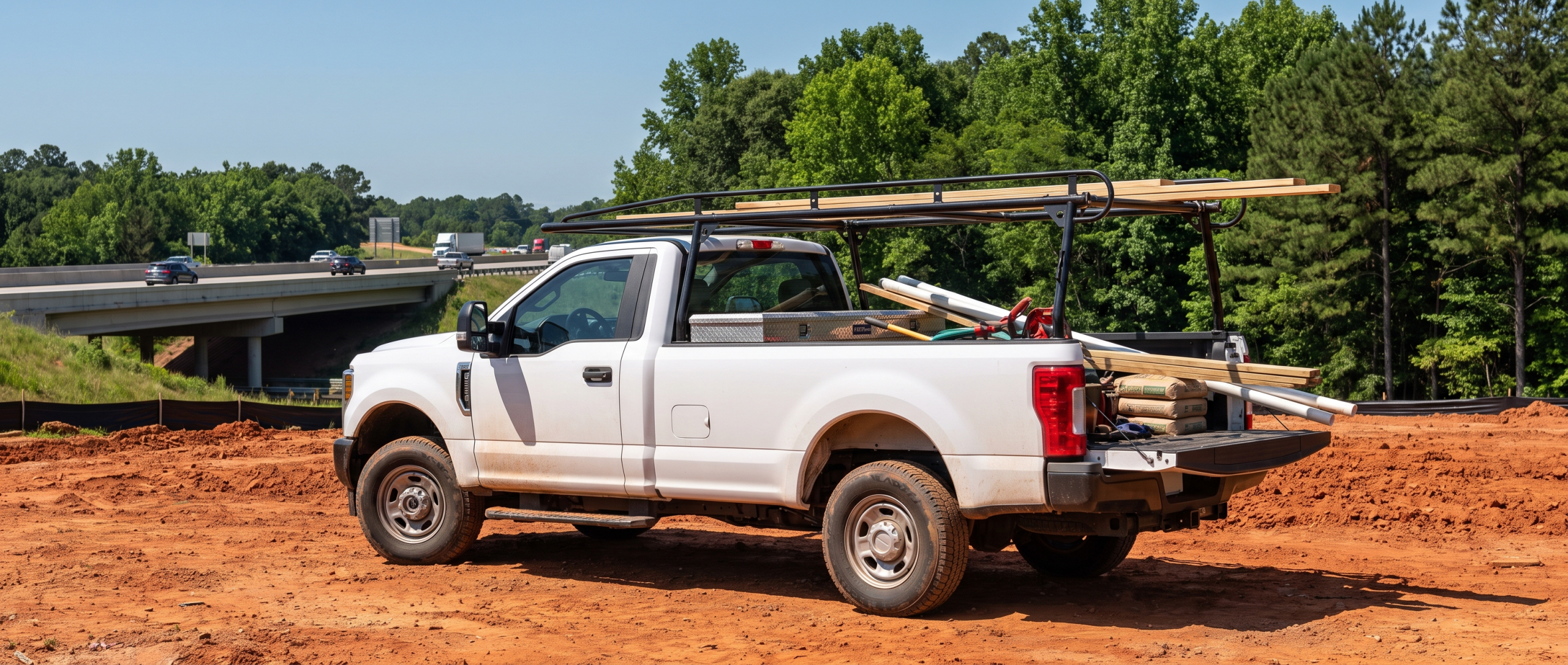
If you run a trade crew anywhere along the I-85 corridor through Upstate South Carolina, the truck you drive isn’t a lifestyle choice. It’s a tool with a payload sticker and a job to do. Our starting recommendation is the 2026 Ford F-150 with the PowerBoost Full Hybrid and the 7.2 kW Pro Power Onboard option, for most general contractors who want one truck that hauls a crew, tows a loaded trailer, and drops the generator. We’ll walk through all four picks below, including where the F-150 stops being enough and you need to move up.
The Ranking at a Glance
| Rank | Pick | Best For | Standout Spec |
|---|---|---|---|
| 1 | Ford F-150 PowerBoost | Mid-size contractor crew, on-site power | Up to 7.2 kW Pro Power Onboard, 11,600 lb tow (Ford-verified) |
| 2 | Ford F-250 Super Duty | Heavy equipment, gooseneck trailers | Up to 23,000 lb tow, 4,246 lb payload (Ford-verified) |
| 3 | Ford F-350 Super Duty | Major haul, fifth-wheel, fleet use | Up to 38,000 lb gooseneck tow, up to 8,000 lb payload (Ford-verified) |
| 4 | Ford Ranger | Solo sub, light tools, daily driver | 7,500 lb tow, up to 1,767 lb payload (Ford-verified) |
The Ford F-150 PowerBoost Is the Contractor’s Swiss Army Knife
Most contractors in the Upstate don’t need a Super Duty every day, and the 2026 F-150 with the 3.5L PowerBoost Full Hybrid V6 handles the bulk of trade work with 11,600 lbs of towing and up to 2,440 lbs of payload, per Ford’s towing guide. That covers most enclosed utility trailers, single-axle equipment trailers, and skid steers in the lighter class. What makes it different for job-site work is the available 7.2 kW Pro Power Onboard system (available on select trims with the PowerBoost engine), which Ford lists as delivering 120V and 240V outlets directly in the cab and bed. No separate generator eating bed space. No gas to haul for a second engine.
The tradeoff is real, though. Once you’re regularly pulling something past 12,000 lbs, or you need the payload headroom a framing crew with materials demands, the F-150’s frame is a light-duty platform and it’ll feel it. For contractors running BMW plant supply-chain jobs or bigger commercial builds along the I-85 growth corridor, that ceiling matters. But for HVAC, electrical, plumbing, and landscaping crews doing multiple daily stops, this is the one we’d tell you to drive first.
See our Super Duty inventory if your trailer pushes past that range.
View Current Work Truck Specials
The Ford F-250 Super Duty Handles the Heavy Work
When your job requires pulling excavators, loaded flatbeds, or tandem-axle equipment trailers, the F-250 is where the conversation has to start, and Ford rates the 2026 F-250 Super Duty at up to 23,000 lbs of conventional towing and up to 4,246 lbs of payload when properly configured. The available 6.7L Power Stroke turbo-diesel V8 is the engine most serious contractors spec here. It puts out 500 horsepower and 1,200 lb-ft of torque in high-output form, according to Ford’s Super Duty specifications.
The F-250 is also the practical daily-driver boundary. It’s a heavy-duty truck, but a single-rear-wheel F-250 still fits a normal parking space and doesn’t feel like piloting a commercial vehicle around town. Subcontractors who need serious numbers on the weekend but are also doing supply runs through downtown Greer appreciate that. The F-250 is where we see contractors land when they outgrow the F-150 and aren’t quite ready to commit to a dually.
There’s a real tradeoff on the diesel. It costs more to maintain than a gas-powered truck, so if you’re not logging serious towing miles, the 7.3L gas V8 (405 horsepower, 445 lb-ft torque, up to 17,300 lb tow, in Ford’s published specs) is a capable, lower-maintenance option that a lot of buyers overlook.
The Ford F-350 Super Duty Is Built for Fleet and Fifth-Wheel Work
The 2026 Ford F-350 Super Duty earns its place the moment your trailer has a fifth-wheel or gooseneck connection, and in dual-rear-wheel form Ford rates it at up to 38,000 lbs gooseneck towing and up to 8,000 lbs of payload. That’s a number most single-truck contractors will never push, but it matters because it builds in a genuine safety margin. Running a loaded 24-foot gooseneck flatbed at 22,000 lbs in a properly spec’d F-350 DRW is a different experience than running that same load at the edge of an F-250’s rating.
The dually configuration is the real differentiator here, and it comes with a downside you should know going in. A dually F-350 is noticeably wider than a standard truck, which creates real friction in tight job sites, parking structures around the GSP corridor, and narrow commercial districts. For contractors who live in the truck and work predominantly on open commercial sites, it’s not an issue. For someone making daily material runs through tight neighborhoods, it adds friction every single day.
The Ford Ranger Is the Right Call for Solo Subs
The 2026 Ford Ranger doesn’t belong at the top of a contractor list, but it belongs on it, and a solo electrician, trim carpenter, or specialty subcontractor who drives a lot of highway miles between sites, runs mostly hand tools, and doesn’t tow anything heavier than a single-axle utility trailer gets real utility from one. Ford rates it at up to 7,500 lbs of towing and up to 1,767 lbs of payload with the Trailer Tow Package, per Ford’s Ranger specifications. That covers a lot of working scenarios.
The honest case against it for contractor work is straightforward. A crew of two or three with full gear bags, material runs, and a loaded trailer will hit the Ranger’s payload ceiling faster than the spec sheet makes it look. It’s conventional-hitch only (no fifth-wheel or gooseneck rating), and the bed’s genuinely shorter than a full-size. For a solo operator or a small electrical sub running mostly service calls, it’s practical. For anyone who regularly has two people and a bed full of materials, step up to the F-150.
Ford Commercial Truck Maintenance for Greer Businesses: What Your Schedule Actually Should Look Like
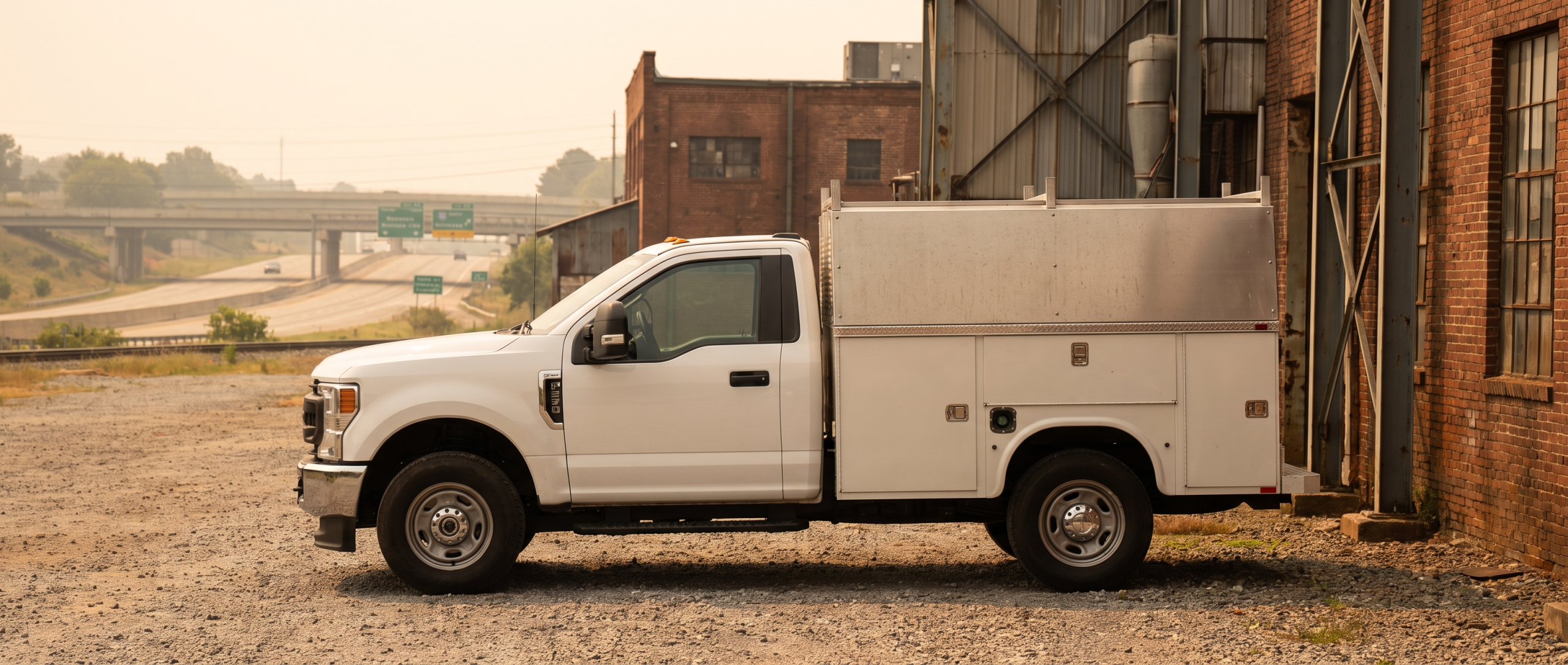
A lot of Ford commercial trucks running the I-85 corridor out of Greer are on the wrong maintenance schedule. The cause isn’t neglect. Ford publishes two distinct service schedules, and the trucks working out of Greer overwhelmingly qualify for the stricter one.
So here’s the straight version. If your Ford F-150 hauls materials to job sites, sits in morning I-85 traffic with a loaded bed, or pulls a trailer to a supplier off Highway 101, Ford classifies that as severe-duty use. The intervals run shorter, the fluid specs differ, and skipping that distinction is what turns a preventable repair into a multi-week downtime bill. We’ve been working on trucks for Upstate SC businesses since 1937, and the gap between what the dashboard says and what this truck actually needs is the conversation that matters most.
How Often Does a Commercial Ford Truck Actually Need Service?
How often a commercial Ford truck needs service depends on which truck you’re running and how hard you run it, and for most Greer operators the honest answer lands more often than the oil life monitor alone suggests, since a loaded bed and highway heat push these trucks toward Ford’s stricter classification.
So is the oil life monitor enough on its own? Not for this kind of work. Ford’s Intelligent Oil Life Monitor calculates oil change intervals on the fly, and it’s genuinely useful. But Ford’s own published severe-duty guidelines recommend oil changes around every 5,000 miles for trucks that routinely tow, haul near max payload, or idle extensively at job sites. That runs meaningfully shorter than the 7,500-mile normal-condition baseline. For 2026 Super Duty 6.7L Power Stroke diesels under severe-duty classification, Ford specifies 5W-40 full synthetic, and the engine holds 15.0 quarts per full change. The spec matters. The wrong oil is no small thing.
The table below maps the trucks we service most for Greer operators against realistic intervals.
| Vehicle | Normal Oil Interval | Severe-Duty Oil Interval | Diesel Fuel Filter | Transmission Fluid (Heavy Tow Use) |
|---|---|---|---|---|
| 2026 Ford F-150 (EcoBoost gas) | 7,500 mi | 5,000 mi | N/A | 60,000 mi |
| 2026 Ford F-150 PowerBoost Hybrid | 7,500 mi | 5,000 mi | N/A | 60,000 mi |
| 2026 Ford Super Duty (gas V8) | 7,500 mi | 5,000 mi | N/A | 60,000 mi |
| 2026 Ford Super Duty (6.7L Power Stroke diesel) | 7,500 mi / 6 mo | 5,000 mi | 15,000-20,000 mi | 60,000 mi |
| 2026 Ford Transit (gas EcoBoost, normal use) | 7,500-10,000 mi | 5,000 mi | N/A | Inspect at 60,000 mi |
Ford’s published severe-duty triggers cover frequent towing, hauling near max payload, sustained idling at work sites, many short trips, and operation in extreme temperatures. A July workday in Upstate SC (sustained heat, loaded bed, stop-and-go on I-85 during BMW Manufacturing Plant shift changes) checks multiple boxes at once.
Where Does Your Greer Fleet Actually Spend Its Miles?
The Ford Super Duty lineup is the backbone of commercial work in this market, and where those trucks spend their miles is exactly what pushes them into severe-duty territory. Think supply routes along I-85, deliveries between the supplier network that clusters around the BMW plant campus, construction hauls across Spartanburg County, loaded and idling and then back on the highway. That pattern is textbook severe-duty operation. Engines see more heat cycles per mile. Transmission fluid degrades faster. Diesel fuel filters on Power Stroke trucks need attention at the closer end of the 15,000-20,000 mile window.
Ford Transit-250 and Transit-350 vans running delivery routes with frequent stops and full cargo floors sit in the same severe-duty category, and Ford’s published guidance for Transit explicitly names frequent stops, heavy payloads, and extended idling as triggers for the tighter schedule. In a dense logistics corridor like ours, a commercial Transit rarely earns the relaxed interval.
- Tire rotations every 7,500 miles reduce uneven wear on load-bearing rear axles
- Brake inspections belong at every oil change interval for trucks hauling near payload limits
- Engine air filters need a check at 30,000 miles, sooner on dusty work sites or gravel access roads
- Battery terminal cleaning at 15,000-20,000 miles prevents hard-start failures on hot Upstate SC mornings
- Diesel Exhaust Fluid levels on Power Stroke trucks should be verified monthly
Schedule Your Commercial Service Appointment
Planning Service Around Your Crew’s Schedule, Not Against It
Planning service around your crew works best when you treat scheduled downtime as cheaper than the breakdown it prevents, because a three-truck operation loses real money the moment one vehicle sits waiting, and a little rhythm keeps all three earning. Here’s how Greer businesses tend to build that rhythm with us.
Use the IOLM as a prompt, not the whole answer. The oil life monitor is useful but doesn’t see the full severe-duty picture. Set your own mileage reminder at 5,000 miles if your F-250SD or F-350SD regularly tows or hauls. Don’t wait for “Oil Change Required” if you know the truck has been running hard all week.
Batch diesel fuel filter service. The Power Stroke fuel filter window runs 15,000-20,000 miles, roughly every second oil change at a severe-duty interval. Scheduling filter service alongside the second oil change cuts the number of separate trips per year.
Document every service visit. A clean, timestamped service history adds real value when you trade up or sell. We log it properly with Motorcraft-spec parts every time.
The downtime you prevent now costs far less than the repair you’re putting off. We’ve held that line since 1937, and it hasn’t changed.
Frequently Asked Questions
Does the oil life monitor tell me when to change oil on a commercial Ford truck?
Ford’s Intelligent Oil Life Monitor tracks engine revolutions and temperature cycles to estimate remaining oil life. It’s a useful tool. For most commercial use in Greer, though, Ford’s published severe-duty guidelines recommend not exceeding 5,000-mile intervals regardless of what the monitor shows.
What exactly qualifies as severe-duty use for a Ford Super Duty or Transit?
Ford’s published definitions include: regular towing, hauling near maximum payload, extended idling at work sites, frequent short trips, and operation in extreme temperatures. A loaded truck running I-85 in July heat qualifies. If your truck does any of these things on a typical workweek, Ford’s recommendation is the shorter severe-duty service intervals across oil, filters, brakes, and drivetrain fluids.
Is transmission fluid on the 2026 Super Duty truly lifetime, or does it need to be changed?
Ford markets the 10-speed TorqShift’s fluid as lifetime under normal commuter-type use. For a Super Duty regularly pulling near its Gross Combined Weight Rating, the heat cycles from that work degrade the fluid considerably faster. Ford dealerships recommend replacing transmission fluid at 60,000 miles for trucks in heavy towing service.
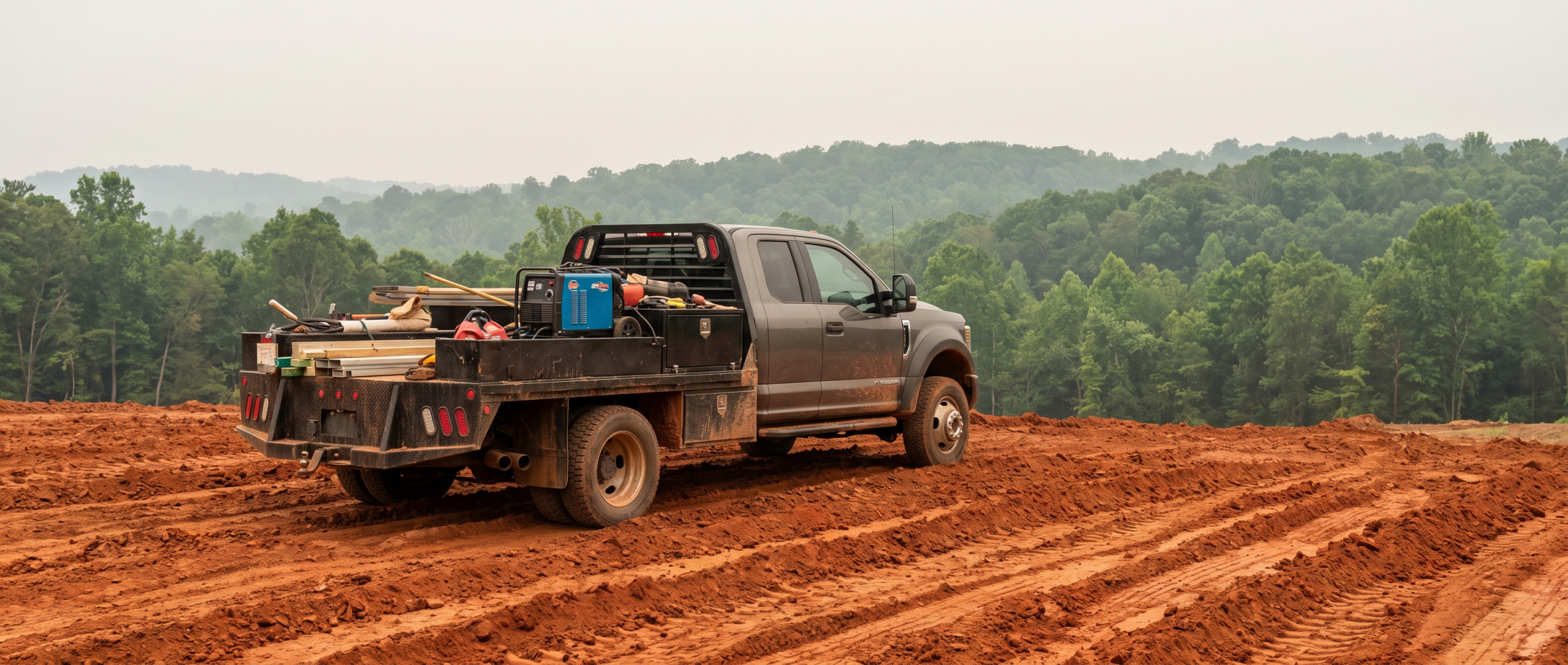
You cleared the I-85 pull hauling your excavator just fine, so you figured the truck was specced right. Then you started loading clay spoil off a Greer subdivision cut and the rear end squatted before the bed was even half full. The engine isn’t the problem. Neither is a bad tire. Grading and excavation work in Piedmont South Carolina runs into a specific mismatch, where crews size their Super Duty for towing the machine, then find that hauling Upstate’s dense red clay is a payload problem more than a towing one. We’ll walk through what’s going on and how to spec the right truck for the work you’re doing.
Browse our 2026 Ford Super Duty lineup at D&D Ford Motors
What’s Actually Going Wrong With Your Work Truck?
The truck feels underpowered, but that’s rarely the diagnosis for a grading or excavation crew in Upstate SC, where a Super Duty that squats hard under load, brakes poorly with a full dump insert, or struggles to cycle a hydraulic body is almost always hitting its payload ceiling, not its towing limit. Ford rates the 2026 F-350 Super Duty DRW at up to 8,000 pounds of payload in the right configuration. Piedmont red clay runs roughly 2,600 to 2,800 pounds per compacted cubic yard. A three-yard haul hits 8,000 pounds before you’ve counted the dump insert sitting on top of the bed. That math changes which model you need.
| Symptom on the Job Site | Likely Cause | What to Address |
|---|---|---|
| Rear end squats before the bed is full | Payload ceiling reached, or SRW under a DRW-class load | Step to DRW; check your door-jamb payload sticker first |
| Sluggish pull leaving a loaded site | Engine not delivering low-RPM torque for the load | Consider the 6.7L Power Stroke diesel; torque peaks at 1,600 RPM |
| Dump body won’t cycle or cycles slowly | No PTO provisions ordered, or undersized PTO | Spec diesel with PTO; Ford lists up to 300 lb-ft of diesel PTO torque |
| Trailer sway with the excavator in tow | GVWR/GCWR not verified, only tow rating checked | Add Onboard Scales with Smart Hitch to monitor pin weight in real time |
| Fine empty, sketchy when loaded | Payload exceeded before tow rating is touched | Pull the door-jamb sticker; actual payload may be well below the model max |
The Real Culprit: You Specced the Tow Rating and Ignored Payload
The culprit here is a spec you probably didn’t scrutinize, since towing numbers close the deal while payload numbers sit quietly in the fine print, and a crew that checks only the tow rating gets caught out the first time the bed does the work instead of the hitch. The 2026 Ford F-250 Super Duty with the High-Output 6.7L Power Stroke diesel can tow up to 23,000 pounds. That covers every mini-excavator or skid-steer a grading crew is going to put on a gooseneck, so the F-250 looks right on paper.
The problem surfaces the moment you switch from towing mode to hauling mode. Ford lists the 2026 F-250 at a maximum payload of 4,246 pounds, a figure that holds for one specifically configured truck (and dense red clay from a Greer subdivision cut chews through it fast). Add the weight of a two-and-a-half-ton dump insert sitting in the bed and there’s almost nothing left.
Greer sits in the Piedmont region of Upstate South Carolina. The clay there doesn’t haul like topsoil.
The 2026 Ford F-350 Super Duty changes the math. In DRW trim with the Heavy-Duty Payload Package, Ford rates it at up to 8,000 pounds of payload capacity. It reads plainly on a brochure, yet it’s the highest payload rating in the non-commercial Super Duty pickup lineup, and it’s what grading crews need when the job goes from pulling to hauling. The DRW rear also steadies the truck under a loaded dump insert in a way a single-rear-wheel setup can’t come close to matching.
The tradeoff is honest. A dually adds width, and that’ll matter on narrow residential lot access roads. If your crew spends most of the day towing the machine and only occasionally hauls material in the bed, a well-configured F-250 may be the right call. Run dump bodies on the majority of your jobs and the F-350 DRW is the truck. The F-250 is undersized for that work pattern.
Print-and-Go Checklist: Speccing a Super Duty for Grading and Excavation Work
- [ ] Decide payload-first or tow-first (most grading and excavation crews need payload-first)
- [ ] SRW vs. DRW: DRW for dump bodies and heavy material hauling; SRW for primarily gooseneck towing
- [ ] Engine: 6.7L Power Stroke diesel for PTO hydraulics or daily high-mileage hauls; 7.3L gas for lower upfront cost and simpler DEF-free maintenance
- [ ] Order PTO provisions on diesel models if you’re running a PTO-driven hydraulic dump pump
- [ ] Request Pickup Box Delete (option code 66D) if mounting a dedicated dump body instead of the stock bed
- [ ] Confirm upfitter switches are included (factory-rated wiring for body lighting, air compressor, and hydraulic controls)
- [ ] Verify Onboard Scales with Smart Hitch is configured (real-time payload and pin weight, visible in-cab)
- [ ] Pull the door-jamb sticker on the specific unit before you order the upfit body
Gas, Diesel, and When to Bring In Our Service Team
The engine choice comes down to how you actually run the truck, so the split is clean once you know your pattern, with the diesel earning its keep on PTO hydraulics and loaded daily miles while the gas V8 fits crews that mostly tow and rarely haul material in the bed. A lot of grading crews try to sort this out alone and end up with the wrong order.
If you’re running a PTO-driven hydraulic dump pump, the diesel is not optional. Ford offers PTO provisions on diesel-equipped 2026 Super Duty models only. Diesel PTO delivers up to 300 lb-ft of torque through a 10-bolt mounting pattern built for larger PTO devices. The standard 6.7L Power Stroke produces 475 horsepower and 1,050 lb-ft of torque, with peak torque arriving at 1,600 RPM. That engine pulls clean on a loaded red-clay haul instead of lugging through gear changes on a subdivision grade.
If you’re mostly towing and rarely hauling material directly in the bed, the 7.3L “Godzilla” gas V8 is a legitimate option. Ford lists it at 430 horsepower and 485 lb-ft of torque. It carries a lower upfront cost, skips DEF fluid management entirely, and is easier to service for crews that aren’t running to high mileage. Diesel earns back its cost fastest on daily high-mileage, heavy-load patterns.
What you shouldn’t sort out alone is the full upfit order sheet. Picking the Pickup Box Delete option, pairing it with the right upfitter switches, PTO provisions, and alternator spec is exactly the kind of pre-delivery conversation our service team works through with commercial customers. An incorrect upfit order can mean months of back-and-forth with the body installer. We’d rather catch it before the order ships.
One more spec is worth noting. The 2026 Super Duty also includes Pro Power Onboard, which delivers up to 2 kW of generator power for jobsite tools directly from the truck. It won’t replace a trailer-mounted generator on a big cut, but it’s genuinely useful for a compactor, power tool, or jobsite light when you don’t want to unload the trailer to plug something in.
Talk to Our Service Team About Your Work Truck Build
Frequently Asked Questions
Do I need the diesel for excavation and grading work in Upstate SC?
Not in every configuration, but for most grading and excavation builds, yes. If you’re running a PTO-driven hydraulic dump body, the diesel is required (Ford only offers PTO provisions on diesel-equipped 2026 Super Duty models). If you’re towing an excavator or skid-steer on a gooseneck and hauling spoil occasionally, the 7.3L gas V8 at 430 horsepower and 485 lb-ft of torque is capable and easier to service. The diesel justifies its cost on high-mileage, heavy-load daily patterns where its 1,050 lb-ft of torque and diesel exhaust braking deliver real operational value across a full work week.
F-250 or F-350 for a grading crew running a dump body?
The F-350 DRW. Ford rates the 2026 F-350 Super Duty DRW with the Heavy-Duty Payload Package at up to 8,000 pounds of payload, which covers most dump-body material hauls on residential and light commercial grading jobs. The 2026 F-250 tops out at 4,246 pounds of payload (enough for trailer towing work, but clearly undersized when you’re loading Piedmont clay directly into a dump insert multiple times a day). If your jobs scale up to industrial sitework with a full commercial dump body, that’s when the F-450 or F-550 chassis cab becomes the right conversation to have with us.
By the D&D Ford Motors Team | July 2026

If you’re heading up US-276 from Greer toward Caesars Head State Park and Raven Cliff Falls, the 2026 Ford Bronco Sport is the stronger vehicle for the roads you’ll face on the way up, the tight first-come lot you’ll be maneuvering into, and the gear you need hauled out of the back. The Forester gets close, genuinely close, only when you step up to its Wilderness trim, which is its own separate price tier and its own separate conversation.
That’s our call. We’ll walk you through the reasoning below, spec by spec.
What’s the Plan at a Glance?
The trip from Greer runs roughly 30 miles on US-276, climbing the Blue Ridge Escarpment through sustained grades and tight switchbacks before you reach Caesars Head, so give yourself a real head start because the timing rules up here are strict. Trails close one hour before dark, day-use parking is first-come-first-served with zero roadside overflow allowed, and every trail on the park is rated advanced wilderness. The Raven Cliff Falls trail is 3.9 miles round trip with 754 feet of elevation gain. Plan your start time accordingly.
| Stop | What to Do | Best Time to Arrive | Parking Notes |
|---|---|---|---|
| US-276 from Greer | Sustained mountain grade, wet curves common after summer storms | Morning departure | Road-only, no stops needed |
| Caesars Head State Park Overlook | Blue Ridge Escarpment views, fall hawk-watching season | Before 10 AM on weekends | First-come lot only; no roadside parking |
| Raven Cliff Falls Trailhead | 3.9-mile round trip, 754 ft elevation gain, advanced terrain | Early morning start | Same lot as overlook; fills fast on summer weekends |
| Mountain Bridge Wilderness (Jones Gap link) | Longer loop trails, primitive backcountry camping by reservation | Full-day commitment | Separate Jones Gap access point |
The Capability Numbers That Actually Matter Here
Neither of these vehicles will struggle with a paved state highway, but US-276 gives both AWD systems a real workout on wet grades and tight curves, and that’s where the trim-level differences start to bite if you’re not paying attention. The 2026 Ford Bronco Sport carries 8.8 inches of ground clearance standard across the entire lineup. Every trim. Ford also rates it for up to 24 inches of water fording and builds seven GOAT terrain modes (Goes Over Any Type of Terrain) into every configuration without requiring a package upgrade. The 2026 Subaru Forester runs 8.7 inches of clearance on its standard trims, and X-MODE traction control is available only on higher-grade configurations. At equivalent tier pricing, the Bronco Sport clears slightly more ground and delivers a more complete terrain-management system standard. Browse Bronco Sport trims at D&D Ford to see what’s on the lot right now.
The Forester Wilderness Changes the Equation (for the Right Buyer)
The 2026 Subaru Forester Wilderness genuinely changes this comparison for the right buyer, though it doesn’t move the needle for everyone, so we’ll give you a straight answer on where it wins and where the standard Forester quietly gives that capability back. Subaru increased ground clearance to 9.3 inches for 2026, fitted Yokohama Geolandar all-terrain tires, added Dual-Function X-MODE (Snow/Dirt plus Deep Snow/Mud settings), and rated the Wilderness for 3,500 pounds of towing capacity. The EPA rates standard 2026 Forester models at 26 city and 33 highway miles per gallon with the 2.5-liter flat-four. For longer mountain legs, that’s a genuine efficiency advantage.
The tradeoff is real. You only get those numbers at the Wilderness trim level. Step back to the standard Forester, and clearance drops to 8.7 inches, X-MODE moves behind higher configurations, and the tow rating falls to 1,500 pounds. If your mountain trips involve a loaded cargo trailer or a dedicated overlanding kit, the Wilderness earns its place. If you’re doing day hikes at Caesars Head with gear in the back, the case is weaker. See what’s currently in our Ford inventory to compare configurations side by side.
Why the Bronco Sport Fits This Drive
Cargo capacity is where the Bronco Sport earns the mountain run from Greer, and it does it without asking you to buy up a trim tier, though the Badlands stays the pick if you want the most aggressive off-road hardware. Ford lists 32.5 cubic feet behind the rear seats, and the optional slide-out cargo table turns the tailgate area into a genuine gear-staging platform when you’re swapping trail shoes at the trailhead. The 1.5-liter EcoBoost three-cylinder (180 horsepower, 200 lb-ft of torque) runs in every trim except the Badlands and returns EPA-rated 25 city / 30 highway miles per gallon. A 60-mile round trip to Caesars Head and back, with a decent climb woven into it, is exactly the kind of mixed driving where that efficiency shows up. The Badlands’ 2.0-liter EcoBoost (250 horsepower, 280 lb-ft of torque) is the right call if you want the full Advanced 4×4 system with twin-clutch rear drive and the more aggressive off-road tune. For pavement-plus-parking-lot duty, the 1.5-liter is the honest pick and costs you nothing in capability on this route.
We’ve been serving the Carolinas since 1937, and the Blue Ridge has always been part of what Upstate SC buyers want their vehicles to reach. The Forester is a capable, well-built machine, and it’s the right choice for a specific buyer. But for a typical Greer-to-Caesars-Head run in a compact SUV, the Bronco Sport covers the terrain, hauls the gear, and delivers the terrain modes without requiring you to buy up a trim tier to unlock the capability you actually need. See available Bronco Sports at D&D Ford Motors and let our team walk you through the trims that fit your mountain season.
By the D&D Ford Motors Team | July 2026
Ford Expedition vs GMC Yukon: Which Full-Size SUV Actually Fits Upstate SC Family Life?
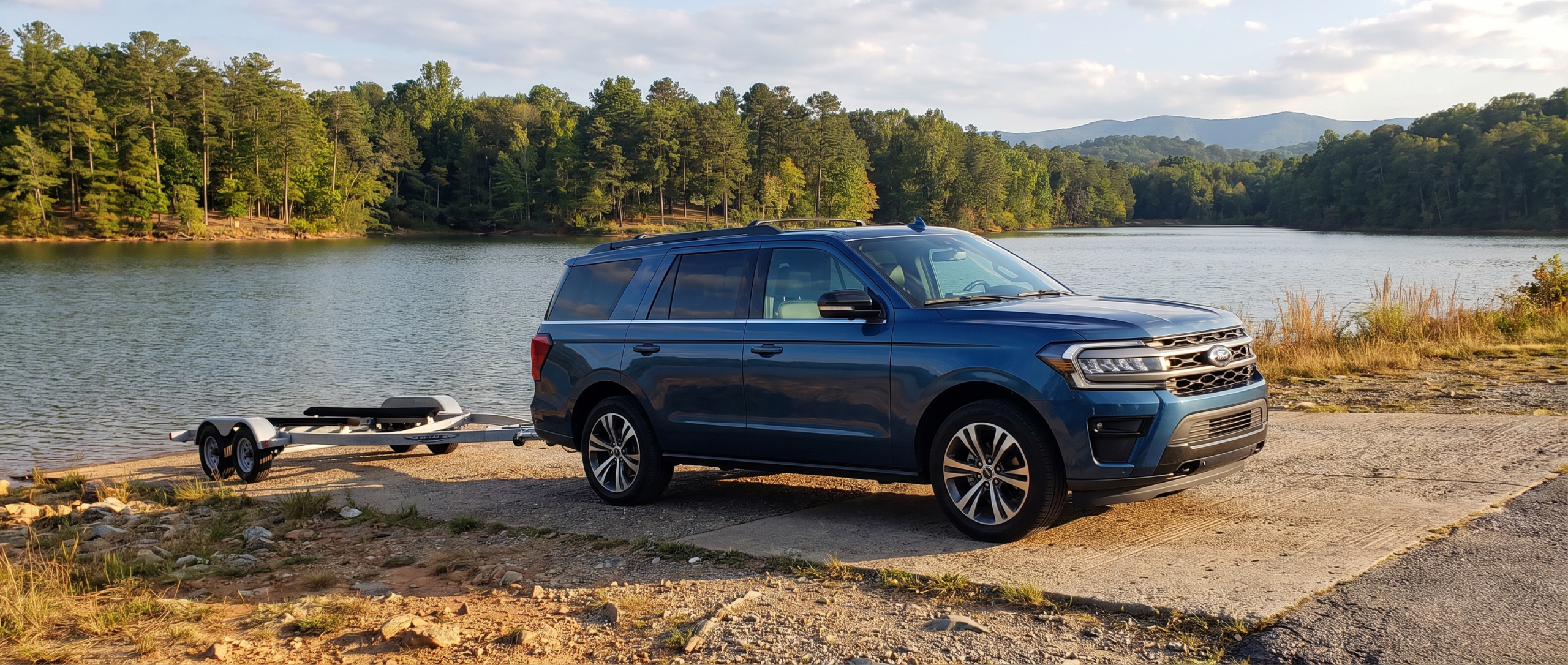
Pull a loaded bass boat out of Lake Hartwell on a July afternoon, three kids in the back and a week of gear crammed behind the third row, and you’ll know in a hurry whether you bought the right full-size SUV. Both the 2026 Ford Expedition and the 2026 GMC Yukon are serious machines. They just make different trade-offs, and those trade-offs land differently depending on how your family actually uses the road.
Our read is straightforward. For Spartanburg-area families who tow regularly and want the most towing margin plus better everyday fuel efficiency, the Expedition earns the nod. If you want a diesel engine option for long hauls or you’d rather have the feel of a traditional V8, the Yukon makes a real case. Neither answer is wrong, and one is more likely right for you.
See the 2026 Ford Expedition at D&D Ford Motors
Why Does the Expedition Fit Upstate SC Driving So Well?
| Local Condition / Use | Expedition Feature | Why It Matters Here |
|---|---|---|
| Towing to Lake Hartwell or Lake Keowee | Max tow: 9,600 lbs (4×4 + HD Tow Package) | Boats, jet ski trailers, campers; Yukon caps at 8,400 lbs |
| I-85 highway commuting (loaded) | EPA: 16 city / 24 hwy (2WD) | Ford’s 3.5L EcoBoost V6 edges the Yukon’s 5.3L V8 (15 city / 20 hwy) |
| Blue Ridge foothills grades (SC-11, Caesars Head) | 400 to 440 hp; 480 to 510 lb-ft of torque available low in the rev range | Turbo torque hits harder off the line on climbs than a naturally aspirated V8 |
| Full family + full gear, third row occupied | Split Gate tailgate (lower drops like a truck tailgate, holds 500 lbs) | Easier loading at trail heads and boat ramps without hunting for a clear hitch angle |
| Eight-passenger family trips | Standard 8-seat bench or optional 7-seat captain’s chair config | Yukon XL also seats 8, but standard Yukon and Expedition both cover this at the same wheelbase |
| Long-haul comfort on I-85 runs | Available BlueCruise hands-free driving, panoramic vista roof | Yukon offers Super Cruise; both have driver-assist highway tech, though features vary by trim |
The Expedition’s Towing Advantage Is Real (and Local-Relevant)
The Expedition’s towing edge is real for Upstate families who haul, and it shows up on the boat ramp at Lake Hartwell in July heat with a fully loaded trailer, but for lighter loads either truck handles the job without complaint. Ford lists the 2026 Expedition’s maximum tow rating at 9,600 lbs on the 4×4 with the Heavy-Duty Trailer Tow Package. GMC rates the 2026 Yukon at 8,400 lbs with the Max Trailering Package. That 1,200-lb difference isn’t trivial if you own a larger bass boat, a mid-size camper, or a pair of jet skis on a tandem trailer. You feel it on the ramp.
The engine story explains part of why. The Expedition runs a 3.5-liter twin-turbocharged EcoBoost V6. Ford rates it at 400 horsepower and 480 lb-ft of torque in standard trim, and 440 horsepower and 510 lb-ft in the High Output version. Turbo engines deliver peak torque at lower RPMs than naturally aspirated V8s, and that matters when you’re pulling a load up the grade on the Cherokee Foothills National Scenic Highway or merging onto I-85 from a short on-ramp with a trailer in tow. The Yukon’s standard 5.3-liter V8 produces 355 horsepower and 383 lb-ft of torque. Its optional 6.2-liter V8 jumps to 420 horsepower and 460 lb-ft. Capable numbers. But the Expedition’s torque advantage stays in its column, up to 510 lb-ft against the 460 lb-ft of the Yukon’s biggest V8.
Now for the caveat, because the Yukon offers something the Expedition doesn’t. GMC’s available 3.0-liter Duramax turbodiesel produces 305 horsepower and a substantial 495 lb-ft of torque, and the EPA rates it at 21 city / 26 highway combined in RWD configuration. If you’re logging serious highway miles between Spartanburg and somewhere far north and efficiency is your priority, the Yukon diesel gives you an option Ford simply doesn’t have. We think that matters for a real segment of Upstate SC buyers.
Not sure if you need this much truck? The Ford Explorer may be the better fit for smaller families
See Current Ford Expedition Offers
How the Cargo and Interior Space Actually Stack Up
On interior space the Yukon genuinely edges the Expedition in raw cargo volume, so a family that prizes maximum luggage room with every seat full should give the GMC a hard look, but the Expedition answers with a smarter tailgate. Online comparisons tend to miss that second half. So let’s be direct.
Behind the third row with all seats occupied, the 2026 Expedition offers 22.9 cubic feet of cargo space. The 2026 Yukon goes a bit bigger at 25.5 cubic feet in the same configuration. If your family travels with the third row full and still needs luggage space, that gap is real. Step up to the Yukon XL (the extended wheelbase version) and it’ll stretch to 41.5 cubic feet behind the third row, a genuinely different proposition. When maximum cargo with a full passenger load is the goal, the Yukon XL and the Expedition MAX are the right conversations, and the MAX carries 37.4 cubic feet behind the third row.
Fold everything down to the first row and they’ll both open up dramatically. The Expedition’s max cargo volume reaches 108.5 cubic feet per Ford’s specs. The Yukon tops out higher at 122.8 cubic feet. On raw volume with the seats down, the GMC takes it. What the Expedition brings is the feature that actually moves gear, that Split Gate tailgate, which holds up to 500 lbs and gives you a load floor to stand gear on during loading. The GMC hauls more. The Ford loads smarter.
Compare the Expedition MAX for even more cargo room behind the third row
The Fuel Economy Edge Families Actually Feel
On fuel economy the Expedition’s EcoBoost V6 quietly beats the gasoline Yukon on the highway, a result that surprises anyone expecting a turbo six to fall behind a V8, but the Yukon’s diesel option rewrites the story on long hauls. The EPA rates the 2026 Expedition at 16 city / 24 highway for 2WD Active trim models. On the GMC side, the 2026 Yukon’s standard 5.3-liter V8 earns 15 city / 20 highway in RWD configuration. So the Expedition’s highway number runs four miles per gallon better, and on a longer I-85 run or a trip to the coast, that gap adds up across a 26-gallon tank.
So does the Yukon ever pull ahead on fuel? On long highway hauls, yes, and its diesel flips that math, with 21 city / 26 highway genuinely impressive for a full-size SUV. If the diesel Yukon is the trim you’re cross-shopping, we’ll tell you straight it’s the smarter pick. For everyone else buying the gasoline Yukon, the Expedition’s EcoBoost holds a consistent efficiency advantage in the kind of driving Upstate SC families actually do.
Around Spartanburg and Greer, the everyday mix is towing to the lake and running kids to practice on I-85, and for that mix the highway number is the one you’ll feel at the pump. A two- or three-mpg advantage on the highway, at 20,000 miles a year, is real money over a five-year ownership window.
Explore financing options for your new Expedition at D&D Ford Motors
The Explorer and Palisade Tie on Everything: What Greenville Families Actually Get Wrong
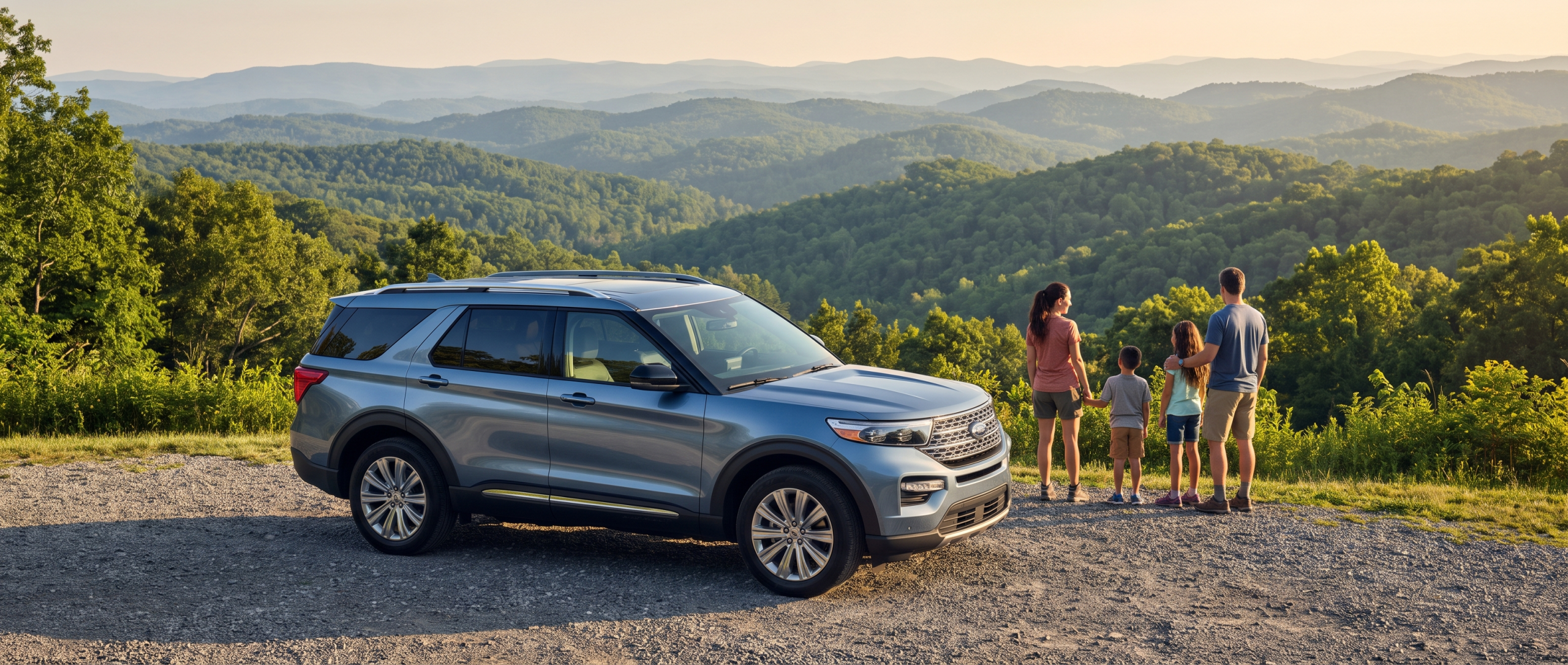
A common myth trails the 2026 Ford Explorer and the 2026 Hyundai Palisade around the showroom. People treat the two as basically the same SUV, so it’s tempting to just buy whichever one looks better. Both seat seven. Both tow 5,000 pounds. Both have big screens and three rows. Close enough, right?
That framing misses real differences. Each of these SUVs wins specific categories by a meaningful margin, and which one wins for your family depends entirely on what you’re doing with it around Greenville and Upstate SC. We’ll lay out those differences so you can stop guessing and start deciding.
- Myth: The Explorer and Palisade are essentially tied in capability, so the decision comes down to looks or brand preference.
- Reality: The Explorer leads on powertrain output (300 hp base vs 287 hp) and NHTSA crash-test ratings (5-star frontal and side for the Explorer; no comparable Palisade rating published yet for the redesigned 2026 model).
- Reality: The Palisade wins on cargo behind the third row (19.1 cu ft vs 16.3 cu ft, per Hyundai and Ford specifications) and adds a hybrid powertrain option the Explorer does not offer.
- Reality: Both tow 5,000 lbs when properly equipped, but the Explorer’s standard Class III Tow Package is included on every trim, no add-on required.
- Bottom line: If you tow a boat to Lake Keowee and need the stronger safety scorecard, the Explorer earns it. If your third row is always full of kids and you want more behind-seat breathing room, the Palisade’s extra cargo space is real.
Is the Palisade Really the Better-Space SUV in Every Category?
Only behind the third row, and that single caveat quietly undoes the whole assumption, because families shopping on raw cargo volume hear 19.1 versus 16.3 cubic feet behind row three and figure the Palisade has to dominate every other measure too. Hyundai lists 19.1 cubic feet behind the third row and 86.7 cubic feet maximum (all rows down) on the 2026 Palisade. Ford lists 16.3 cubic feet behind the third row and 85.8 cubic feet maximum on the 2026 Explorer. So the Palisade does carry a real, verified 17 percent more cargo when all three rows are occupied and you’ve got gear to fit back there.
That win is genuine. If your family road-trips fully loaded with six or seven people and real luggage, you’ll notice the Palisade’s rear compartment is the better place to be. No asterisk needed.
But fold the second row, and the gap narrows in a hurry. The Explorer’s 4WD-capable rear-wheel-drive architecture and its flat cargo floor catch up fast, and you’ll find the total volume numbers land nearly identical. Check available 2026 Ford Explorer trims and match a configuration to your typical load. The Palisade wins row three, seats up.
| What You’re Comparing | 2026 Ford Explorer | 2026 Hyundai Palisade |
|---|---|---|
| Cargo behind row 3 | 16.3 cu ft | 19.1 cu ft |
| Max cargo (all rows down) | 85.8 cu ft | 86.7 cu ft |
| Base engine output | 300 hp / 310 lb-ft | 287 hp / 260 lb-ft |
| Standard tow package | Yes, every trim | Requires proper equipment |
| Max towing capacity | 5,000 lbs (standard) | 5,000 lbs (V6, equipped) |
| NHTSA frontal crash (2026) | 5 stars | Rating pending (redesign) |
| Base infotainment screen | 13.2 inches | 12.3 inches |
| Hybrid option | No | Yes (329 hp, est. 34 mpg combined) |
What the Space Difference Actually Means for Upstate SC Families
For Upstate SC families, the space difference splits cleanly along two lines, the trailer you pull to Lake Keowee on a Saturday and the kids you haul to school on Monday, and the two SUVs answer those questions in noticeably different ways. Roll onto our lot on East Wade Hampton Boulevard on a summer afternoon and you’ll hear the same two concerns surface together, a hitch question and a third-row question in one breath. The specs tell a different story for each.
For towing, the Explorer’s setup is the cleaner one. Ford builds the Class III Trailer Tow Package into every single 2026 Explorer trim as standard equipment, which means you’re not shopping for add-ons before you can hitch a pontoon boat for a run down to Lake Keowee. The standard 2.3L EcoBoost four-cylinder puts out 300 hp and 310 lb-ft of torque. If you need the full 5,600 lb rating (and you’re thinking about a heavier travel trailer on the Cherokee Foothills Scenic Highway), that requires stepping up to the Explorer ST’s 3.0L EcoBoost V6, which Ford rates at 400 hp and 415 lb-ft of torque.
The Palisade’s 3.5L V6 makes 287 hp and 260 lb-ft. It still tows 5,000 lbs when properly equipped, and it’s smooth about it, for what it’s worth. But if you opt for the new Palisade Hybrid (329 hp, rated up to an estimated 34 mpg combined), towing capacity drops to 4,000 lbs. That tradeoff matters if a boat is in the picture.
On fuel economy, the Explorer’s 2.3L EcoBoost in rear-wheel drive earns an EPA-estimated 20 city / 29 highway. On I-85 between Greer and Greenville, that 29 highway figure is the one you’ll feel. The Palisade V6 with front-wheel drive earns an EPA-estimated 19 city / 25 highway. The Explorer’s efficiency edge with the base engine is real, not marginal.
So What Should You Actually Do With This Information?
The straight answer is to buy the one that fits how your family’s miles actually break down, and that means you’re weighing the trailer, the third row, and the highway commute against each other instead of settling it on badge or looks alone. If your situation is larger, a Ford Expedition scales up from here. For most Greenville families, one of these two three-row SUVs is the right-sized answer.
Lean Explorer if you’re towing regularly, if the NHTSA’s 5-star frontal and side crash ratings matter to your household, or if your daily driver math favors the EPA’s 29 mpg highway estimate on I-85. The ST trim’s 400 hp V6 also pushes the Explorer into a different performance tier than anything the Palisade’s base V6 reaches.
The Palisade is the better call if all three rows are genuinely occupied on most trips, if the verified 19.1 cubic feet behind row three matters to your gear-hauling routine, or if the hybrid’s estimated 34 mpg combined rate makes the fuel math work over 15,000-plus annual miles. The redesigned 2026 interior is also legitimately more upscale than the Explorer’s base cabin. We’ll call that a real tradeoff and say it plainly.
Neither SUV is wrong. Each is just wrong for the wrong family. Start a financing application once you know which way you’re leaning, and we’ll have the specific trim you’re eyeing ready on the lot.
Frequently Asked Questions
Does the 2026 Ford Explorer really outpower the 2026 Hyundai Palisade?
On base engines, yes. The 2026 Explorer’s standard 2.3L EcoBoost four-cylinder is rated at 300 horsepower and 310 lb-ft of torque. The Palisade’s standard 3.5L V6 produces 287 horsepower and 260 lb-ft of torque, and the Explorer’s optional 3.0L EcoBoost V6, available on the ST trim, reaches 400 horsepower and 415 lb-ft. The Palisade’s new hybrid powertrain hits 329 horsepower, so that version does surpass the Explorer’s base output. It depends which engines you’re comparing, but the Explorer’s standard power advantage is real.
Which SUV is safer for a family in 2026?
Per NHTSA testing, the 2026 Ford Explorer earned five stars in both the frontal and side crash tests regardless of drivetrain configuration. The 2026 Hyundai Palisade is a full redesign for this model year, and equivalent NHTSA five-star crash ratings for the 2026 model had not been published as of this writing. Both vehicles include modern active safety systems as standard equipment. For Greenville families where crash-test results are a deciding factor, the Explorer’s published NHTSA scores are the stronger documented record right now.
Which one has more cargo space behind the third row?
The Palisade wins this one. With all three rows in place, the Palisade offers 19.1 cubic feet of cargo space behind the third row, compared to the Explorer’s 16.3 cubic feet. That’s a real advantage if your family travels with all seven seats occupied and needs to pack gear.
By the D&D Ford Motors Team | July 2026
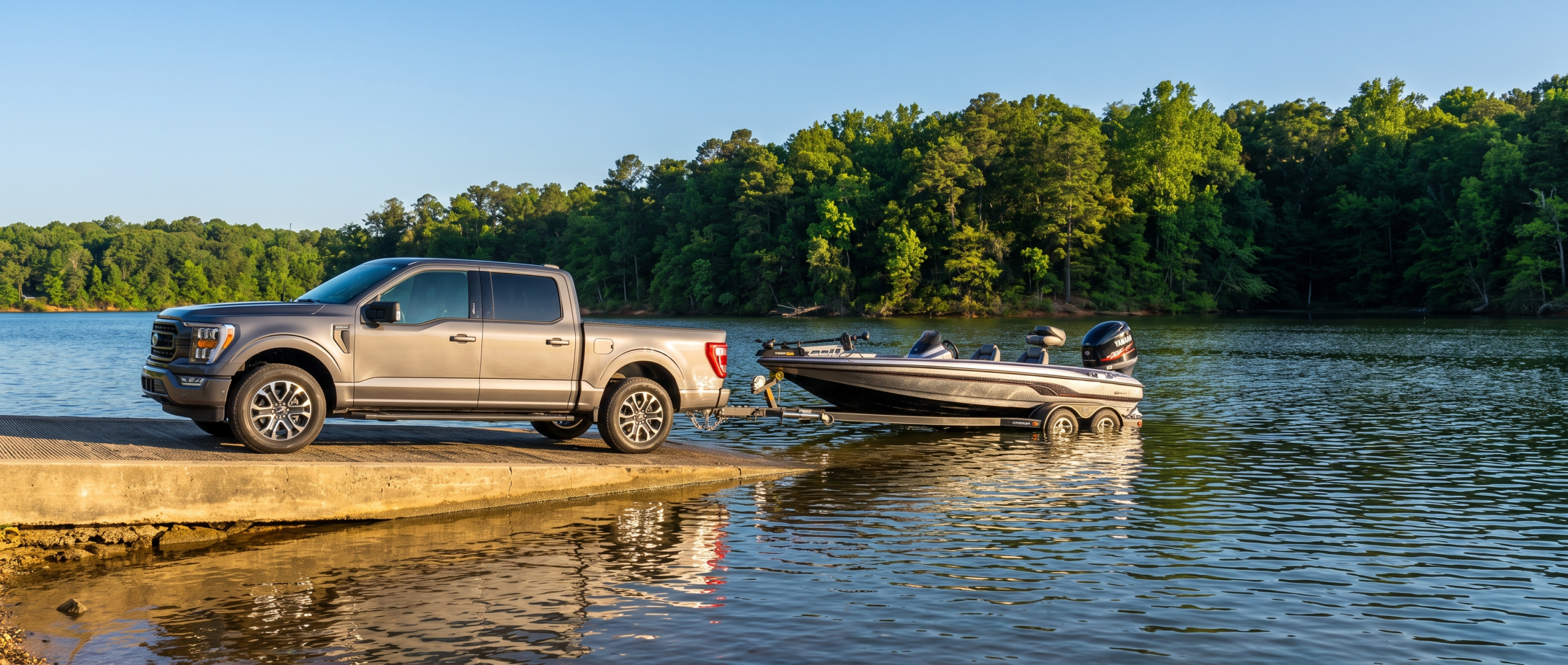
If you’re standing between a 2026 Ford F-150 and a 2026 Toyota Tundra, the bottom line comes down to this. The F-150 gives you more towing ceiling and a wider menu of powertrains, but the Tundra earns a safety edge that matters if your family rides in the back seat. The truck that fits you depends on what you haul and who rides with you.
- The 2026 Ford F-150 tops out at 13,500 lbs of towing (with the 3.5L EcoBoost and Max Trailer Tow Package, per Ford’s official towing guide). The 2026 Toyota Tundra peaks at 12,000 lbs on gas models, per Toyota.
- The F-150 offers six powertrain choices including the PowerBoost hybrid; the Tundra offers two.
- The Tundra is the only full-size gas pickup to earn a 2026 IIHS Top Safety Pick. The F-150 received a Poor rating in the IIHS moderate front overlap test for rear-passenger protection.
- The Tundra uses an independent multi-link rear suspension with coil springs; the F-150 uses a leaf-spring rear. Ride quality shows it, especially loaded.
- Your real number matters more than the ceiling number. Read the payload math section before you buy.
What’s the Real Difference Between These Two Trucks?
The gap is smaller than the spec sheets suggest and wider than most comparison articles admit, which is the frustrating truth of it. Both trucks are 2026 models wearing twin-turbocharged V6 engines as their main powertrains. Both tow serious weight, seat five adults, and park on the same street. The differences that matter show up in three places, how much you can really pull once the truck is loaded, how the truck rides on a backroad or a loaded return trip on I-85, and what happens in a crash.
Look at the head-to-head below, where the deciding factors live.
| Decision Axis | 2026 Ford F-150 | 2026 Toyota Tundra |
|---|---|---|
| Max towing (properly equipped) | 13,500 lbs (3.5L EcoBoost) | 12,000 lbs (i-FORCE gas V6) |
| Max payload (select configs) | 2,440 lbs | 1,850 lbs |
| Powertrain options | 6 engines (gas + hybrid + V8) | 2 (gas twin-turbo V6 + hybrid) |
| Hybrid tow rating | 11,600 lbs (PowerBoost) | 11,450 lbs (i-FORCE MAX) |
| Hybrid EPA est. MPG (4WD) | 22 city / 24 hwy | ~20 city / ~24 hwy (est.) |
| Rear suspension | Leaf spring | Independent coil-spring |
| IIHS rear-passenger protection | Poor (moderate overlap) | Good (Top Safety Pick) |
| NHTSA overall safety | 5-star (prior-gen data) | 5-star |
Does the Tow Rating Gap Actually Matter for What You Pull?
For most of what Upstate buyers hook up, the gap barely registers, though it turns into a genuine advantage once you climb past 11,000 lbs. That 13,500-lb F-150 rating is real. It’s also achieved on a 4×2 Regular Cab with the 3.5L EcoBoost, the Max Tow Axle, and the Tow/Haul Package, and Ford’s 2026 towing guide spells that out. Drop into a 4×4 SuperCrew (the configuration most Upstate families want), add your three passengers and a loaded tool drawer in the bed, and that ceiling comes down. The Tundra’s 12,000 lbs has asterisks too.
The practical question is what you hook up. A loaded bass boat on a dual-axle trailer, common at Lake Hartwell boat ramps, typically runs 4,000 to 6,500 lbs depending on hull size. A mid-size camper runs 5,000 to 8,500 lbs. A car hauler with a weekend vehicle runs 8,000 to 10,000 lbs. For everything in those ranges, both trucks get there. For a loaded horse trailer or a heavy equipment trailer pushing past 11,000 lbs, the F-150’s ceiling is a genuine advantage. The Tundra starts running thin.
The F-150’s 5.0L V8 offers another angle here. Ford rates it at 12,800 lbs of towing and 2,235 lbs of payload. Think of it as a traditional V8 for buyers who want eight cylinders without apology, splitting the difference between the max-tow EcoBoost and the hybrid’s efficiency.
The Suspension Difference Nobody Talks About
If ride comfort sits at the top of your list, the Tundra’s rear suspension has a clear edge when the bed runs empty, and that edge flips the other way once you load it down for work. Toyota moved to an independent multi-link rear setup with coil springs when it redesigned the truck for the 2022 model year. The F-150 still rides on a leaf-spring rear. Coil springs compress more progressively, offer more travel, and tend to give a noticeably smoother unladen ride. On the Cherokee Foothills Scenic Highway (SC-11) on a Sunday with nothing in the bed, you feel it.
That gap matters more than most comparison articles acknowledge. Empty miles add up around here.
The tradeoff runs the other way with load. Leaf springs are proven for heavy hauling and high-payload work, they’re simpler to service, and they’re broadly supported at shops across Upstate SC. Contractors who load the bed hard every day often prefer them for that reason. The Tundra’s Platinum, 1794 Edition, and Capstone trims add standard automatic load-leveling suspension to compensate at the high end of the lineup, but that’s a trim-level upgrade, not a base feature.
Standing in our service bay, we’d put it plainly. The Tundra rides better empty, the F-150 handles a loaded bed with fewer surprises at work weight. Our service team has straightened leaf-spring packs on hard-worked F-150s, and that’s a pattern we can stand behind. Coil-spring repairs on a Tundra show up less often here in Greer, though parts availability is also thinner at independent shops off East Wade Hampton Boulevard.
The Powertrain That Changes the Math: PowerBoost Hybrid
If your decision hinges on the hybrid, the PowerBoost pulls ahead on efficiency and jobsite power while giving up a little raw torque to Toyota, and that split is worth walking through. The EPA rates the 2026 F-150 PowerBoost at 22 city / 24 highway / 23 combined MPG in 4WD trim. It still tows 11,600 lbs. And it ships with Pro Power Onboard, which delivers up to 7.2 kW of exportable power from the bed. That last point hits differently if you run power tools on job sites, need a generator after a storm, or park at a campsite without a hookup.
The Tundra’s i-FORCE MAX hybrid puts out 437 hp and 583 lb-ft of torque, more than the PowerBoost’s 430 hp and 578 lb-ft. Its off-the-line feel is genuinely strong. But Toyota’s estimated fuel economy for the hybrid runs around 20 city / 24 highway in 4WD trim, and it doesn’t offer an onboard power export function. For buyers whose decision comes down to the hybrid question, the F-150 PowerBoost tows more, returns better city MPG by EPA estimates, and doubles as a mobile generator. The Tundra hybrid rides better empty and carries slightly more raw torque. Call it a tradeoff, not a knockout for either side.
See Current F-150 Offers at D&D Ford
So Which Truck Should You Pick?
Your pick splits cleanly by what you haul and who rides with you, and after nearly 90 years of serving this community in Greer, we’ll lay it out by buyer type. Neither truck is a mistake here. One fits your load better.
Pick the 2026 Ford F-150 if:
- You regularly pull trailers above 10,000 lbs (heavy equipment, large RVs, fully loaded horse trailers).
- You want a choice of six powertrains, including the 5.0L V8 for buyers who want displacement over turbos.
- You need maximum payload, 2,440 lbs, to carry crew plus a fully loaded bed.
- The PowerBoost hybrid’s Pro Power Onboard matters for your work or camping setup.
- Service availability and part depth across Upstate SC is a priority.
Pick the 2026 Toyota Tundra if:
- Your tow loads stay comfortably under 10,000 lbs (boats, campers, mid-size trailers).
- Rear-seat safety for family passengers is a top criterion. The IIHS data is the clearest differentiator in this comparison.
- You want a smoother unladen ride, especially on the Blue Ridge approach roads where you’re running empty half the time.
- The higher-trim load-leveling suspension appeals to you.
We’ll make one honest concession. The Tundra’s IIHS rear-seat result is a finding that matters if you carry kids or adults in the back seat regularly. The F-150 hasn’t addressed that weakness for 2026. If your family fills those rear seats, that test result is worth weighing. What the F-150 brings back is a broader powertrain selection, higher payload ratings, and the deepest service network in the region.
We’ve sold trucks in Greer since 1937. Trucks earn their keep in this market on real work and hard weekends, not on a big number on a window sticker. Value your current truck here, then come see which configuration of the F-150 fits your load, whenever you’re ready.
Frequently Asked Questions
What is the towing difference between the 2026 Ford F-150 and the 2026 Toyota Tundra?
The 2026 Ford F-150 tows up to 13,500 lbs when properly equipped with the 3.5L EcoBoost V6 and the Max Trailer Tow Package, per Ford’s official 2026 towing guide. The 2026 Toyota Tundra tops out at 12,000 lbs on gas-powered models, per Toyota. Both ratings are configuration-specific maximums. Your actual real-world number depends on drivetrain (4×4 adds weight), cab style, passengers, and bed load. A loaded 4×4 SuperCrew F-150 with three passengers tows meaningfully less than 13,500 lbs, so check the door-jamb payload sticker on any specific truck before hitching a heavy trailer.
Which is safer, the 2026 Ford F-150 or the 2026 Toyota Tundra?
For 2026, the Toyota Tundra is the only full-size gas-powered pickup to earn the IIHS Top Safety Pick award. The IIHS gave the 2026 Ford F-150 a Poor
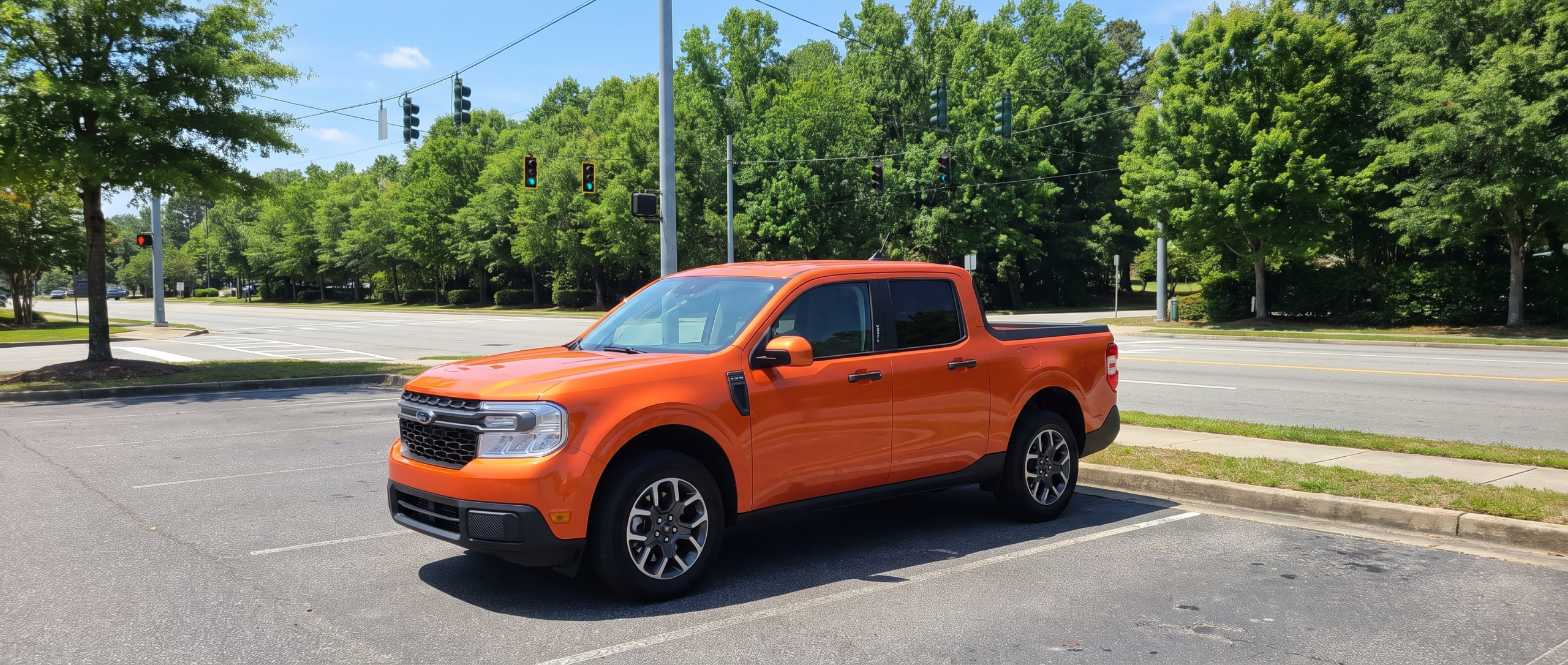
If you drive East Wade Hampton Boulevard every day, you already know how it goes. Signal, brake, inch forward, signal again. The stretch of US-29 between Greer and the airport corridor is as much a stop-and-go gauntlet as it is a through-route. That exact driving pattern is precisely where the 2026 Ford Maverick Hybrid earns its EPA rating of 42 mpg city. Not in spite of all those red lights. Because of them.
The Maverick Hybrid is a self-charging full hybrid. Every time you lift your foot before a red light on US-29, the truck’s electric motor runs backward and recharges the battery. No plug. No charging station. The fuel savings happen automatically, and they’re biggest right here in Upstate SC stop-and-go driving.
How Does a Self-Charging Hybrid System Actually Work?
Many drivers assume a hybrid needs a plug to do anything useful, and that assumption costs them at the pump. The 2026 Maverick Hybrid pairs a 2.5-liter Atkinson-cycle gasoline engine with an electric motor and a small 1.1-kilowatt-hour lithium-ion battery, and the whole system recharges itself while you drive. No external power source required.
Here’s where Wade Hampton Boulevard becomes relevant to the engineering. When you lift off the accelerator or press the brake pedal, the electric motor physically reverses direction and becomes a generator. Per Ford’s own engineering documentation, that process recovers more than 90 percent of the braking energy that a conventional vehicle simply loses as heat through the pads and rotors. That recovered electricity feeds back into the battery and gets used the next time the truck pulls away from a stop. Every signal on US-29 where you slow before the light is, mechanically speaking, a small charging event.
The EPA rates the 2026 Maverick Hybrid FWD at 42 mpg city and 35 mpg highway, for a combined 38 mpg. Notice that the city number sits higher than the highway number. That’s the opposite of how a conventional gas truck behaves, and it’s a direct result of how much regen opportunity a stop-and-go corridor provides compared to a steady highway cruise.
| Powertrain | City MPG | Hwy MPG | Combined | Best For |
|---|---|---|---|---|
| 2026 Maverick Hybrid FWD | 42 | 35 | 38 | Stop-and-go commuters, urban use |
| 2026 Maverick Hybrid AWD (XL/XLT) | 40 | 34 | 37 | Wet roads + commuting balance |
| 2026 Maverick Hybrid AWD (Lariat) | 39 | 32 | 36 | Comfort trim with traction |
| 2026 Maverick EcoBoost FWD | 23 | 30 | 26 | Towing, performance, specialty trims |
| 2026 Maverick EcoBoost AWD | 22 | 29 | 25 | Max traction, heavier hauling |
*EPA estimates. Actual results vary by driving habits and conditions.*
The combined system produces 191 horsepower. That’s perfectly adequate for daily driving and light hauling. You’re not going to beat a Tremor with an EcoBoost off the line, and we’d never tell you otherwise.
Which Setup Do You Actually Need Here in the Greer Area?
The Maverick Hybrid in FWD trim is the clear answer for anyone whose daily loop runs along US-29, up toward Greenville-Spartanburg International Airport, or through the commercial stretches of Greer. Suburban corridors, school-run traffic, regular errands: that’s the Hybrid’s native environment, and its fuel numbers reflect that honestly.
The tradeoff worth naming is towing and outright performance. The 2.0-liter EcoBoost option produces 250 horsepower and 277 pound-feet of torque, compared to the Hybrid’s 191 horsepower, and it can handle up to 4,000 pounds of towing when properly equipped. If you’re regularly pulling a boat trailer to Lake Keowee or running heavier loads for work, the EcoBoost is the right engine for that life. If your truck bed hauls lumber a few times a year and your cab hauls kids daily, the Hybrid wins on the math that actually affects your fuel bill.
In our experience at D&D Ford, customers sometimes arrive convinced they need the EcoBoost because it sounds more capable. Sometimes they’re right. But when we walk through actual weekly use together, commuting on US-29, grocery runs, one or two trips a month with real cargo, the Hybrid turns out to be the correct choice for that driving pattern. The 13.8-gallon tank combined with 38 combined mpg puts an estimated range of roughly 500 miles between fill-ups on typical use. That changes how often you stop for gas in a measurable way.
The Hybrid AWD trims (rated 37 mpg combined on XL/XLT and 36 on Lariat) are worth a conversation if wet roads or occasional gravel give you pause. South Carolina summers bring real thunderstorms, and those stretches where US-29 pools after a heavy rain are worth thinking about before you configure. You’ll give up a few mpg for the added traction confidence. For some buyers, that’s a reasonable trade.
What the Maverick Hybrid Means for Your Next Vehicle Decision
The 2026 Maverick Hybrid occupies a category of its own: the only full-size-cab, short-bed truck in Ford’s lineup that runs a standard hybrid powertrain. If you’re comparing it to the Ford Ranger, which is a fine mid-size truck, understand that the Ranger uses a turbocharged gas engine rather than a hybrid. The comparison that actually maps is this: the Maverick Hybrid is built for drivers who want a bed and five seats but whose driving is mostly urban and suburban. The Ranger is built for drivers who need more capability and can accept trading some efficiency to get it.
Our team has noticed a consistent pattern over years of selling both trucks. Customers who come from cars and small crossovers often underestimate how much they’ll actually use the bed, and overestimate how much heavy capability they need day to day. The Maverick gives you the truck identity and a usable 4.5-foot bed without the fuel cost of a larger truck. That fits a lot of Greer-area buyers who are purchasing a practical daily driver with occasional truck utility, not a dedicated work rig.
The Atkinson-cycle engine deserves a quick explanation here, because it clarifies when the Hybrid is the wrong choice. Atkinson engines trade peak power for thermal efficiency. They extract more energy per combustion cycle than a conventional engine but don’t produce as much raw output. On a highway at 70 mph with a trailer behind you, that tradeoff works against you. In stop-and-go on Wade Hampton, it’s a genuine advantage. Know your actual driving pattern and this truck becomes straightforward to evaluate.
Terms Worth Knowing Before You Shop
| Term | What It Means in Plain Language |
|---|---|
| Atkinson-cycle engine | A gas engine tuned for efficiency over power; extracts more energy per cycle, but lower peak output |
| Regenerative braking | The electric motor runs backward when you brake, acting as a generator to recharge the battery |
| eCVT (Electronic CVT) | A transmission with no fixed gear steps; the hybrid system manages the power blend automatically |
| Full hybrid (HEV) | Runs on gas and electric; the battery recharges itself while you drive — no plug required |
| PHEV (Plug-in Hybrid) | Requires external charging for full electric range; the Maverick Hybrid is NOT a PHEV |
Serving the Carolinas since 1937, the D&D Ford team on East Wade Hampton Boulevard is here for a straight conversation, not a sales pitch. If you’d like to put the Maverick Hybrid’s system on a screen and walk through how it maps to your actual commute, we’re ready for that conversation.
Frequently Asked Questions
Is the Ford Maverick Hybrid a plug-in?
No. The 2026 Ford Maverick Hybrid is a conventional full hybrid, not a plug-in hybrid. It recharges its 1.1-kilowatt-hour battery through the gasoline engine and through regenerative braking while you drive. You never need a charging station or a home charger. The system manages itself automatically every time you decelerate or brake.
Why does the Maverick Hybrid get better city mpg than highway mpg?
Because the hybrid system’s biggest advantage is energy recovery during braking and deceleration, something that happens constantly in city driving and almost never at a steady highway cruise. The EPA rates the 2026 Maverick Hybrid FWD at 42 mpg city and 35 mpg highway because stop-and-go driving gives the regenerative braking system more opportunities to capture and reuse energy. On the highway at a sustained 70 mph, the Atkinson-cycle engine is doing most of the work with less regen assist, so the number drops. If your daily drive looks like East Wade Hampton Boulevard, that city number is the one that actually reflects your real-world fuel cost.
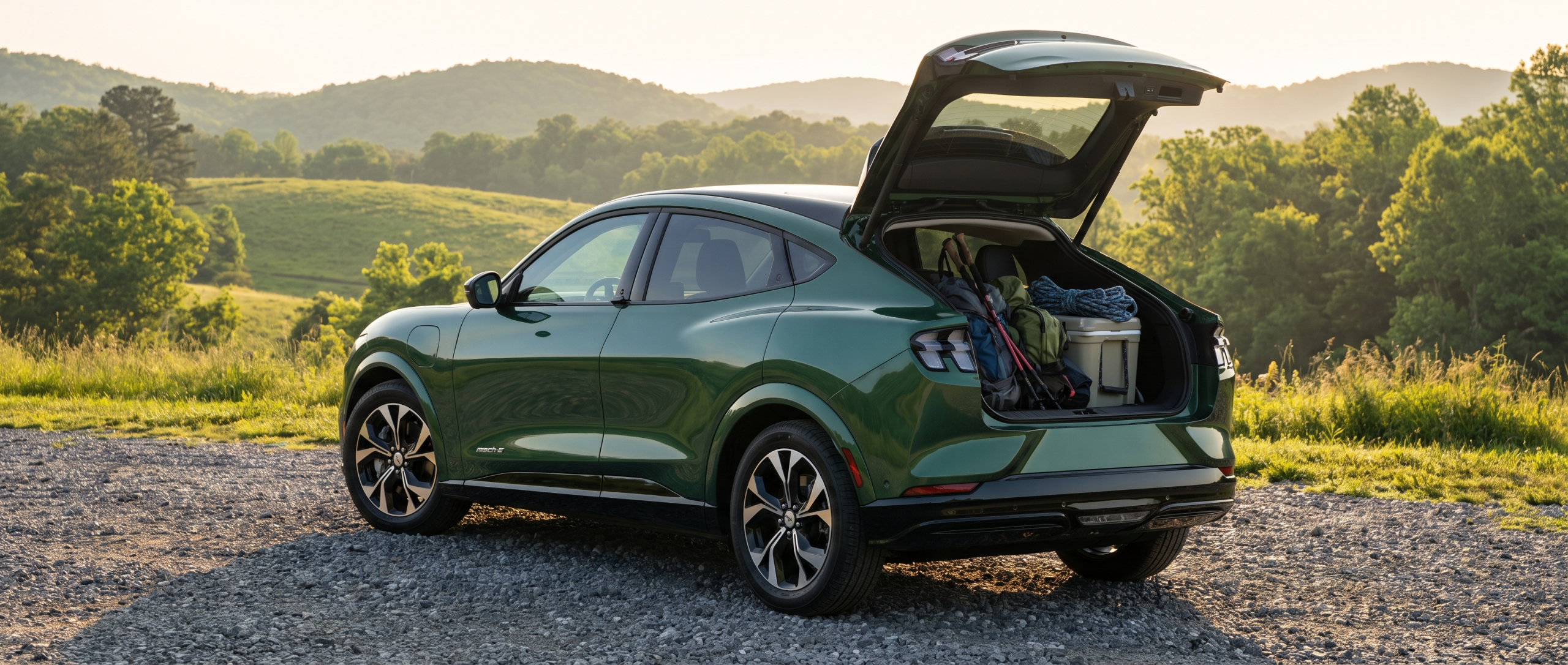
Picture this: school bags, a cooler for Paris Mountain, the dry-cleaning you’ve been meaning to grab for a week, and a quick airport run to GSP tucked into your Thursday. That’s a normal Tuesday in Greer. A fair question before you configure one of these is whether the Mach-E actually fits the way Upstate SC families live. It does, with one thing worth knowing going in.
The 2026 Ford Mustang Mach-E carries up to 59.7 cubic feet of cargo with the second row folded flat, and up to 29.7 cubic feet behind those rear seats with passengers on board. That’s a load story worth telling in detail. Below we’ll cover the specs, the practical loading order, and the charging reality on I-85, because range numbers on a sticker only tell part of the story.
Will It All Fit?
For a crossover wearing a Mustang badge, the Mach-E carries a lot more than its silhouette suggests, and the numbers from Ford back that up for the kinds of loads Greer families actually move:
| Load / Item | Mach-E Spec | Fits? Notes |
|---|---|---|
| Two adults + gear (weekend day trip) | 29.7 cu ft (2nd row up) | Yes — comfortable margin |
| Full family grocery run (4-6 bags + extras) | 29.7 cu ft | Yes — loads flat and fast |
| Airport run for two (GSP drop-off) | 29.7 cu ft | Yes — two checked-bag duffels with room |
| Paris Mountain hiking gear (4 packs, poles) | 29.7 cu ft | Yes — stack vertically or fold one seat |
| Second row folded fully flat | 59.7 cu ft total | Yes — long flat floor, genuine hauler |
| Frunk (available option, 2026) | Available add-on | Optional on 2026; great for valuables/gym bag |
| 5 passengers seated | 2-3 front/rear bench | Yes — five-passenger rated |
Ford lists cargo dimensions for the 2026 Mustang Mach-E Premium at 29.7 cubic feet behind the second row and up to 59.7 cubic feet with it folded. One honest note here: the frunk that used to be standard is now an available option on the 2026 model year. It’s a smart add-on for keeping sweaty gear or airport valuables out of sight, but it’s not automatic. Know before you configure.
Loading for the Upstate: How Our Team Thinks About It
Browse what’s on our lot and you’ll see the Mach-E’s cargo floor drops pretty level when that rear seat folds. That matters in Greer, where a lot of weekend hauling involves awkward shapes: folding chairs, a couple of mountain bikes in a hitch rack, kayak paddles that ride inside. The floor isn’t totally flat (there’s a slight step), but it’s practical enough for everything short of serious truck-duty loads.
The trim decision actually affects your haul, so here’s how they break down.
Select (RWD): The EPA rates this at 260 miles of range. It’s the lightest footprint and the most range-efficient when you’re doing pure Greer errand loops, from East Wade Hampton Boulevard out to Pelham Road and back, day after day.
Premium (AWD, Extended Range): The EPA rates this version at 300 miles of range. If you’re doing the I-85 run to Greenville or Spartanburg regularly, or jumping up toward Caesars Head on weekends, that buffer is real and noticeable.
GT (eAWD): 480 horsepower and 280 miles EPA-rated range. The EPA pegs it at 90 MPGe combined. Ford lists 0-60 times in the mid-3-second range for this trim, and it still hauls the same 59.7 cubic feet. Aggressive driving does erode that range faster than the spec sheet implies, so keep that in mind if you drive with a heavy foot on I-85.
We’ll be straight with you: the Mach-E is not the answer if you regularly tow a boat to Lake Hartwell or Lake Keowee. For towing needs, the Ford F-150 exists in the same lineup for a reason. But for the family that drives 40-60 miles a day on Upstate roads and wants performance EV feel without a range penalty on a five-day week? The Mach-E covers that.
5 Steps to Loading the Mach-E for a Greer Weekend Run
- Load the frunk first (if equipped). Wet swimwear, muddy trail shoes, anything you don’t want touching clean cargo: keep it separated up front. It’s drainable and water-resistant.
- Fold the rear seat in sections. The Mach-E uses a 60/40 split rear bench, so you can carry three adults and still open one side for longer gear.
- Lay flat cargo items on the floor first. Sleeping pads, folding chairs, flat boxes: those anchor the base and keep round items from rolling.
- Use the underfloor storage. The center console area has out-of-sight compartments that hold cables, a small first-aid kit, or the charging adapter so it’s not rattling loose.
- Check your range before backing out. The Mach-E’s Intelligent Range feature in the FordPass app shows real-time estimated range adjusted for your current battery state and conditions. SC summer heat can knock 10-15% off the EPA figure, so a quick check before a long run is worth 30 seconds of your time.
Job Done: What the 2026 Mach-E Is and Isn’t for Greer
The 2026 Ford Mustang Mach-E fits daily Greer life well when your world is airport runs to GSP, school drop-offs, regular I-85 commuting, and the occasional Blue Ridge day trip toward Caesars Head or Raven Cliff Falls. The EPA-rated range between 240 and 320 miles depending on trim and drivetrain is real-world sufficient for that pattern. The cargo room (29.7 cubic feet seats-up, 59.7 folded) is genuinely useful. The 15.5-inch center display and available Ford BlueCruise hands-free highway tech make the I-85 commute less of a grind.
What it isn’t is a replacement for a truck if you regularly haul heavy loads, tow anything meaningful, or spend time off pavement. We’ve been in Greer since 1937, and we know the difference between the buyer who needs a Mach-E and the buyer who needs a Super Duty. Neither is a compromise when it’s matched right.
If you’ve got a trade-in sitting in the driveway, start there. Knowing what it’s worth costs nothing and changes the conversation.


