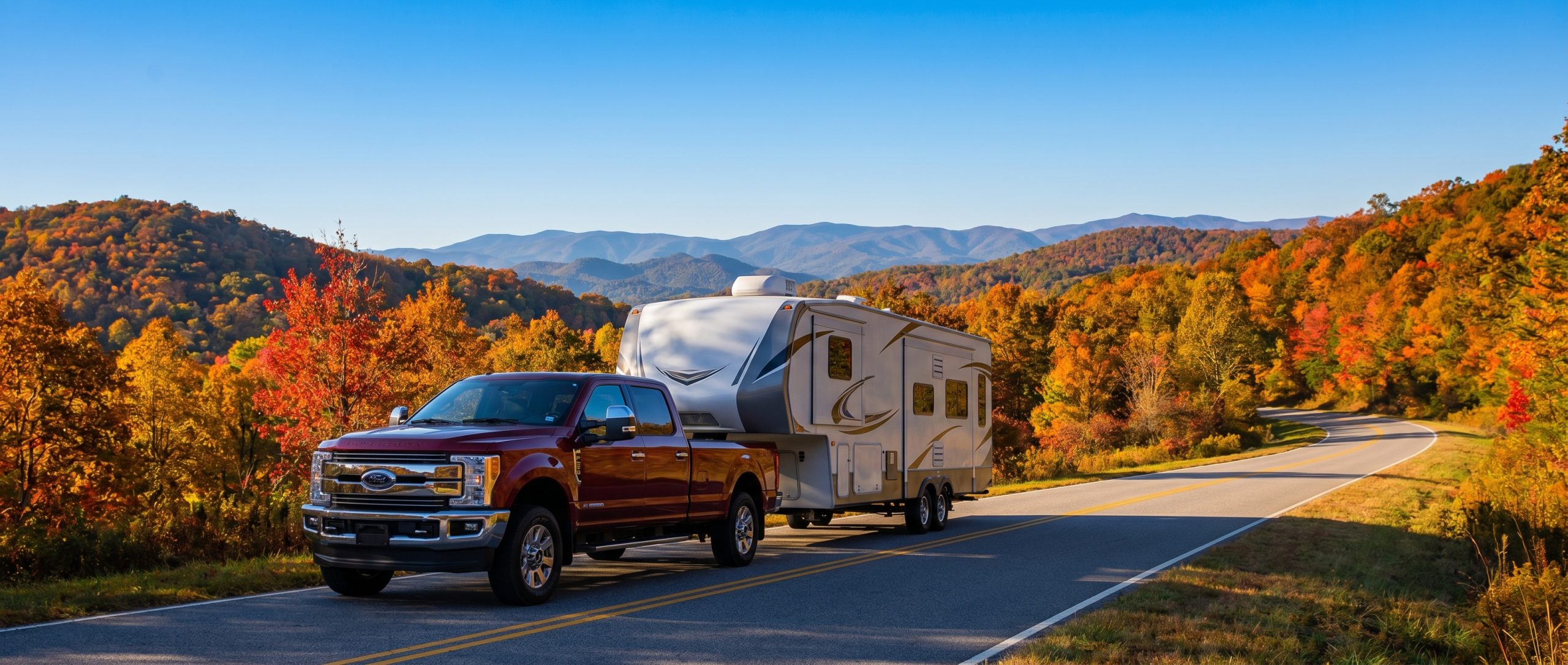
Most people underestimate what mountain towing actually demands from a truck – until they’re climbing a 6% grade somewhere between Asheville and the Tennessee border with a 14,000-pound fifth wheel swaying behind them. If you’re planning to tow a camper through the Blue Ridge Mountains from Greer, SC, the Ford® Super Duty™ isn’t just a capable option – it’s built specifically for the kind of sustained, high-stress towing that mountain terrain creates. This guide breaks down exactly what makes the Super Duty worth serious consideration before your next trip north into the hills.
What Mountain Towing Actually Does to Your Truck
Pulling a camper on flat ground and pulling one through the Blue Ridge Mountains are completely different mechanical challenges. On mountain terrain, your engine, transmission, brakes, and cooling system are all working at maximum output simultaneously – and they need to sustain that effort for miles at a time, not just seconds.
When you’re climbing from the Upstate South Carolina foothills toward destinations like Caesars Head State Park or continuing north toward the parkway, elevation gain is gradual but relentless. Grades of 5-8% are common on mountain approach roads, and those grades don’t let up. Your truck’s engine is fighting gravity the entire time. Downhill runs are equally demanding – braking a loaded trailer on a long descent generates serious heat in your braking system.
A truck that handles towing in flat conditions can struggle badly in this environment. Engine temperature spikes, transmission hunting between gears, and inadequate trailer brake integration are all real concerns on routes that matter to Greer-area campers. The Super Duty was engineered around exactly this kind of sustained stress.
How the Super Duty’s Powertrain Handles Sustained Grades
The Ford Super Duty’s towing capability starts with what’s under the hood, and the numbers behind these engines reflect serious engineering work.
The available 6.7L Power Stroke® Turbo Diesel V8 produces up to 1,050 lb-ft of torque – which is the figure that actually matters when you’re climbing. Horsepower tells you how fast a truck accelerates on flat ground. Torque tells you whether it can maintain speed and composure while pulling thousands of pounds uphill. That torque rating makes the Super Duty one of the most capable options available for mountain towing in its class.
The 10-speed SelectShift® automatic transmission works alongside that engine by finding the right gear ratio for the grade you’re on and staying there. Mountain roads punish transmissions that constantly hunt between gears. The Super Duty’s transmission calibration is designed to read load conditions and hold gears intelligently rather than cycling up and down searching for efficiency at the wrong moment.
For drivers weighing their options, the powertrain choice matters based on how they’ll use the truck:
| Powertrain | Best For | Max Towing (approx.) |
|---|---|---|
| 6.7L Power Stroke Diesel | Long mountain hauls, heavy fifth wheels, frequent towing | Up to 40,000 lbs (depending on config) |
| 7.3L Gas V8 | Occasional towing, lighter travel trailers, mixed use | Up to 18,500 lbs (depending on config) |
| 6.2L Gas V8 | Light-duty camper trailers, around-town flexibility | Lower range, lighter loads |
The diesel is the choice for serious Blue Ridge Mountain towing. For lighter pop-up campers or smaller travel trailers, the 7.3L gas engine handles the work without the added diesel maintenance considerations.
Integrated Towing Technology: More Than Raw Power
Raw towing capacity matters, but the technology built around it is what separates a truck that can tow from one that feels controlled and confident doing it.
The Super Duty’s Pro Trailer Backup Assist™ is one of the more useful real-world features for campers. Backing a large trailer into a mountain campsite – often on uneven terrain, between trees, sometimes at the end of a long driving day – is genuinely difficult. This system lets you steer the trailer with a knob rather than counter-steering the wheel, which takes a skill most occasional towers haven’t had time to develop.
Trailer sway control is another feature worth understanding before heading into the mountains. At highway speeds on mountain approach roads, crosswinds and road surface changes can introduce trailer sway. The system detects the oscillation early and applies selective braking to individual wheels to bring the rig back into line – before the driver even feels the sway begin.
Additional towing features on the Super Duty include:
- Trailer Brake Controller – integrated directly into the cab, not an aftermarket add-on
- Trailer Tire Pressure Monitoring – monitors trailer tires, not just the truck’s tires
- Hill Start Assist – prevents rollback on steep inclines when moving from brake to throttle
- Exhaust Brake – on diesel models, uses engine compression to slow the truck on descents without riding the brakes
- Ford Towing Technology Suite – camera system that provides views around the trailer, including side cameras and a hitch view
That exhaust brake feature deserves specific mention for mountain routes. On a long downhill stretch heading back toward Greer on I-26 or winding down from the higher elevations, riding your service brakes for miles builds up heat that can lead to brake fade. The exhaust brake carries much of that load instead, keeping your service brakes fresh for when you actually need them.
Choosing the Right Super Duty Configuration for Your Camper
The Super Duty family includes the F-250SD™, F-350SD™, F-450SD™, and F-550SD™ – and the right choice depends on what you’re towing, not just on general preference.
Payload capacity is the figure most campers overlook. Towing capacity tells you how much a truck can pull. Payload tells you how much weight can be loaded into the truck itself – including passengers, gear, and the tongue weight of your trailer. A fifth-wheel hitch places 15-25% of the trailer’s weight directly onto the truck’s bed as tongue weight. If your trailer’s tongue weight exceeds your truck’s payload, you’re overloaded even if you’re within towing limits.
Here’s a practical framework for matching truck to camper:
- F-250SD – Strong choice for travel trailers and lighter fifth wheels under approximately 15,000 lbs
- F-350SD – Better for heavier fifth wheels and gooseneck trailers; Dual Rear Wheel (DRW) option adds stability
- F-450SD – For serious fifth wheels in the 18,000-22,000 lb range; substantially higher payload capacity
- F-550SD – Commercial towing applications and the largest recreational rigs
Cab and bed configurations also matter practically. A crew cab with a short bed provides passenger comfort but requires a sliding fifth-wheel hitch to clear the cab during turns. A regular or extended cab with a long bed simplifies fifth-wheel setup. For families heading from Greer out toward Lake Hartwell for a launch point before heading north, or camping near Oconee State Park, the crew cab usually wins on comfort for longer drives.
The Blue Ridge Mountain Routes Greer Drivers Actually Use
Understanding the roads is part of understanding what your truck needs to handle. Greer, SC sits at roughly 900 feet of elevation. The Blue Ridge Parkway runs at elevations between 2,000 and 6,000 feet. That’s a significant climb across relatively short distances, depending on your route.
Common approaches from Greer include:
- US-25 North through Greenville toward Hendersonville, NC – A steady grade with moderate traffic; manageable but not forgiving with a poorly matched truck and trailer
- I-26 West toward Asheville, NC – Higher speeds on the approach, significant grade changes through the mountains, popular with campers heading to the Asheville area
- SC-11 (Cherokee Foothills Scenic Highway) – Lower elevations but excellent for accessing Caesars Head State Park and Table Rock State Park before pushing higher
- US-276 toward the parkway – Steeper and more technical; a real test of towing setup on the mountain approach sections
Table Rock State Park and Caesars Head State Park are popular staging areas for Greer-area families before pushing deeper into the mountains. Both involve roads that benefit from a truck with good low-end torque and reliable braking on the return.
Explore our new inventory if you want to see which Super Duty configurations are currently available before planning your next mountain trip.
Real-World Ownership Considerations for Mountain Towers
Buying the right truck is only part of the equation. Maintaining it properly for mountain towing keeps it performing the way it was designed.
Diesel engines in towing applications benefit from more frequent oil changes than the standard interval if you’re doing regular mountain pulls. The sustained high-load operation is harder on engine oil than typical highway driving. Ford’s recommended service intervals are a starting point, but serious towers often go shorter on intervals when they’re putting the truck through consistent heavy use.
Transmission fluid deserves attention after mountain trips. Extended high-load towing, especially on steep grades, runs transmission fluid temperatures higher than normal driving. Checking fluid condition and following Ford’s heavy-duty towing service schedule keeps the transmission healthy long-term.
Brake inspection after mountain trips is worth adding to your routine. If you’re using the exhaust brake properly on a diesel, your service brakes should be in good shape – but it’s worth confirming, especially on the front axle.
Tire condition and inflation are factors many campers overlook:
- Check both truck and trailer tire pressures before mountain trips – cold inflation pressures change at altitude
- Inspect tires for sidewall cracking and uneven wear before long hauls
- Understand your truck’s recommended tire pressures for loaded versus unloaded conditions
Common Questions About Ford Super Duty Towing in Greer, SC
What Super Duty model is the right choice for towing a travel trailer through the Blue Ridge Mountains from Greer, SC?
For most travel trailers in the 8,000-15,000 lb range, the F-250SD is a strong starting point for Blue Ridge Mountain towing from Greer. If your trailer is a larger fifth wheel above 15,000 lbs or you’re frequently running full loads with passengers and gear, the F-350SD or F-450SD provides more payload capacity and stability on sustained mountain grades. Always verify payload limits before purchase.
Does the Ford Super Duty diesel handle mountain grades better than the gas engine?
Yes, for sustained mountain towing, the 6.7L Power Stroke diesel outperforms the gas options in practical terms. The diesel’s torque curve is designed for high-load, low-rpm situations – exactly what long mountain grades demand. The exhaust brake feature on the diesel is also a significant advantage on descents, reducing reliance on service brakes during long downhill runs near areas like Caesars Head or the Blue Ridge Parkway.
How do I calculate whether my Super Duty can safely tow my camper in the mountains?
Start with the truck’s payload sticker in the driver’s door jamb. Calculate your tongue weight (typically 15-20% of trailer weight for travel trailers, or 20-25% for fifth wheels). Add that to the weight of passengers and gear in the truck. If that total exceeds the payload rating, the truck is overloaded regardless of towing capacity numbers. Mountain towing puts more stress on these limits than flat-road towing.
What Ford towing technology is most useful for mountain campground navigation near Greer, SC?
Pro Trailer Backup Assist is particularly valuable for mountain campgrounds, where sites are often tighter and less forgiving than flat-terrain parks. Trailer sway control is critical for the switchback sections and road conditions around the Upstate SC and western NC mountain routes. The integrated trailer brake controller also outperforms aftermarket units in terms of calibration and response.
How should I maintain my Ford Super Duty after mountain towing trips from Greer?
After mountain towing trips, inspect brake wear and fluid condition, particularly if you’ve been running long descents. Check transmission fluid condition and consider shorter service intervals if you’re towing mountains regularly. The diesel engine benefits from consistent oil change intervals rather than extended ones when under frequent high-load use. Ford’s heavy-duty towing maintenance schedule applies to regular mountain towers.
Is the Ford F-350SD significantly better than the F-250SD for the Blue Ridge Mountain routes near Greer, SC?
The F-350SD‘s main advantage is higher payload capacity, not just higher towing capacity. On mountain routes from Greer, payload matters because fifth-wheel tongue weight and passenger loads can push an F-250 close to its limits on heavier trailer setups. The F-350SD also offers a Dual Rear Wheel configuration that improves stability under heavy loads – a real benefit on the narrower mountain approach roads north of Greer.
Planning Your Mountain Trip Starts with the Right Truck
The Blue Ridge Mountains reward preparation. The routes heading north from Greer, SC toward the parkway, Caesars Head, and beyond are some of the most scenic drives in the Southeast – and they’re also genuinely demanding on a tow vehicle. The Ford Super Duty earns its reputation on roads exactly like these, where sustained grades, loaded weight, and long descents leave no room for a truck that’s underpowered or under-equipped.
The team at D&D Ford Motors understands what Greer-area campers need from a truck, and they’re well-positioned to help you match the right Super Duty configuration to your specific trailer and routes.


