

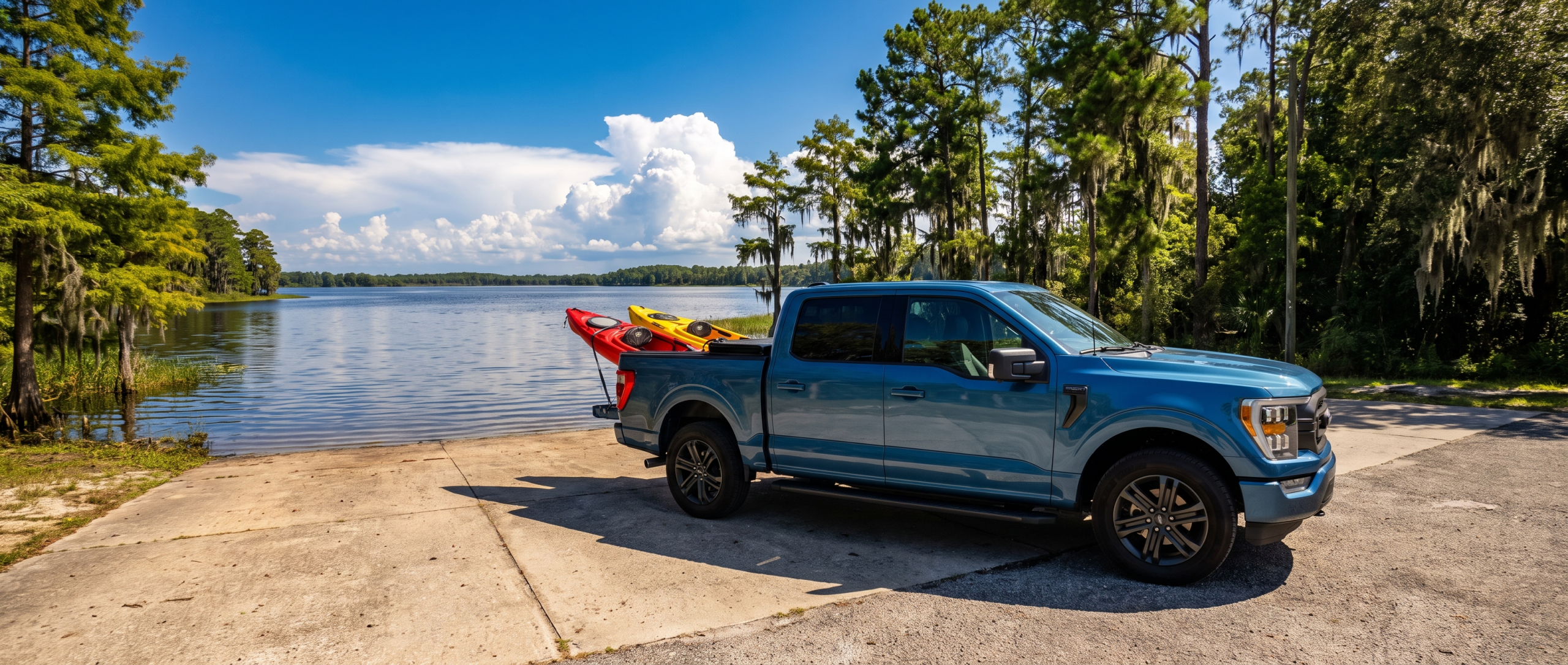
The 2026 Ford F-150 already comes ready for Upstate SC. The accessories you bolt on, though, decide whether the truck works for you in July or against you. So you’re protecting the bed from cargo damage and afternoon downpours, keeping gear from baking in 95-degree heat, and, if you’re headed to Lake Hartwell for the weekend, actually powering the cooler, fan, or camp lights without dragging a separate generator along.
The Upstate doesn’t play nice in summer. The National Weather Service has recorded heat indices up to 105 degrees Fahrenheit at Greenville-Spartanburg International Airport in July. Those conditions steer more of the choice than you’d think. They affect which tonneau cover material holds up, whether a drop-in bed liner creates a moisture trap against your aluminum bed, and whether your trim level’s Pro Power Onboard output covers what you’re planning.
Let’s walk through each call.
- Tonneau cover first: it handles both the UV damage to your cargo and Upstate SC’s near-daily afternoon thunderstorms; soft roll-up is the flexible pick, hard tri-fold is the security pick
- Bed liner second: spray-in bonds permanently and won’t trap moisture against your aluminum bed; drop-in is fine for occasional use but must match your exact bed length (5.5′, 6.5′, or 8′)
- Pro Power Onboard: available on most non-XL trims; the PowerBoost hybrid unlocks 7.2 kW (enough to run a portable fridge, box fan, and job-site tools simultaneously)
- Bed extender: makes Lake Hartwell kayak runs doable without a trailer; pairs best with a soft roll-up cover you can retract
- Running boards: concrete on longer days when you’re loading and unloading gear repeatedly in summer heat
What actually matters when choosing F-150 summer accessories?
Three things drive every accessory decision for an Upstate SC summer, and they’re weather protection, fitment precision, and power availability, so nail all three and the truck earns its keep, but miss even one and you’ve bought the wrong gear for the season. We’ll walk each one below and where it earns its place in the Upstate.
| Accessory | Best For | Key Spec / Detail | Tradeoff |
|---|---|---|---|
| Soft roll-up tonneau | Lake runs, mixed cargo, frequent access | Heat-resistant reinforced vinyl; rolls fully toward cab for full bed access | Lighter security than hard cover; not completely waterproof in driving rain |
| Hard tri-fold tonneau | Security, daily work use, cleaner look | Sits under half an inch above bed rails (weatherproof channel seals) | Limits bed height for taller cargo; higher cost |
| Spray-in bed liner | Work hauling, permanent protection | Bonds to aluminum bed; no gap for moisture or grit to collect | Permanent (you can’t remove it); requires professional installation |
| Drop-in HDPE bed liner | Light hauling, lease trucks, flexibility | Lifts out without tools; must match 5.5′, 6.5′, or 8′ bed exactly | Can trap moisture underneath if not routinely removed and dried |
| Pro Power Onboard (2.0 kW) | Charging tools, phones, small fan | Standard on most non-XL gas trims; outlets in cab and bed | Not enough for a full-size compressor fridge and tools simultaneously |
| Pro Power Onboard (7.2 kW) | Camp power, job site, fridge + fan + lights | Available on PowerBoost Full Hybrid trims | Requires PowerBoost powertrain; not available on XL |
| Bed extender | Kayaks, lumber, bikes without a trailer | Folds flat when not in use | Reduces usable bed depth for boxed cargo |
| Step bars / running boards | Frequent loading in summer heat | Reduces step-in height; keeps foot placement stable when wet | Adds width; not ideal if tight parking is a daily concern |
Tonneau Covers: the one accessory the Upstate makes mandatory
An afternoon thunderstorm in Greer can drop over two inches of rain in a single event, so a tonneau cover ranks first for summer here, and the piece that decides whether your cargo stays dry is a cover you can close before the sky opens. The SC State Climatology Office has documented that pattern in July, and the rain tends to arrive with about 20 minutes’ notice. A cover that’s a pain to close in a hurry won’t get closed.
Soft roll-up covers stay popular here for a practical reason. Browse the F-150s we have in stock if you’re working from a new truck baseline. For an existing truck, it comes down to how often you need the full bed open.
If the answer is weekly, go soft roll-up. The reinforced vinyl on a quality cover stays flexible in extreme temperatures (no warping in July heat), and it rolls all the way toward the cab, so you get full bed access for oversized loads like kayaks, coolers, and lumber when you need it. A hard tri-fold sits less than half an inch above the bed rails and gives you a tighter weather seal, but it caps what you can haul tall and adds noticeable weight to the fold sections.
There’s a tradeoff worth naming out loud. A soft cover isn’t a security solution. If you regularly leave tools or valuables in the bed overnight, the hard tri-fold or a retractable aluminum cover wins on that count, no question.
Bed Liners: the fitment trap nobody talks about
Bare aluminum beds scratch fast, so a liner isn’t optional on a working F-150, and the choice comes down to spray-in versus drop-in rather than whether to run one at all, since either one beats a bare bed. Our service team sees it up close. Ford builds the F-150’s bed from high-strength military-grade aluminum alloy, so it doesn’t rust the way a steel bed does, though it still shows surface damage quickly when you’re sliding kayak paddle shafts, lumber, or concrete blocks across it.
Spray-in bed liners bond directly to the aluminum surface. They cover every contour, close off any gap where moisture or grit can collect underneath, and they don’t shift under load. The tradeoff is permanence. Once it’s on, it’s on.
Drop-in HDPE liners cost less and lift out without tools, which is genuinely useful when you want to hose down the bed after a weekend at Lake Hartwell. The fitment catch is real, though. A drop-in liner that doesn’t match your exact bed length leaves exposed gaps at the edges that collect standing water (a particular problem in summer, when afternoon rain gets followed by 95-degree heat and humidity, cooking anything trapped beneath the liner).
Pros / Cons: Spray-In vs Drop-In Bed Liner
| Pros | Cons |
|---|---|
| Spray-in: No moisture gap; conforms to all contours | Spray-in: Permanent; requires professional install |
| Spray-in: Doesn’t shift under load | Spray-in: Higher upfront investment |
| Drop-in: Removable; easy to clean | Drop-in: Must match exact bed length or leaves gaps |
| Drop-in: Lighter installation burden | Drop-in: Can trap moisture under liner in humid SC summers |
| Drop-in: Lower initial outlay | Drop-in: Can shift on hard stops |
Match the gear to how you actually drive
The simplest way through this is to match the gear to your summer routine, so picture the three or four ways you’ll use the truck between now and September and let that shape the short list. Overthinking is the usual trap, and we’d rather keep it plain.
If you’re mostly hauling to a job site off I-85 and back, start with a spray-in liner and a hard tonneau cover. Everything else can wait.
Running Lake Hartwell most weekends, or looking at an F-150 that’s already set up for outdoors use? Then the priority is bed access (soft roll-up) plus real power (Pro Power Onboard). Ford lists the 2026 F-150’s PowerBoost Full Hybrid V6 as available across all trim levels. The 7.2-kilowatt output means you can run a compressor fridge and a box fan and still keep overhead for lights or a phone charger, all without a separate generator sitting in the bed taking up room. For a two-night camp at the lake, that’s a meaningful capability a non-hybrid F-150’s 2.0 kW output can’t match.
Step bars are worth adding if you’re getting in and out of the truck repeatedly through the day. Loading a kayak onto a bed extender when the asphalt is 120 degrees and you’ve already made three trips to the water is when a solid step earns its keep. None of it’s glamorous, but it works.
We’d skip a few things for now. Roof racks, elaborate lighting kits, and auxiliary fuel tanks are all real accessories with real applications, but they’re overkill for a South Carolina summer unless your use case specifically calls for them. Start with the layer that protects the bed and the layer that powers your weekend. Add from there.
Frequently Asked Questions
Will a soft tonneau cover warp or crack in Upstate SC summer heat?
A quality soft tonneau cover built from double-coated reinforced vinyl won’t warp in South Carolina heat. The vinyl formulation used in commercial-grade covers is designed to stay flexible in extreme temperatures. The larger concern in the Upstate isn’t heat damage to the cover itself (it’s making sure the cover creates a real seal against the tailgate and side rails so afternoon thunderstorms don’t push water into the bed at the seams).
Does Pro Power Onboard work with a tonneau cover installed?
Yes. Ford places Pro Power Onboard outlets in the bed at a position accessible even with most tonneau covers in place, and the cab-side outlets work completely independently of any bed accessory. For high-demand use at a campsite (running a compressor fridge or power tools), the bed outlets on the PowerBoost 7.2-kilowatt configuration are the ones to use. If you’re pairing Pro Power with a hard tri-fold cover, just confirm with our team that your specific cover’s panel geometry clears the outlet position on your bed configuration.


