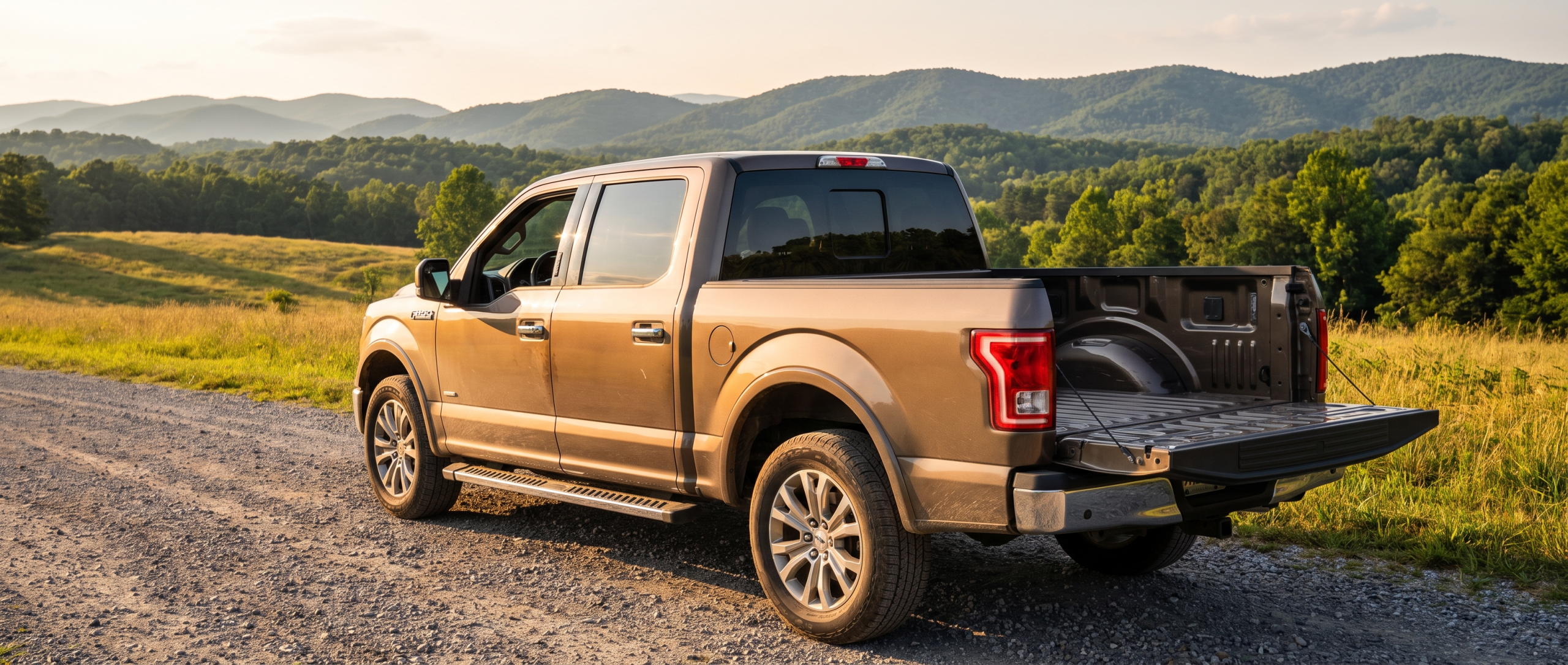
Buying a used Ford F-150 in Greer shouldn’t feel like defusing a bomb. Walk onto a lot without knowing which generation carries a cam phaser history that can turn into a costly major repair, though, and it starts to. Same goes for which recalls need closing before the tailgate drops. Here’s the short version. The 2019-2020 window (13th generation, sorted) and the 2022-2024 window (14th generation, past its early-build issues) are where the value lives right now. Everything else either needs a harder look or works for a narrower buyer.
We’ve been selling and servicing Ford trucks on East Wade Hampton Boulevard since 1937. The pattern at our service center tracks the documented NHTSA and Ford TSB record closely. Certain years come in clean. Others come in with known issues that should’ve been on the pre-purchase checklist.
Browse our used Ford truck inventory
- Sweet spot for most Greer buyers: 2019-2020 (13th gen, bugs sorted, cam phaser risk lessened vs 2015-2018) and 2022-2024 (14th gen, past early 2021 build-quality issues, redesigned cam phasers).
- Skip the 2018 5.0L V8 unless the compression test comes back clean. Documented oil consumption of 1-3 quarts per 1,000 miles hit a meaningful share of that engine.
- The 2021 model year is valid, but it carries more NHTSA recall paperwork than 2022-2024. Confirm every recall is closed, especially seat belt routing (NHTSA 21V653) on SuperCab builds.
- The 2015-2017 aluminum-body transition years have seen door latch, brake master cylinder, and cam phaser issues. They’re not poison, but they need more due diligence.
- Any year you tow with regularly: confirm the integrated trailer module recall (NHTSA 26S28, affecting 2021-2026 trucks) has been remedied at a Ford dealer before you hook anything up.
Which Years Are the Sweet Spot for a Used F-150?
The clearest buying windows on today’s used market are the 2019-2020 pair and the 2022-2024 stretch, and yes, they cost a bit more than the trouble years, but you’re paying for sorted engineering rather than a repair you’ll inherit. Below, the reasoning runs year by year so you can walk any lot with a straight frame of reference.
| Year Range | Generation | Sweet Spot? | Years to Watch, Why It Matters |
|---|---|---|---|
| 2014 | 12th gen (final year) | Yes, for budget builds | Last steel-body year, proven 5.0L Coyote V8, sorted generation, low recall count |
| 2015-2017 | 13th gen (early) | Proceed carefully | First aluminum-body years; teething issues documented across multiple NHTSA campaigns including door latch recall, cam phasers (3.5L / 5.0L), brake master cylinder |
| 2018 | 13th gen mid | Depends on engine | 2.7L EcoBoost is fine here; 5.0L needs compression and oil-consumption check; 5.0L V8 oil consumption documented at 1-3 quarts per 1,000 miles |
| 2019-2020 | 13th gen (refined) | Yes | Second-gen 2.7L became more reliable; cam phaser reports lessened (not eliminated); 5.0L oil consumption fixed for 2021; fewer issues than 2015-2018 |
| 2021 | 14th gen (launch) | Conditionally | Redesigned cam phasers are a genuine improvement; close all open recalls first; multiple early recalls (seat belt, insulator, trailer brake) |
| 2022-2024 | 14th gen (mature) | Yes | Most complete used-truck package; redesigned phasers show very few reported failures at 100k+ miles; verify towing recall ITRM (2021-2026) |
The 2014 deserves a word here. As the last steel-body F-150, it pairs a 5.0L Coyote V8 with a well-documented reputation for reaching 200,000 miles on disciplined oil-change intervals. For a real work truck with a solid frame, it’s tough to beat.
Which Years Should You Watch Out For?
Two things trip up Upstate SC used-truck buyers more than anything else, and neither one disqualifies a truck by itself, though both belong on your checklist before you sign anything. One is the cam phaser situation on the 3.5L EcoBoost. The other is that NHTSA towing recall now covering nearly the entire 14th generation.
Cam phasers, generation by generation. The 3.5L EcoBoost cam phaser issue shows up across F-150 forums and in multiple technical service bulletins. Going by verified owner reports and Ford’s own TSB history, the 2011-2016 3.5L models are the most affected window, with failures turning up as early as 60,000-80,000 miles on some trucks. Ford tried updates on the 2018-2020 generation, but phaser failures still got reported on 2018 and 2019 models. Then came the 2021 redesign of the cam phaser and timing system, and that’s a genuine engineering change. Forum data from owners running 100,000-plus miles on 2021+ 3.5L trucks shows far fewer reports. The risk isn’t zero, but the documented failure rate looks a lot lower.
The 5.0L V8 carries its own note. The 2018-2020 model years saw documented excessive oil consumption on that engine (not the 2.7L). Ford fixed the root cause from the 2021 model year forward. If you’re looking at a 2018 or 2019 5.0L, run a warm compression test and ask for service records showing oil-consumption history.
See available Ford F-150 trucks at D&D Ford Motors
NHTSA recalls to close before you sign. The federal recall record is your best due-diligence tool, and it’s free at nhtsa.gov/recalls by VIN. Focus on the campaigns that matter most for the used-buy window.
- NHTSA 21V653 (2021 SuperCab only): Front outboard seat belt may have been misrouted through the rubber trim sleeve without the metal anchor. Per NHTSA, approximately 16,430 SuperCab vehicles built January through May 2021 are affected. Consider it safety-critical.
- NHTSA 22V193000 (2021-2022): Software error that could stop a towed trailer’s electric brake system from working. The remedy is a software update.
- NHTSA 26S28 / 26S12 (2021-2026, towing): The integrated trailer module may lose communication with the vehicle during trailer towing, which knocks out trailer brake and signal lights. Per NHTSA, this affects 2021-2026 F-150 trucks. The remedy is a dealer software update. If you tow anything at Lake Hartwell or haul equipment up the Cherokee Foothills National Scenic Highway on SC-11, this one can’t wait.
- NHTSA 23V896 / 25S82 (2021-2025 with Trailer Tow Max Duty package): Rear axle hub bolt may fatigue and break on trucks fitted with the 9.75-inch heavy-duty axle. Per NHTSA recall 25S82, approximately 103,174 vehicles are affected. Dealers replace left and right rear axle shaft assemblies with revised geometry at no charge.
Schedule your used-truck recall check at D&D Ford Motors
Value Your Current Truck Before You Shop
Which Year Fits Which Buyer?
The right model year depends less on some abstract reliability ranking and more on what you’re actually going to do with the truck, so there’s no single winner here, only the best match for the job you have in mind. Sort by the job and it breaks down cleanly.
You haul and tow regularly, and reliability is the priority. Go 2022-2024 with the 3.5L EcoBoost or the 5.0L V8. The 14th generation fixed the oil-consumption issue on the 5.0L and redesigned the cam phasers. The EPA rates the 2022 5.0L V8 at 17 city / 24 highway (2WD). Close the ITRM recall and you’ve got a genuinely capable used work truck, the most modern F-150 package you can buy used.
You want maximum value per dollar and have mechanical confidence. The 2019-2020 with the 2.7L EcoBoost is your truck. Ford’s second-generation 2.7L is the most reliable turbocharged engine in this generation of the F-150. The EPA rates the 2020 2.7L at 20 city / 26 highway in 2WD configuration. Towing tops out at 8,500 pounds. Cam phaser history on the 2.7L runs cleaner than the 3.5L across every generation. Still, pull the VIN to confirm nothing from the 2019-2020 electrical or structural campaigns is open.
You want a real work truck and price is the driver. The 2014 5.0L V8 steel-body is the truck, deeply depreciated and the final year of the sorted 12th generation. The 5.0L Coyote in a well-kept 2014 routinely reaches 200,000 miles. Inspect the frame for surface rust (Upstate SC gets damp in summer) and check that the timing chain isn’t showing cold-start slack. Clear those boxes and you’ve got a straightforward truck.
You want the latest tech and can absorb slightly more recall paperwork. A 2021 works well, especially in SuperCrew body style (which sidesteps the seat belt recall affecting SuperCab builds). Close the documented campaigns first. The 14th-gen interior, Pro Power Onboard option, and SYNC 4 system all improve on the 13th generation. Call it a clear step up.
The honest caveat on the PowerBoost hybrid. Curious about the PowerBoost (2021+)? We know some buyers are, and the appeal is real. The tow numbers are impressive, and the Pro Power Onboard generator capability is genuinely useful. The early reliability record, though, has been rough. If that engine interests you, buy recent (2023-2024) to dodge the worst of the early build period, confirm any open recalls are closed, and factor in the added complexity.
Looking at heavier work? Browse used Ford F-250SD listings
We’re at 13655 East Wade Hampton Blvd in Greer. We’ve been here since long before I-85 was built. Call sales at (864) 877-0711 if you’d like us to pull a VIN report on a truck you’re considering somewhere else. You pay nothing for it, and we know these trucks well.
Frequently Asked Questions
What is the best year for a used Ford F-150?
For most buyers in 2026, the best mix of modern features and documented reliability sits in the 2019-2020 range (13th generation, sorted) or the 2022-2024 range (14th generation, past its launch-year recalls). A 2019-2020 with the 2.7L EcoBoost gives you a proven turbocharged engine with a cleaner NHTSA history than the 3.5L in that same generation. The 2022-2024 trucks benefit from Ford’s redesigned cam phaser system and the 5.0L oil-consumption fix that came with the 14th generation. Either way, run the VIN on nhtsa.gov before you commit.
Which Ford F-150 years should I avoid?
The years that call for the most caution are 2015-2017 (first aluminum-body generation, with documented door latch, brake master cylinder, and 3.5L cam phaser issues) and 2018-2020 5.0L V8 models with documented excessive oil consumption. None of these years is an absolute avoid, but each one demands a specific pre-purchase inspection that a buyer without a mechanical background can miss. The 2004-2008 generation with the 5.4L Triton V8 is a harder pass for most use cases, given its well-documented spark plug issues.
Do I need to worry about recalls on a used Ford F-150?
Yes, and it’s easy to check. Head to nhtsa.gov/recalls and enter the VIN of any used F-150 you’re weighing. For 2021-2026 trucks specifically, the integrated trailer module recall (affecting trailer brake and signal lights during towing) is open on a large number of vehicles. Per NHTSA, this affects 2021-2026 F-150 trucks, and the remedy is a dealer software update. If you’ll tow regularly in Upstate SC, confirm it’s closed at a Ford dealer before you buy.


