

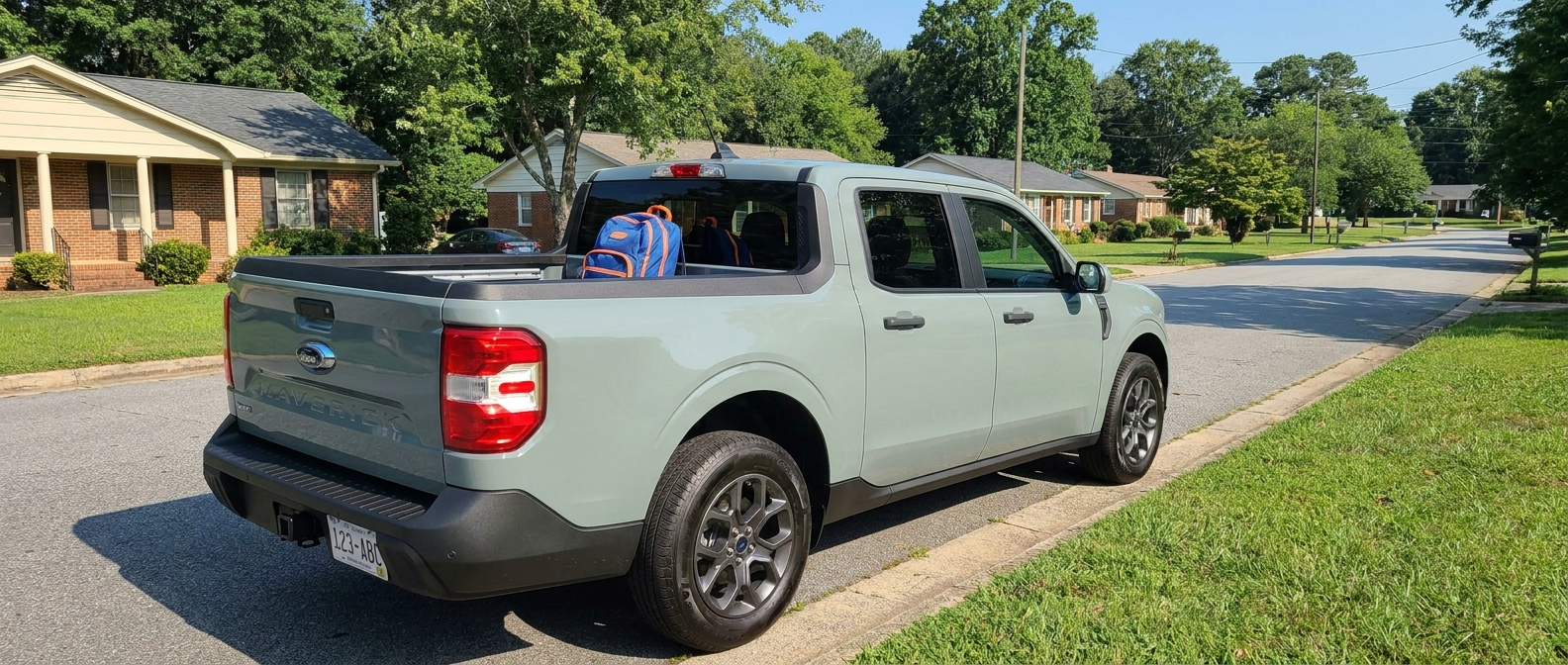
If you run a daily school drop-off loop through Taylors, you’re loading your tires with a kind of stress that the standard “rotate every 7,500 miles” rule was never built for. Wade Hampton Boulevard and the neighborhood feeders off it are exactly the stop-and-go, short-trip, low-speed-braking territory that chews through front tread faster than a highway commute ever does. Your rotation interval depends on your drivetrain first and your daily route second. Get those two right and you’ll pull meaningfully more life out of a full set.
Book your tire rotation at D&D Ford Motors in Greer
- FWD vehicles (Ford Escape, Ford Maverick Hybrid): rotate every 5,000 miles on stop-and-go drop-off routes; use the forward cross pattern
- RWD trucks (Ford F-150 standard, Ford Ranger, Ford Mustang): every 5,000-7,500 miles; use the rearward cross pattern (note: staggered Mustang fitments are side-to-side only)
- AWD/4WD vehicles (Ford Explorer, Ford Expedition, Ford Bronco): every 5,000 miles; use the X-pattern; tread depth must stay within 2/32″ across all four to protect the drivetrain
- The real tradeoff: shorter intervals cost a little time at the service counter; skipping them on a drop-off route can cost you a full set of tires earlier than you expect
- Drop-off driving qualifies as severe service under Ford’s maintenance guidelines (meaning the shorter end of the mileage range is the right call, not a dealership upsell)
What Actually Matters When Choosing Your Rotation Interval?
Two variables set your rotation schedule, and the order of them matters, because your drivetrain type comes first and your daily driving comes second, both of them reshaped by the drop-off run in ways most general tire guides never stop to address. Nail those two and the interval on your schedule will line up with the wear on your tires.
| Drivetrain | Ford Models | Rotation Interval (drop-off route) | Rotation Pattern | Key Tradeoff |
|---|---|---|---|---|
| FWD | Escape, Maverick Hybrid, Bronco Sport FWD | Every 5,000 miles | Forward cross | Front tires do triple duty; longest wear gap without rotation |
| RWD | F-150 (2WD), Ranger (2WD), Mustang | Every 5,000-7,500 miles | Rearward cross | Staggered Mustang trims: side-to-side only, no front-to-rear swap |
| 4WD (part-time) | F-150 4WD, Ranger 4WD, Bronco | Every 5,000-7,500 miles | Rearward cross or X-pattern | Frequent 4WD engagement means shorter interval |
| AWD (full-time) | Explorer AWD, Expedition, Maverick AWD | Every 5,000 miles | X-pattern | Tread depth mismatch stresses AWD drivetrain components |
The Ford Scheduled Maintenance Guide sets the general window at every 5,000 to 7,500 miles, and that spread exists because driving conditions vary. Drop-off routes live at the demanding end.
The Driving Pattern That Changes Your Interval
Stop-and-go drop-off routes around Taylors wear tires for one mechanical reason, and it comes down to where the braking load lands, because front brakes handle roughly 70% of braking force on most vehicles and every school-zone slowdown, bus stop, and tight turn dumps that force onto the front tires. On a 2026 Ford Escape or Maverick Hybrid, both front-wheel drive, the front axle is already juggling steering articulation, engine torque, and braking force at the same time. Add a daily drop-off loop on top and the fronts wear measurably faster than the rears.
That wear gap is the problem. Without rotation, the FWD front tires can be significantly worn while the rears still carry most of their original tread (that gap is what forces the early replacement). You wind up buying two tires early while the other two still have life left. That costs more every time.
See the 2026 Ford Maverick lineup at D&D Ford
Here’s a pattern we can stand behind at the service counter. Fords driven almost entirely on short urban trips show disproportionate front-edge wear next to Fords that mix in regular highway miles. None of that’s luck. It comes straight from the physics of repeated low-speed braking and tight turns, and Wade Hampton Boulevard’s stop-and-go rhythm between Taylors and Greer runs that exact pattern.
Explore the 2026 Ford Escape at D&D Ford Motors
Match the Gear to How You Drive
The right rotation pattern isn’t optional, and your drivetrain decides it completely, so running the wrong one only shuffles the tires around from corner to corner without ever addressing the underlying wear imbalance that rotating is meant to correct in the first place. Match the pattern to your drive layout and every service visit actually earns its keep.
FWD (Ford Escape, Ford Maverick Hybrid, Ford Bronco Sport FWD): The forward cross moves the rear tires straight up to the front on the same side while the fronts cross diagonally to the opposite rear corners. It offsets the front axle’s triple load. On a daily drop-off route, this is the pattern that pays off most, because it hands your overworked front tires a rest cycle at every service visit.
RWD trucks and the Ford Mustang (Ford F-150 standard, Ford Ranger 2WD, Ford Mustang): The rearward cross runs the mirror image, with the rear tires crossing forward and the fronts sliding straight back. The Mustang carries one hard exception. Performance trims with staggered tire sizes, wider rears than fronts, can’t rotate front-to-rear at all, so those setups are held to side-to-side rotation within each axle pair, and only when the tires are non-directional. Bring your Mustang to us and we’ll confirm which pattern fits your specific build.
AWD and 4WD (Ford Explorer AWD, Ford Expedition, Ford Bronco, Ford F-150 4WD): AWD systems are the most sensitive to tread-depth variation across all four positions. A mismatch greater than 2/32″ of tread depth forces the system to work against itself and piles mechanical stress on the transfer case and differentials. The X-pattern, where all four tires cross-swap positions, is the recommended approach. For full-time AWD vehicles on drop-off routes, the 5,000-mile interval isn’t a suggestion. It guards the drivetrain, not just rubber.
During back-to-school season in Greenville County, more than 380 active bus routes hit local roads as early as 6 a.m., with Taylors-area feeders running the same residential streets most families use for drop-off. That piles on more stop-and-go repetition on your tires before you even reach work.
Schedule Your Tire Rotation at D&D Ford
The tradeoff is straightforward. Rotating at 5,000 miles instead of 7,500 means one extra service visit a year for most drop-off drivers, which is real time and a real inconvenience. Catching a rotation early still beats replacing a full set because one axle wore out ahead of the other. Pair the rotation with a tread-depth check and a pressure inspection at the same visit and you’ve done everything the Ford maintenance guide asks of you.
Browse 2026 Ford Explorer options at D&D Ford Motors
Since 1937 we’ve served the Carolinas, and in that stretch tire maintenance has been skipped more than almost any other item on the service schedule. Drivers do care. The trouble is that the 7,500-mile rule feels like plenty of runway, and on a drop-off route it isn’t. Trust your drivetrain type and the Ford maintenance window, and let us handle the pattern.
Frequently Asked Questions
Does the rotation pattern really differ between my Ford Maverick Hybrid and my neighbor’s F-150?
Yes, and the difference matters. The Ford Maverick Hybrid is front-wheel drive, so the correct pattern is the forward cross: rear tires move straight to the front, front tires cross diagonally to the opposite rear corners. A standard rear-wheel-drive Ford F-150 uses the rearward cross pattern: rear tires cross to the front, front tires move straight to the rear. Running the wrong pattern on either vehicle still moves the tires, but it doesn’t address the wear imbalance that’s actually building up on your specific drivetrain. Check your owner’s manual or bring it to our service center on East Wade Hampton Boulevard and we’ll confirm the right pattern for your trim before we touch anything.
How do I know if my Ford AWD vehicle needs a 5,000-mile rotation or a 7,500-mile one?
If your Ford is a full-time AWD vehicle used primarily for short-trip, stop-and-go driving (including daily school drop-off loops in the Taylors area), the 5,000-mile interval is the right call. AWD systems are engineered to work within a tight tread depth window across all four tires. When any one tire wears significantly faster than the others, the system has to compensate mechanically, which adds stress to transfer case components over time. The Ford Scheduled Maintenance Guide sets the 5,000-to-7,500-mile window for a reason: the lower end covers exactly this kind of driving. If you also use your vehicle for frequent highway miles, you’re probably fine at 6,000 or 7,000. When in doubt, rotating at 5,000 is never wrong.


