School zones don’t care how few miles are on your odometer. In Greer, South Carolina, the posted speed limit drops to 20 mph in active school zones, and if you’re running a school-run route past Greer High School on East Gap Creek Road, or any of the area’s 21 public school campuses, you’re hitting that brake pedal in a tight, repetitive pattern twice a day, five days a week, nine months straight. That kind of stop-and-go wears Ford brakes differently than highway miles do. Right now, in mid-August, is the moment to know where your truck or SUV stands before the first bell rings.
The short answer is simple. If your Ford has gone more than two years without a brake inspection, or if you’ve been running school carpool, get it checked before August ends.
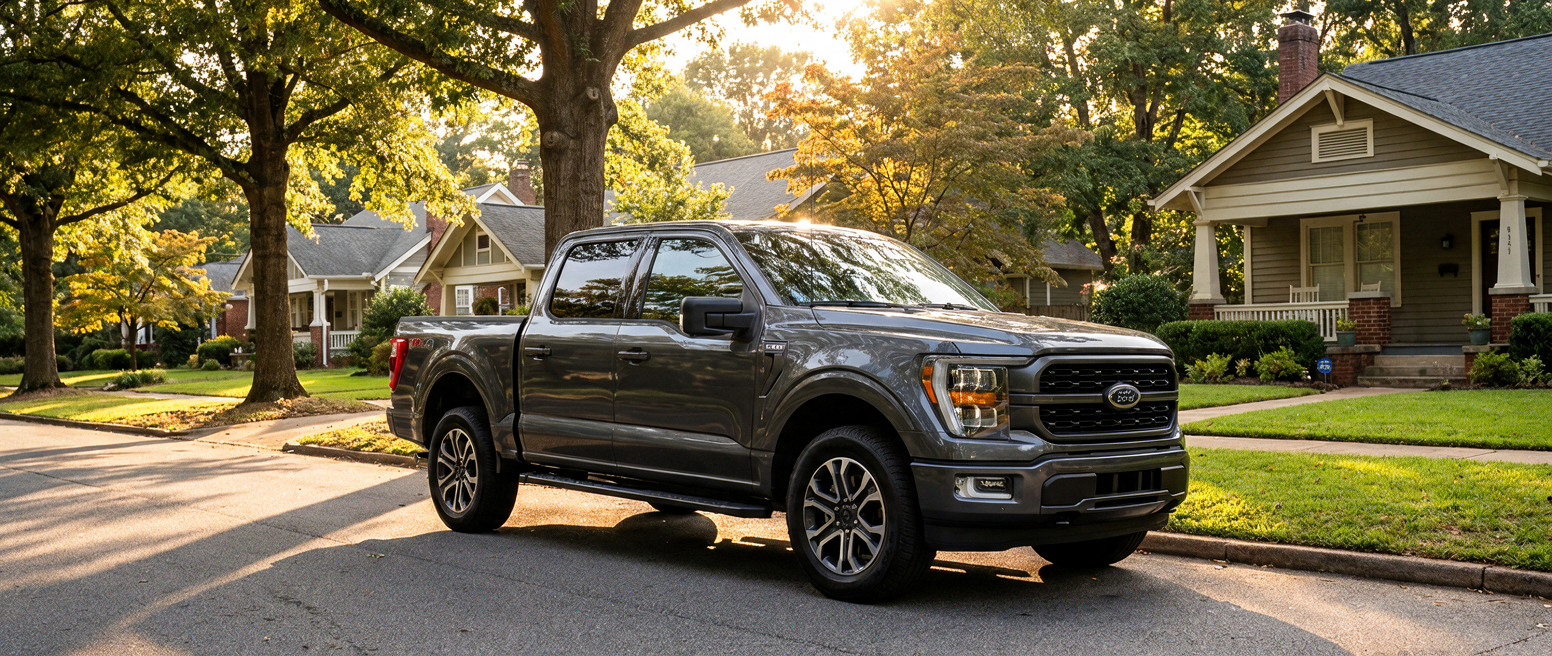
The Ford F-150 is a common sight on the school-run routes around here, and it’s one where our team notices brake wear that doesn’t line up with the mileage on the dash.
How Much Does School-Zone Driving Actually Wear Your Ford’s Brakes?
Quite a bit more than the mileage alone suggests, because the wear comes from heat cycling rather than distance. Highway braking is one long, gradual application that spreads heat across the rotor over distance. School-zone braking works the other way, stacking a dozen or more short, moderate stops into each drop-off window and generating a heat cycle every time without giving the rotors enough runway to cool between them.
Ford’s factory service documentation sets brake pad minimum lining thickness at 3 mm for the F-150, front and rear. That number matters, because pads worn below it put the metal backing plate in contact with your rotor, turning a straightforward pad replacement into a rotor replacement too. School-run driving shortens the gap between fine and due faster than the odometer suggests, and the wear is real whether you’re at 25,000 miles or 75,000.
Our service team leans on this decision table. It maps what you’re seeing and feeling to what the brakes likely need.
| What you notice | Likely pad depth | What it means | How urgent |
|---|---|---|---|
| No noise, firm pedal, normal stopping | Above 4 mm | Healthy, on schedule | Inspect at next service |
| Faint squeal at low speed only | Near 3 mm | Wear indicator making contact | Schedule within two weeks |
| Consistent squeal on every stop | 2 to 3 mm | Approaching minimum threshold | Schedule this week |
| Grinding, vibration, or pulling | Below 2 mm | Metal-on-metal contact possible | Stop driving; service today |
| Soft or spongy pedal feel | Varies | Brake fluid or caliper issue | Immediate inspection |
| Brake warning light on at startup | Varies | System fault or fluid level low | Do not delay |
The squeal at low speed is deliberate. Ford engineers it in as a wear indicator, a small metal tab set to contact the rotor right when the pad lining runs low. The tab is doing exactly its job. A grind is different, and it means that tab is long gone and the backing plate is next to make contact.
Schedule Your Ford Brake Inspection
Where and When Should Greer Drivers Schedule Ford Brake Service?
The best place is right here in Greer, and the best time is right now in August, though that timing isn’t about a sales calendar. It comes down to what brake fluid does in the heat and humidity Greenville County delivers every summer. We’re at 13655 East Wade Hampton Blvd, which puts us on the same corridor that feeds into the school-zone traffic patterns across this part of Upstate SC.
Does topping off the reservoir fix a fluid problem? No. Brake fluid is hygroscopic, meaning it absorbs moisture from the air over time, and as that moisture content rises, the boiling point drops. Under the repeated heat cycles of school-zone driving, degraded fluid can reach its boiling point before your brakes finish doing what you need. Ford recommends testing brake fluid condition at around 45,000 miles or three years, whichever comes first. Ford’s owner’s manual content specifies DOT 4 Low Viscosity High Performance brake fluid for vehicles with vacuum brake booster systems. If you’re at or past that interval, the fluid test matters as much as the pad measurement.
Our team checks pad depth, rotor condition, caliper operation, and fluid quality in every brake inspection. Book a service appointment online and we’ll get you in before the school year is in full stride.
A quick check before the first school run of the year:
- Pedal feel is firm and consistent with no sponginess under light pressure
- No grinding, pulling to one side, or vibration when slowing to a stop
- Brake warning light is off on a cold start after the engine warms up
- Pad lining visible through the wheel looks thicker than a pencil eraser (roughly 4 to 5 mm)
- Rotor faces show no deep grooves or heavy rust streaking
Plan It This Way Before August Ends
How you plan this depends on how fresh your pads are, and there’s a real tradeoff worth naming in the timing. If your Ford is running new or near-new pads, a school-run schedule isn’t an emergency, so you can fold a brake inspection into your next routine oil change visit. Ford’s multi-point inspection covers pads, rotors, and fluid levels at every scheduled maintenance interval regardless, so it doesn’t need to be a separate trip.
The scenario that costs you is waiting past the squeal. Pads worn below the 3 mm lining minimum can score rotors within a few weeks of school-run driving. Wait too long and a pad job on one axle becomes a pad-and-rotor job. That’s avoidable with earlier action.
If you’re hauling kids in a Ford Expedition, factor in the weight. The Expedition is heavy, and that weight burns through rotors faster. No way around it. The 3 mm minimum still applies, and Ford’s inspection intervals still govern, but the rate of wear getting there runs faster than in a lighter vehicle, so inspection timing matters even more when you’re loading up for school runs.
The same logic applies to the three-row Ford Explorer that a lot of Greer families run as a daily school shuttle. These vehicles work hard every morning and afternoon from August through May, and the brakes show it.
The plan itself is simple. Schedule a brake inspection now, before school starts. If everything measures out healthy, you know where you stand and you’re set for the year. If the pads are close or the fluid tests below threshold, we handle it in the same visit. Either way, you head into school-run season knowing your stopping distance is what Ford engineered it to be. We’ve been doing this in Greer since 1937. We’re not going anywhere.
Frequently Asked Questions
Do school zone stops really wear out Ford brakes faster than regular driving?
Yes, and the reason is heat cycling. Highway braking is one long, gradual application that gives rotors time to cool over distance. School-zone driving produces many short stops in a tight window, each generating a heat cycle without full cool-down between them. Repeated heat cycling accelerates both pad material wear and the thermal degradation of brake fluid. Ford’s minimum pad lining threshold of 3 mm applies regardless of how you got there, but stop-and-go school-run driving can get you there at fewer miles than you’d expect from straight highway use.
How do I know if my Ford’s brake fluid actually needs service?
The reservoir level alone is not a reliable indicator. Brake fluid is hygroscopic, meaning it absorbs moisture from the air continuously, and a full reservoir can still contain fluid with a significantly reduced boiling point. Ford recommends testing brake fluid condition at approximately 45,000 miles or three years. Our service team runs a condition test that measures moisture content directly. If moisture is above the acceptable threshold, a fluid exchange brings it back to spec and restores the boiling point your brake system was designed to rely on.
My Ford only has 30,000 miles. Do I really need a brake inspection already?
Mileage tells part of the story, but driving pattern tells the rest. If those 30,000 miles included two school years of carpool runs, stop-and-go commuting through Greer, or regular towing, your brakes have worked considerably harder per mile than the odometer reflects. Ford’s scheduled maintenance includes a brake pad and rotor inspection at every service interval regardless of total mileage, precisely because driving pattern matters as much as distance. A quick inspection at D&D Ford gives you a real measurement rather than a guess, and in most cases it takes no longer than an oil change visit. *By the D&D Ford Motors Team | August 2026*


