
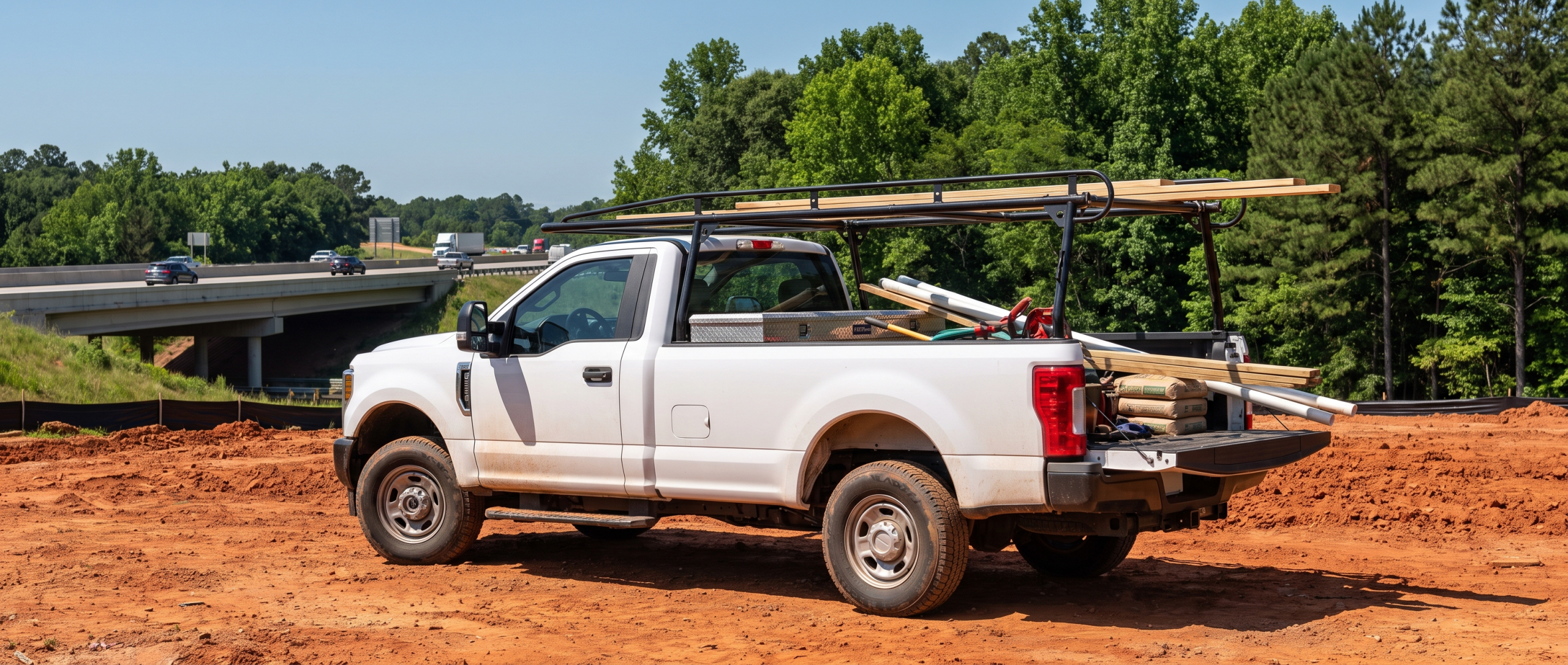
If you run a trade crew anywhere along the I-85 corridor through Upstate South Carolina, the truck you drive isn’t a lifestyle choice. It’s a tool with a payload sticker and a job to do. Our starting recommendation is the 2026 Ford F-150 with the PowerBoost Full Hybrid and the 7.2 kW Pro Power Onboard option, for most general contractors who want one truck that hauls a crew, tows a loaded trailer, and drops the generator. We’ll walk through all four picks below, including where the F-150 stops being enough and you need to move up.
The Ranking at a Glance
| Rank | Pick | Best For | Standout Spec |
|---|---|---|---|
| 1 | Ford F-150 PowerBoost | Mid-size contractor crew, on-site power | Up to 7.2 kW Pro Power Onboard, 11,600 lb tow (Ford-verified) |
| 2 | Ford F-250 Super Duty | Heavy equipment, gooseneck trailers | Up to 23,000 lb tow, 4,246 lb payload (Ford-verified) |
| 3 | Ford F-350 Super Duty | Major haul, fifth-wheel, fleet use | Up to 38,000 lb gooseneck tow, up to 8,000 lb payload (Ford-verified) |
| 4 | Ford Ranger | Solo sub, light tools, daily driver | 7,500 lb tow, up to 1,767 lb payload (Ford-verified) |
The Ford F-150 PowerBoost Is the Contractor’s Swiss Army Knife
Most contractors in the Upstate don’t need a Super Duty every day, and the 2026 F-150 with the 3.5L PowerBoost Full Hybrid V6 handles the bulk of trade work with 11,600 lbs of towing and up to 2,440 lbs of payload, per Ford’s towing guide. That covers most enclosed utility trailers, single-axle equipment trailers, and skid steers in the lighter class. What makes it different for job-site work is the available 7.2 kW Pro Power Onboard system (available on select trims with the PowerBoost engine), which Ford lists as delivering 120V and 240V outlets directly in the cab and bed. No separate generator eating bed space. No gas to haul for a second engine.
The tradeoff is real, though. Once you’re regularly pulling something past 12,000 lbs, or you need the payload headroom a framing crew with materials demands, the F-150’s frame is a light-duty platform and it’ll feel it. For contractors running BMW plant supply-chain jobs or bigger commercial builds along the I-85 growth corridor, that ceiling matters. But for HVAC, electrical, plumbing, and landscaping crews doing multiple daily stops, this is the one we’d tell you to drive first.
See our Super Duty inventory if your trailer pushes past that range.
View Current Work Truck Specials
The Ford F-250 Super Duty Handles the Heavy Work
When your job requires pulling excavators, loaded flatbeds, or tandem-axle equipment trailers, the F-250 is where the conversation has to start, and Ford rates the 2026 F-250 Super Duty at up to 23,000 lbs of conventional towing and up to 4,246 lbs of payload when properly configured. The available 6.7L Power Stroke turbo-diesel V8 is the engine most serious contractors spec here. It puts out 500 horsepower and 1,200 lb-ft of torque in high-output form, according to Ford’s Super Duty specifications.
The F-250 is also the practical daily-driver boundary. It’s a heavy-duty truck, but a single-rear-wheel F-250 still fits a normal parking space and doesn’t feel like piloting a commercial vehicle around town. Subcontractors who need serious numbers on the weekend but are also doing supply runs through downtown Greer appreciate that. The F-250 is where we see contractors land when they outgrow the F-150 and aren’t quite ready to commit to a dually.
There’s a real tradeoff on the diesel. It costs more to maintain than a gas-powered truck, so if you’re not logging serious towing miles, the 7.3L gas V8 (405 horsepower, 445 lb-ft torque, up to 17,300 lb tow, in Ford’s published specs) is a capable, lower-maintenance option that a lot of buyers overlook.
The Ford F-350 Super Duty Is Built for Fleet and Fifth-Wheel Work
The 2026 Ford F-350 Super Duty earns its place the moment your trailer has a fifth-wheel or gooseneck connection, and in dual-rear-wheel form Ford rates it at up to 38,000 lbs gooseneck towing and up to 8,000 lbs of payload. That’s a number most single-truck contractors will never push, but it matters because it builds in a genuine safety margin. Running a loaded 24-foot gooseneck flatbed at 22,000 lbs in a properly spec’d F-350 DRW is a different experience than running that same load at the edge of an F-250’s rating.
The dually configuration is the real differentiator here, and it comes with a downside you should know going in. A dually F-350 is noticeably wider than a standard truck, which creates real friction in tight job sites, parking structures around the GSP corridor, and narrow commercial districts. For contractors who live in the truck and work predominantly on open commercial sites, it’s not an issue. For someone making daily material runs through tight neighborhoods, it adds friction every single day.
The Ford Ranger Is the Right Call for Solo Subs
The 2026 Ford Ranger doesn’t belong at the top of a contractor list, but it belongs on it, and a solo electrician, trim carpenter, or specialty subcontractor who drives a lot of highway miles between sites, runs mostly hand tools, and doesn’t tow anything heavier than a single-axle utility trailer gets real utility from one. Ford rates it at up to 7,500 lbs of towing and up to 1,767 lbs of payload with the Trailer Tow Package, per Ford’s Ranger specifications. That covers a lot of working scenarios.
The honest case against it for contractor work is straightforward. A crew of two or three with full gear bags, material runs, and a loaded trailer will hit the Ranger’s payload ceiling faster than the spec sheet makes it look. It’s conventional-hitch only (no fifth-wheel or gooseneck rating), and the bed’s genuinely shorter than a full-size. For a solo operator or a small electrical sub running mostly service calls, it’s practical. For anyone who regularly has two people and a bed full of materials, step up to the F-150.


