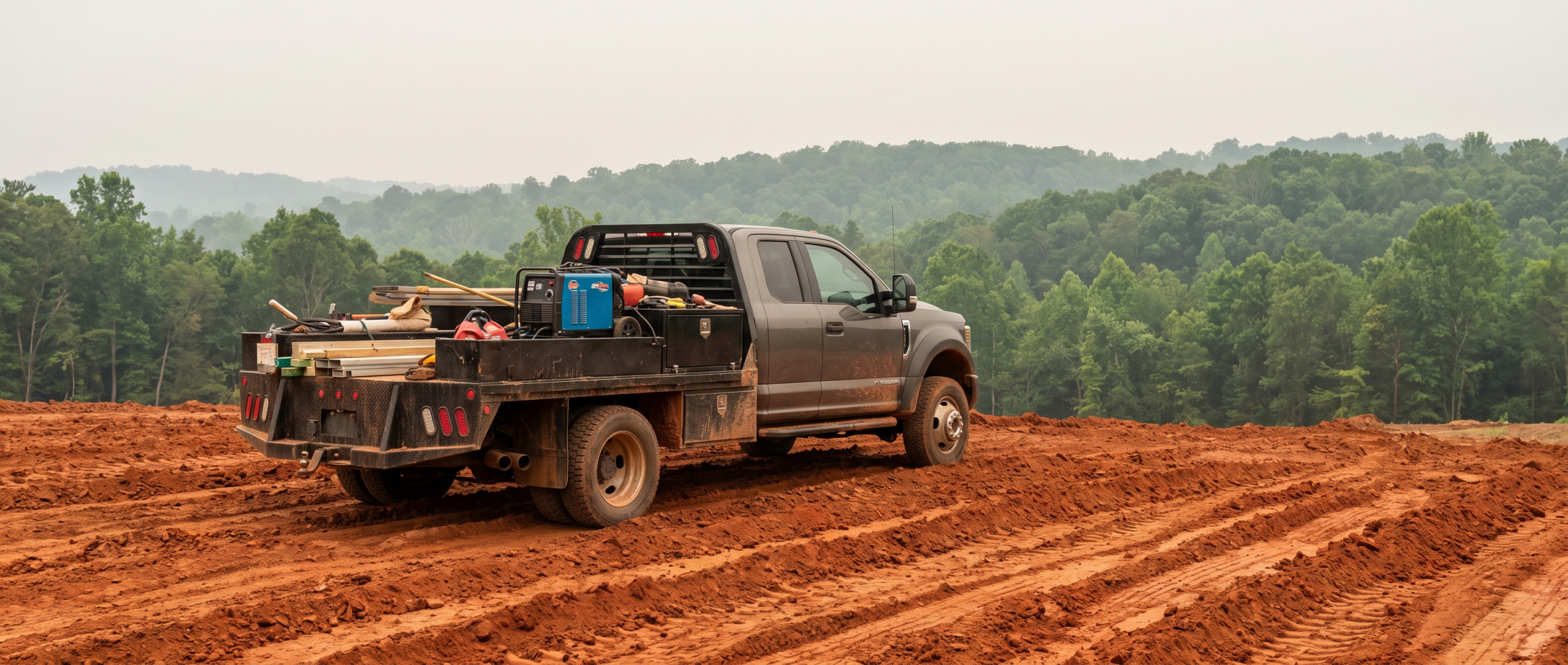
You cleared the I-85 pull hauling your excavator just fine, so you figured the truck was specced right. Then you started loading clay spoil off a Greer subdivision cut and the rear end squatted before the bed was even half full. The engine isn’t the problem. Neither is a bad tire. Grading and excavation work in Piedmont South Carolina runs into a specific mismatch, where crews size their Super Duty for towing the machine, then find that hauling Upstate’s dense red clay is a payload problem more than a towing one. We’ll walk through what’s going on and how to spec the right truck for the work you’re doing.
Browse our 2026 Ford Super Duty lineup at D&D Ford Motors
What’s Actually Going Wrong With Your Work Truck?
The truck feels underpowered, but that’s rarely the diagnosis for a grading or excavation crew in Upstate SC, where a Super Duty that squats hard under load, brakes poorly with a full dump insert, or struggles to cycle a hydraulic body is almost always hitting its payload ceiling, not its towing limit. Ford rates the 2026 F-350 Super Duty DRW at up to 8,000 pounds of payload in the right configuration. Piedmont red clay runs roughly 2,600 to 2,800 pounds per compacted cubic yard. A three-yard haul hits 8,000 pounds before you’ve counted the dump insert sitting on top of the bed. That math changes which model you need.
| Symptom on the Job Site | Likely Cause | What to Address |
|---|---|---|
| Rear end squats before the bed is full | Payload ceiling reached, or SRW under a DRW-class load | Step to DRW; check your door-jamb payload sticker first |
| Sluggish pull leaving a loaded site | Engine not delivering low-RPM torque for the load | Consider the 6.7L Power Stroke diesel; torque peaks at 1,600 RPM |
| Dump body won’t cycle or cycles slowly | No PTO provisions ordered, or undersized PTO | Spec diesel with PTO; Ford lists up to 300 lb-ft of diesel PTO torque |
| Trailer sway with the excavator in tow | GVWR/GCWR not verified, only tow rating checked | Add Onboard Scales with Smart Hitch to monitor pin weight in real time |
| Fine empty, sketchy when loaded | Payload exceeded before tow rating is touched | Pull the door-jamb sticker; actual payload may be well below the model max |
The Real Culprit: You Specced the Tow Rating and Ignored Payload
The culprit here is a spec you probably didn’t scrutinize, since towing numbers close the deal while payload numbers sit quietly in the fine print, and a crew that checks only the tow rating gets caught out the first time the bed does the work instead of the hitch. The 2026 Ford F-250 Super Duty with the High-Output 6.7L Power Stroke diesel can tow up to 23,000 pounds. That covers every mini-excavator or skid-steer a grading crew is going to put on a gooseneck, so the F-250 looks right on paper.
The problem surfaces the moment you switch from towing mode to hauling mode. Ford lists the 2026 F-250 at a maximum payload of 4,246 pounds, a figure that holds for one specifically configured truck (and dense red clay from a Greer subdivision cut chews through it fast). Add the weight of a two-and-a-half-ton dump insert sitting in the bed and there’s almost nothing left.
Greer sits in the Piedmont region of Upstate South Carolina. The clay there doesn’t haul like topsoil.
The 2026 Ford F-350 Super Duty changes the math. In DRW trim with the Heavy-Duty Payload Package, Ford rates it at up to 8,000 pounds of payload capacity. It reads plainly on a brochure, yet it’s the highest payload rating in the non-commercial Super Duty pickup lineup, and it’s what grading crews need when the job goes from pulling to hauling. The DRW rear also steadies the truck under a loaded dump insert in a way a single-rear-wheel setup can’t come close to matching.
The tradeoff is honest. A dually adds width, and that’ll matter on narrow residential lot access roads. If your crew spends most of the day towing the machine and only occasionally hauls material in the bed, a well-configured F-250 may be the right call. Run dump bodies on the majority of your jobs and the F-350 DRW is the truck. The F-250 is undersized for that work pattern.
Print-and-Go Checklist: Speccing a Super Duty for Grading and Excavation Work
- [ ] Decide payload-first or tow-first (most grading and excavation crews need payload-first)
- [ ] SRW vs. DRW: DRW for dump bodies and heavy material hauling; SRW for primarily gooseneck towing
- [ ] Engine: 6.7L Power Stroke diesel for PTO hydraulics or daily high-mileage hauls; 7.3L gas for lower upfront cost and simpler DEF-free maintenance
- [ ] Order PTO provisions on diesel models if you’re running a PTO-driven hydraulic dump pump
- [ ] Request Pickup Box Delete (option code 66D) if mounting a dedicated dump body instead of the stock bed
- [ ] Confirm upfitter switches are included (factory-rated wiring for body lighting, air compressor, and hydraulic controls)
- [ ] Verify Onboard Scales with Smart Hitch is configured (real-time payload and pin weight, visible in-cab)
- [ ] Pull the door-jamb sticker on the specific unit before you order the upfit body
Gas, Diesel, and When to Bring In Our Service Team
The engine choice comes down to how you actually run the truck, so the split is clean once you know your pattern, with the diesel earning its keep on PTO hydraulics and loaded daily miles while the gas V8 fits crews that mostly tow and rarely haul material in the bed. A lot of grading crews try to sort this out alone and end up with the wrong order.
If you’re running a PTO-driven hydraulic dump pump, the diesel is not optional. Ford offers PTO provisions on diesel-equipped 2026 Super Duty models only. Diesel PTO delivers up to 300 lb-ft of torque through a 10-bolt mounting pattern built for larger PTO devices. The standard 6.7L Power Stroke produces 475 horsepower and 1,050 lb-ft of torque, with peak torque arriving at 1,600 RPM. That engine pulls clean on a loaded red-clay haul instead of lugging through gear changes on a subdivision grade.
If you’re mostly towing and rarely hauling material directly in the bed, the 7.3L “Godzilla” gas V8 is a legitimate option. Ford lists it at 430 horsepower and 485 lb-ft of torque. It carries a lower upfront cost, skips DEF fluid management entirely, and is easier to service for crews that aren’t running to high mileage. Diesel earns back its cost fastest on daily high-mileage, heavy-load patterns.
What you shouldn’t sort out alone is the full upfit order sheet. Picking the Pickup Box Delete option, pairing it with the right upfitter switches, PTO provisions, and alternator spec is exactly the kind of pre-delivery conversation our service team works through with commercial customers. An incorrect upfit order can mean months of back-and-forth with the body installer. We’d rather catch it before the order ships.
One more spec is worth noting. The 2026 Super Duty also includes Pro Power Onboard, which delivers up to 2 kW of generator power for jobsite tools directly from the truck. It won’t replace a trailer-mounted generator on a big cut, but it’s genuinely useful for a compactor, power tool, or jobsite light when you don’t want to unload the trailer to plug something in.
Talk to Our Service Team About Your Work Truck Build
Frequently Asked Questions
Do I need the diesel for excavation and grading work in Upstate SC?
Not in every configuration, but for most grading and excavation builds, yes. If you’re running a PTO-driven hydraulic dump body, the diesel is required (Ford only offers PTO provisions on diesel-equipped 2026 Super Duty models). If you’re towing an excavator or skid-steer on a gooseneck and hauling spoil occasionally, the 7.3L gas V8 at 430 horsepower and 485 lb-ft of torque is capable and easier to service. The diesel justifies its cost on high-mileage, heavy-load daily patterns where its 1,050 lb-ft of torque and diesel exhaust braking deliver real operational value across a full work week.
F-250 or F-350 for a grading crew running a dump body?
The F-350 DRW. Ford rates the 2026 F-350 Super Duty DRW with the Heavy-Duty Payload Package at up to 8,000 pounds of payload, which covers most dump-body material hauls on residential and light commercial grading jobs. The 2026 F-250 tops out at 4,246 pounds of payload (enough for trailer towing work, but clearly undersized when you’re loading Piedmont clay directly into a dump insert multiple times a day). If your jobs scale up to industrial sitework with a full commercial dump body, that’s when the F-450 or F-550 chassis cab becomes the right conversation to have with us.
By the D&D Ford Motors Team | July 2026


