

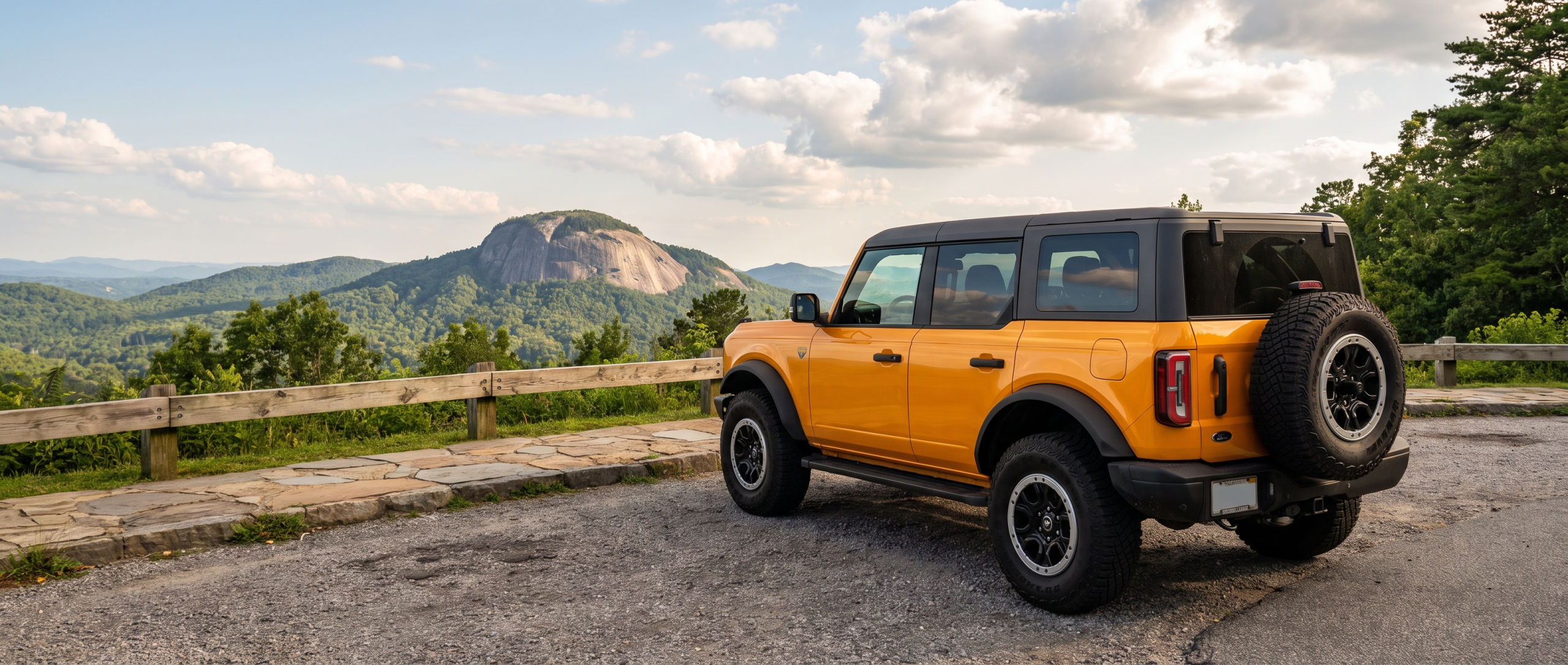
Greer sits right on I-85, which means Table Rock State Park is one of the easiest mountain escapes in the Carolinas — about an hour northwest on the Cherokee Foothills Scenic Highway. The problem is that the drive to Table Rock is just the warm-up. The park road, the trailhead lots, and the access routes off SC-11 throw actual conditions at your vehicle: loose gravel, steep grades on a fully loaded rig, standing water after the afternoon thunderstorms that roll through the Blue Ridge in summer, and tight switchbacks heading into the park’s upper lots. The 2026 Ford Bronco was engineered for exactly this sequence — highway comfort for the SC-11 leg, genuine off-road capability for the terrain that waits on the other end.
Why does the Bronco fit the Table Rock run so well?
The terrain between Greer and Table Rock covers three distinct phases, and most vehicles handle two of them without issue. The Bronco is built to handle all three.
| Local Condition / Use | Bronco Feature That Handles It | Why It Matters on This Route |
|---|---|---|
| SC-11 curves + loaded gear for a full-day hike | 300 hp / 325 lb-ft torque from the 2.3L EcoBoost, 10-speed automatic | Maintains highway speed on the uphill sections without hunting gears under load |
| Gravel park roads and unpaved access routes near the trailhead | Up to 11.6 in. ground clearance (Sasquatch) | Clears the rutted gravel lots and uneven surfaces without undercarriage contact |
| Summer afternoon thunderstorms — standing water and mud | 33.5-inch water fording capability; standard 4×4 with low-range | Crosses the runoff crossings that accumulate on the park road after heavy rain |
| Steep 2,000 ft ascent with full camping or hiking load | Trail Control (available) manages throttle and braking at low speed | Lets the driver focus on steering the narrow trail; no throttle hunting on gradient |
| Tight switchbacks near the upper parking area | Trail Turn Assist (available) locks the inside rear wheel in sharp turns | Tightens the turning radius on the switchback approaches into the park |
| Post-hike cleanup — muddy boots, wet gear, dogs | Bronco’s standard washout-capable interior with built-in floor drains | Hose it out when you get home; no carpet damage to worry about |
The grade from SC-11 into the park is where the engine choice pays off
Greer shoppers comparing trim levels usually focus on the exterior packages and seat materials — and then get surprised when they are two miles up a loaded mountain grade. Ford lists the 2026 Bronco’s base 2.3L EcoBoost four-cylinder at 300 horsepower and 325 pound-feet of torque, which is genuinely capable for most runs. But the available 2.7L EcoBoost V6 bumps output to 330 horsepower and 415 pound-feet of torque, and that extra torque delivers a real benefit when you are carrying four people plus camping gear on the sustained inclines that begin once you leave the valley floor.
Table Rock Mountain sits at 3,124 feet, and the main trail climbs 2,000 feet in 3.6 miles. That elevation does not stop at the trailhead — the road inside the park rises steadily from the SC-11 gate to the nature center and upper lots, often on unpaved or poorly surfaced sections. A vehicle that is already managing its transmission aggressively on the approach road arrives at the trailhead already working hard. The Bronco’s 10-speed automatic holds gears well under load rather than hunting between them, which keeps the drivetrain in a useful power band all the way to the parking area.
Four-door or two-door: the Table Rock gear question
Gear volume is a real decision when you are planning a full-day summit hike with extra water, layers for the summit (temperatures drop at elevation even in July), and possibly overnight camping at the park’s Foothills Trail campsites. Ford rates the four-door 2026 Bronco at up to 83 cubic feet of cargo capacity with the rear seats folded, compared to 52 cubic feet in the two-door configuration. For a crew of two or more adults carrying a full day’s worth of mountain gear, the four-door version gives you room to keep everything organized and accessible — no trunk-Tetris before a strenuous hike.
The two-door Bronco has its own case in Upstate SC: the tighter turning radius and shorter wheelbase (100.4 inches versus 116.1 inches on the four-door) makes it more maneuverable on the narrower park roads and in tight trailhead lots where a long-wheelbase vehicle gets stuck in a three-point turn. If your Table Rock trips are typically solo or two-person with lightweight packs, the two-door is the more nimble choice on the technical sections.
See Current Bronco Offers at D&D Ford
Sasquatch Package or standard setup — what Table Rock actually needs
This is the question that comes up most often from Upstate SC buyers, and the honest answer depends on how far off the main park road you plan to go.
The standard Bronco with the base 4×4 system and stock tires handles SC-11 and the main park road without difficulty. The paved approach and the primary parking lots at Table Rock’s nature center are well maintained, and a non-Sasquatch Bronco gets you there and back without drama.
The Sasquatch Package adds the meaningful upgrade: 35-inch LT315/70R17 rugged-terrain tires on beadlock-capable wheels, electronic-locking front and rear axles, a 4.7 final-drive ratio, and the HOSS 2.0 suspension with Bilstein position-sensitive dampers — lifting ground clearance to 11.6 inches. That matters on two specific Table Rock scenarios: the unpaved access trails near the Foothills Trail entry points, and the summer-storm aftermath when standing water covers the lower park road crossings. The Bronco’s 33.5-inch water fording depth (on properly equipped models) is not a casual spec — that is approximately 2.8 feet of moving water, which represents a real margin above what most summer storm crossings on the park road actually present.
The Badlands trim adds the factory-standard monotube shocks and the front stabilizer bar disconnect — new for 2026 as a standalone Badlands option without requiring the full Sasquatch Package — which improves axle articulation on the uneven surfaces around the park’s secondary lots without committing to 35-inch tires.
The Bronco Sport is a capable companion for SC-11 day trips and the main park roads, but its unibody construction and smaller tire package put it in a different category for the technical terrain east of the main gate. For casual Table Rock visits on paved roads, it is a practical choice. For the gravel and the creek crossings, the full Bronco’s body-on-frame platform and available locking differentials are the better tools.
The piece most trail guides skip: getting home after the storm
Table Rock sits on the Blue Ridge escarpment, which generates some of the most reliable afternoon thunderstorm activity in the Carolinas during summer. The pattern is predictable: clear mornings, building cumulus by early afternoon, heavy rain between 2 and 5 p.m., and partial clearing by evening. That timing means hikers starting before noon often finish their descent in or just after a storm, arriving back at a trailhead lot that has accumulated runoff on the access roads.
Ford’s washout-capable interior floors with built-in drains are a practical detail that is easy to overlook in a spec sheet but noticeable after a wet summit push. Muddy boots, wet dogs, soaked packs — the Bronco’s interior is designed to take that punishment and be rinsed out rather than detailed. For regular Upstate SC mountain users, that single feature eliminates the post-trip anxiety that comes with a carpeted SUV interior.


