

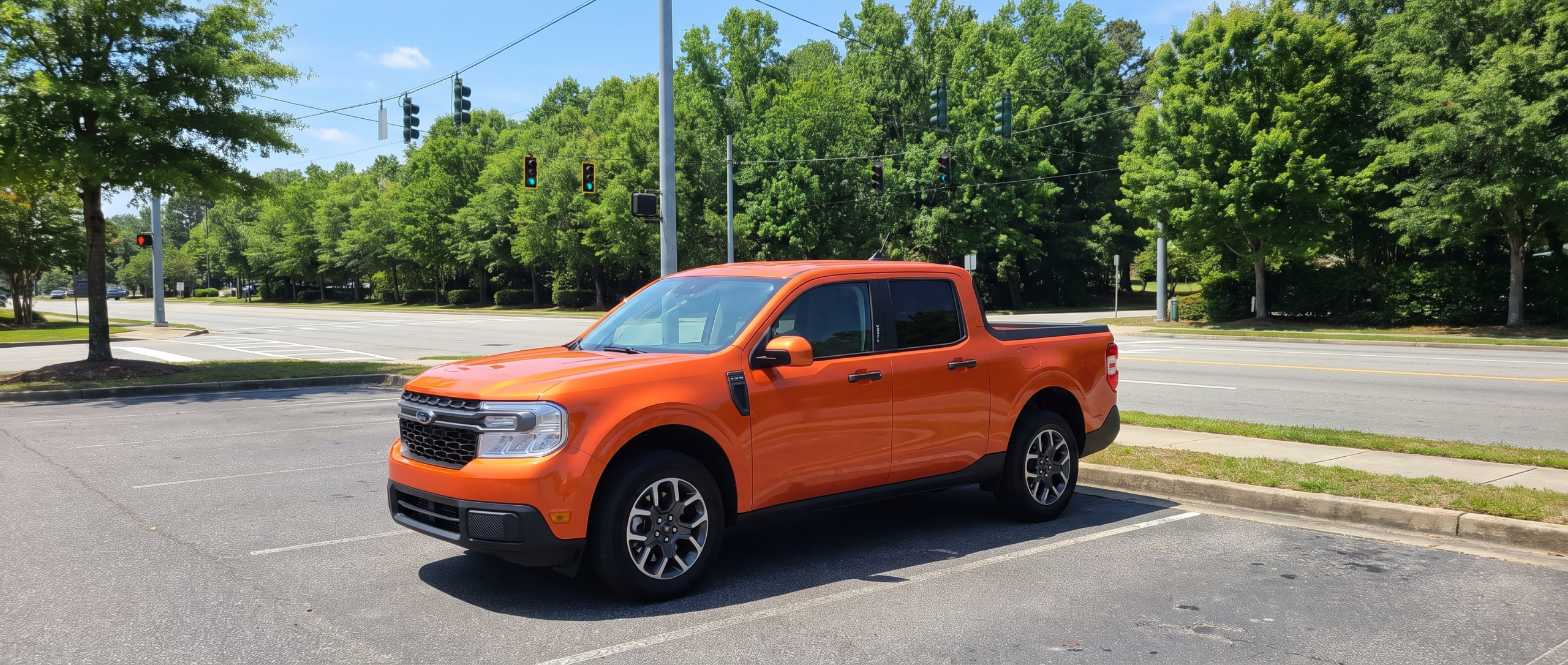
If you drive East Wade Hampton Boulevard every day, you already know how it goes. Signal, brake, inch forward, signal again. The stretch of US-29 between Greer and the airport corridor is as much a stop-and-go gauntlet as it is a through-route. That exact driving pattern is precisely where the 2026 Ford Maverick Hybrid earns its EPA rating of 42 mpg city. Not in spite of all those red lights. Because of them.
The Maverick Hybrid is a self-charging full hybrid. Every time you lift your foot before a red light on US-29, the truck’s electric motor runs backward and recharges the battery. No plug. No charging station. The fuel savings happen automatically, and they’re biggest right here in Upstate SC stop-and-go driving.
How Does a Self-Charging Hybrid System Actually Work?
Many drivers assume a hybrid needs a plug to do anything useful, and that assumption costs them at the pump. The 2026 Maverick Hybrid pairs a 2.5-liter Atkinson-cycle gasoline engine with an electric motor and a small 1.1-kilowatt-hour lithium-ion battery, and the whole system recharges itself while you drive. No external power source required.
Here’s where Wade Hampton Boulevard becomes relevant to the engineering. When you lift off the accelerator or press the brake pedal, the electric motor physically reverses direction and becomes a generator. Per Ford’s own engineering documentation, that process recovers more than 90 percent of the braking energy that a conventional vehicle simply loses as heat through the pads and rotors. That recovered electricity feeds back into the battery and gets used the next time the truck pulls away from a stop. Every signal on US-29 where you slow before the light is, mechanically speaking, a small charging event.
The EPA rates the 2026 Maverick Hybrid FWD at 42 mpg city and 35 mpg highway, for a combined 38 mpg. Notice that the city number sits higher than the highway number. That’s the opposite of how a conventional gas truck behaves, and it’s a direct result of how much regen opportunity a stop-and-go corridor provides compared to a steady highway cruise.
| Powertrain | City MPG | Hwy MPG | Combined | Best For |
|---|---|---|---|---|
| 2026 Maverick Hybrid FWD | 42 | 35 | 38 | Stop-and-go commuters, urban use |
| 2026 Maverick Hybrid AWD (XL/XLT) | 40 | 34 | 37 | Wet roads + commuting balance |
| 2026 Maverick Hybrid AWD (Lariat) | 39 | 32 | 36 | Comfort trim with traction |
| 2026 Maverick EcoBoost FWD | 23 | 30 | 26 | Towing, performance, specialty trims |
| 2026 Maverick EcoBoost AWD | 22 | 29 | 25 | Max traction, heavier hauling |
*EPA estimates. Actual results vary by driving habits and conditions.*
The combined system produces 191 horsepower. That’s perfectly adequate for daily driving and light hauling. You’re not going to beat a Tremor with an EcoBoost off the line, and we’d never tell you otherwise.
Which Setup Do You Actually Need Here in the Greer Area?
The Maverick Hybrid in FWD trim is the clear answer for anyone whose daily loop runs along US-29, up toward Greenville-Spartanburg International Airport, or through the commercial stretches of Greer. Suburban corridors, school-run traffic, regular errands: that’s the Hybrid’s native environment, and its fuel numbers reflect that honestly.
The tradeoff worth naming is towing and outright performance. The 2.0-liter EcoBoost option produces 250 horsepower and 277 pound-feet of torque, compared to the Hybrid’s 191 horsepower, and it can handle up to 4,000 pounds of towing when properly equipped. If you’re regularly pulling a boat trailer to Lake Keowee or running heavier loads for work, the EcoBoost is the right engine for that life. If your truck bed hauls lumber a few times a year and your cab hauls kids daily, the Hybrid wins on the math that actually affects your fuel bill.
In our experience at D&D Ford, customers sometimes arrive convinced they need the EcoBoost because it sounds more capable. Sometimes they’re right. But when we walk through actual weekly use together, commuting on US-29, grocery runs, one or two trips a month with real cargo, the Hybrid turns out to be the correct choice for that driving pattern. The 13.8-gallon tank combined with 38 combined mpg puts an estimated range of roughly 500 miles between fill-ups on typical use. That changes how often you stop for gas in a measurable way.
The Hybrid AWD trims (rated 37 mpg combined on XL/XLT and 36 on Lariat) are worth a conversation if wet roads or occasional gravel give you pause. South Carolina summers bring real thunderstorms, and those stretches where US-29 pools after a heavy rain are worth thinking about before you configure. You’ll give up a few mpg for the added traction confidence. For some buyers, that’s a reasonable trade.
What the Maverick Hybrid Means for Your Next Vehicle Decision
The 2026 Maverick Hybrid occupies a category of its own: the only full-size-cab, short-bed truck in Ford’s lineup that runs a standard hybrid powertrain. If you’re comparing it to the Ford Ranger, which is a fine mid-size truck, understand that the Ranger uses a turbocharged gas engine rather than a hybrid. The comparison that actually maps is this: the Maverick Hybrid is built for drivers who want a bed and five seats but whose driving is mostly urban and suburban. The Ranger is built for drivers who need more capability and can accept trading some efficiency to get it.
Our team has noticed a consistent pattern over years of selling both trucks. Customers who come from cars and small crossovers often underestimate how much they’ll actually use the bed, and overestimate how much heavy capability they need day to day. The Maverick gives you the truck identity and a usable 4.5-foot bed without the fuel cost of a larger truck. That fits a lot of Greer-area buyers who are purchasing a practical daily driver with occasional truck utility, not a dedicated work rig.
The Atkinson-cycle engine deserves a quick explanation here, because it clarifies when the Hybrid is the wrong choice. Atkinson engines trade peak power for thermal efficiency. They extract more energy per combustion cycle than a conventional engine but don’t produce as much raw output. On a highway at 70 mph with a trailer behind you, that tradeoff works against you. In stop-and-go on Wade Hampton, it’s a genuine advantage. Know your actual driving pattern and this truck becomes straightforward to evaluate.
Terms Worth Knowing Before You Shop
| Term | What It Means in Plain Language |
|---|---|
| Atkinson-cycle engine | A gas engine tuned for efficiency over power; extracts more energy per cycle, but lower peak output |
| Regenerative braking | The electric motor runs backward when you brake, acting as a generator to recharge the battery |
| eCVT (Electronic CVT) | A transmission with no fixed gear steps; the hybrid system manages the power blend automatically |
| Full hybrid (HEV) | Runs on gas and electric; the battery recharges itself while you drive — no plug required |
| PHEV (Plug-in Hybrid) | Requires external charging for full electric range; the Maverick Hybrid is NOT a PHEV |
Serving the Carolinas since 1937, the D&D Ford team on East Wade Hampton Boulevard is here for a straight conversation, not a sales pitch. If you’d like to put the Maverick Hybrid’s system on a screen and walk through how it maps to your actual commute, we’re ready for that conversation.
Frequently Asked Questions
Is the Ford Maverick Hybrid a plug-in?
No. The 2026 Ford Maverick Hybrid is a conventional full hybrid, not a plug-in hybrid. It recharges its 1.1-kilowatt-hour battery through the gasoline engine and through regenerative braking while you drive. You never need a charging station or a home charger. The system manages itself automatically every time you decelerate or brake.
Why does the Maverick Hybrid get better city mpg than highway mpg?
Because the hybrid system’s biggest advantage is energy recovery during braking and deceleration, something that happens constantly in city driving and almost never at a steady highway cruise. The EPA rates the 2026 Maverick Hybrid FWD at 42 mpg city and 35 mpg highway because stop-and-go driving gives the regenerative braking system more opportunities to capture and reuse energy. On the highway at a sustained 70 mph, the Atkinson-cycle engine is doing most of the work with less regen assist, so the number drops. If your daily drive looks like East Wade Hampton Boulevard, that city number is the one that actually reflects your real-world fuel cost.


