

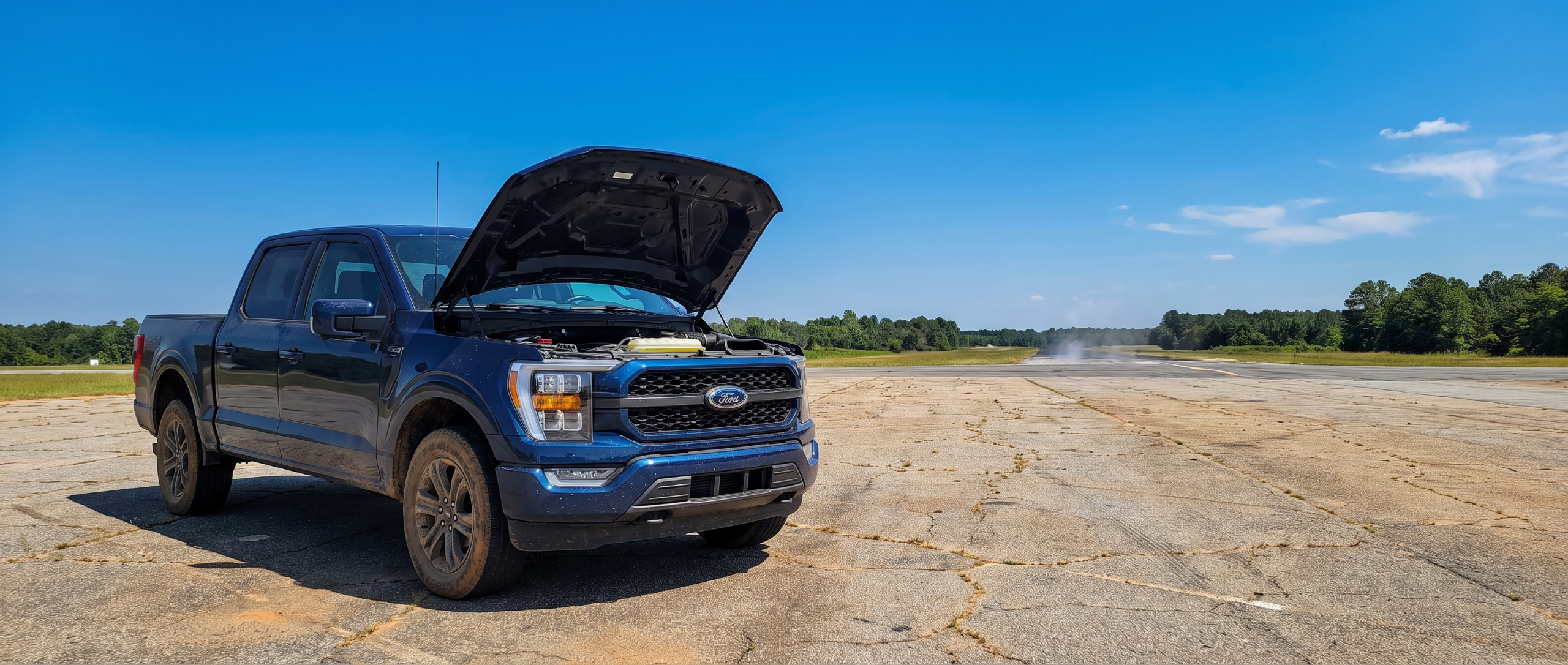
If your used Ford truck or SUV sits in the Upstate heat all week, the battery is already in a race it might not win. The real damage from a Greer summer does not happen on the day your truck refuses to start — it happens the week before, invisibly, as under-hood temperatures climb well past 140 degrees and begin cooking your battery from the inside out. This guide breaks that down by Ford model year, so a used buyer knows exactly which years come with built-in battery advantages, which ones carry a known watch-out, and what to do about any of it before the next heat wave rolls in.
- Batteries in southern states average 17 months shorter service life than in northern climates, per AAA — Upstate SC summers are among the most demanding in the region.
- The sweet spot for a used gas-engine Ford truck (F-150, Explorer, Expedition, Ranger) is the 2021-2024 model year range: AGM batteries standard on higher-load trims, better thermal management, and most open NHTSA recalls already closed.
- The 2022-2024 Ford F-150 Lightning carries an active NHTSA safety recall (25V131) for high-voltage battery cell defects — verify your VIN before buying or driving.
- The 2019-2020 generation deserves a battery load test before purchase: enough age and enough Upstate heat cycles to be on borrowed time.
- The Ford F-150 PowerBoost (2021-present) runs a separate 1.5 kWh lithium-ion pack under the bed — heat affects it differently than the 12V starting battery, and both need attention.
- A battery health check at a Ford service center costs nothing meaningful compared to a roadside breakdown on I-85 at noon in July.
Browse D&D Ford’s pre-owned inventory
Which Ford Model Years Are the Battery Sweet Spots for a Hot Climate?
For a used gas-engine Ford truck or SUV, the 2021-2024 generation hits the sweet spot in Upstate SC heat. These years ride on the 14th-generation F-150 platform (introduced 2021, freshened 2024), which standardized AGM (absorbed glass mat) batteries on higher-trim and higher-electrical-load configurations. That matters here because AGM batteries are sealed — they do not lose electrolyte fluid the way a conventional flooded battery does when under-hood temperatures spike past 140 degrees Fahrenheit during a South Carolina heat wave.
Here is the full model-year breakdown across the most common used Fords in this market:
| Model Year Range | Battery Type (Gas) | Heat Climate Rating | What to Know |
|---|---|---|---|
| 2016-2018 | Standard flooded lead-acid most trims | Watch Out | 8-10 years of age; electrolyte evaporation risk high; replace before buying |
| 2019-2020 | Flooded or AGM depending on trim | Caution | 6-7 years in southern heat; battery load test is a must before purchase |
| 2021-2023 | AGM standard on higher-load trims | Sweet Spot | 14th-gen platform; better sealed construction; verify open recalls via VIN |
| 2024 | AGM; refreshed PowerBoost system | Sweet Spot | 2024 refresh updated PowerBoost hybrid motor logic; strong thermal baseline |
| 2021-2024 Lightning | High-voltage lithium-ion (123 kWh pack on 2026) | Watch Out — See Recall | NHTSA recall 25V131 active for 2022-2024 Lightning; check VIN immediately |
The key distinction the generic summer-battery articles miss: Ford trucks running higher accessory loads (Pro Power Onboard, trailer brake controller, Max Recline seats, SYNC 4 displays) draw more from the 12V battery even at rest. The 2021-and-newer generation was engineered for those loads; earlier models running the same accessories are harder on a battery that was not designed for that demand.
Which Model Years Should You Watch Out For?
The 2019-2020 model years are the ones that deserve a second look — not because they were poorly built, but because of math. AAA data shows vehicle batteries in the southern United States average 17 months shorter service life than batteries in cooler northern climates. A 2019 Ford F-150 in Greer has likely already run through one battery cycle, and if it still has its original unit, that battery has faced five to six full Upstate summers. Under-hood temperatures in a parked South Carolina vehicle can climb past 140 degrees Fahrenheit on a day like the ones Upstate saw in late June and early July 2026, when Greenville-area heat indices pushed past 100 degrees.
The 2022-2024 F-150 Lightning is the clearest years-to-watch entry: per NHTSA, recall 25V131 was issued for a manufacturing defect in high-voltage battery cells that may result in an internal short circuit and fire risk. NHTSA documents confirm the recall affects approximately 950 vehicles. Until the repair is performed, owners were advised to charge only to 80% maximum capacity. Any used Lightning purchase in those years requires a VIN check at ford.com/support/recalls before anything else.
For the 2016-2018 conventional trucks, the concern is simple age plus southern heat. The optimal operating temperature for a car battery is between 60 and 80 degrees Fahrenheit, per established battery chemistry standards. Eight-year-old batteries running well above that threshold for five months a year are living on borrowed time. A professional load test — not just a voltage check — tells the real story.
View F-150 inventory at D&D Ford Motors Browse the Ford Explorer lineup
A Note on the PowerBoost Hybrid Battery
The 2021-and-newer F-150 PowerBoost runs two battery systems simultaneously, and most used-truck buyers do not know it. There is the standard 12V starting battery that every gas Ford uses, and then there is the 1.5 kWh lithium-ion battery pack located under the bed that powers the integrated electric motor. Both are vulnerable to Upstate heat — just differently.
The 12V battery behaves like any other lead-acid or AGM unit: high under-hood temperatures accelerate electrolyte evaporation in conventional units and speed up grid corrosion in AGM types. The lithium-ion hybrid battery pack faces a different challenge: heat speeds up internal chemical reactions within lithium-ion cells, which over time reduces energy capacity and can slow charging response. Ford’s 2024 refresh of the PowerBoost system updated the hybrid motor logic, which also improved how the truck manages thermal load on the pack — making 2024 PowerBoost models a better buy in this climate than 2021-2023 units if hybrid range and Pro Power Onboard output matter to you.
Ford lists the 2026 F-150 PowerBoost at 430 horsepower and 578 lb-ft of torque from the 3.5L twin-turbocharged V6 combined with the 35 kW electric motor. The EPA rates the 2026 F-150 PowerBoost at 22 city and 24 highway in 4WD configuration — meaningful numbers for a truck doing five days a week between Greer, Greenville-Spartanburg International Airport, and job sites along I-85. If you are buying used, that efficiency math only holds if the hybrid battery has not been degraded by heat cycles.
Which Year Fits Which Buyer?
The right model year depends on what you are hauling, how long you plan to own it, and how seriously you take summer maintenance.
You want the simplest battery story: 2021-2023 gas-engine F-150, Explorer, or Expedition. These years put a well-sealed AGM battery in a chassis engineered for higher electrical demand, and most of the significant NHTSA recalls from the 14th-gen launch window have been addressed. A used 2021-2023 Expedition or Explorer purchased from a dealer that has run through open recalls is about as low-risk as used Ford ownership gets on the battery front.
You want the best efficiency and can handle two battery systems: 2024 PowerBoost F-150. The 2024 refresh updated the PowerBoost’s hybrid motor integration, which also tightened thermal management. It is the newest generation of that system available in the used market right now, and it is the one with the most software refinement for southern heat.
You want an older truck and are willing to do the math: 2019-2020 F-150 or Ranger. These are still capable trucks. Run a full battery load test — not a voltage test, but a load test that checks reserve capacity under real current draw — before you commit. Reserve capacity, not cold cranking amps, is the spec that matters most for hot-climate endurance. If the test passes, budget for a battery replacement within the next year or two and you will be fine.
You are considering a used Lightning: 2022-2024. Pull the VIN, run it at ford.com/support/recalls, and confirm recall 25V131 has been remedied before you drive it off any lot. If it has not, the repair involves a full high-voltage battery array inspection and replacement as needed — a dealer fix, not a DIY job. Once cleared, the 2025-updated Lightning carries the 123 kWh pack across all trims (the 98 kWh standard-range option was eliminated for 2026), giving you a strong foundation going forward.
The bottom line for every used Ford buyer in this part of South Carolina: the battery conversation does not end at “it started fine on the test drive.” A battery can function on the hottest day of the year and fail three weeks later when the internal damage from five straight summers catches up with it. That is exactly what makes the July window the right time to check — and the right time to bring it to a shop that can run a proper conductance test, not just look at the terminals.
Book your Ford battery inspection at D&D Ford’s service center
Frequently Asked Questions
How long do Ford truck batteries typically last in South Carolina?
In southern states, car batteries average roughly two and a half to three years of service life, compared to five years or more in cooler northern climates. AAA data shows southern US batteries outlast their northern counterparts by about 17 months less on average. For a Ford F-150 or Explorer in Upstate SC, budget for a replacement somewhere in the three-year window and get a load test every summer once the battery reaches two years of age.
Does the Ford F-150 PowerBoost have a special battery I need to worry about?
Yes — it runs two separate battery systems. There is a standard 12V starting battery (usually AGM on higher-trim configurations) and a 1.5 kWh lithium-ion hybrid battery pack located under the bed. Heat affects both, but differently. The 12V unit is susceptible to electrolyte evaporation and terminal corrosion. The lithium-ion pack is vulnerable to accelerated internal degradation from sustained high ambient temperatures. Both should be inspected before buying a used PowerBoost and annually once you own one.
Is there an open recall on any Ford trucks related to batteries right now?
The most significant active battery recall is NHTSA 25V131, which covers certain 2022-2024 Ford F-150 Lightning models. A manufacturing defect in the high-voltage battery cells may result in an internal short circuit and fire risk. Approximately 950 vehicles are affected. Owners should verify their VIN at ford.com/support/recalls and limit charging to 80% capacity until the repair — a high-voltage battery array inspection and replacement as needed — has been performed at a Ford dealer.


