If you’re standing between a 2026 Ford F-150 and a 2026 Toyota Tundra, the bottom line comes down to this. The F-150 gives you more towing ceiling and a wider menu of powertrains, but the Tundra earns a safety edge that matters if your family rides in the back seat. The truck that fits you depends on what you haul and who rides with you.
- The 2026 Ford F-150 tops out at 13,500 lbs of towing (with the 3.5L EcoBoost and Max Trailer Tow Package, per Ford’s official towing guide). The 2026 Toyota Tundra peaks at 12,000 lbs on gas models, per Toyota.
- The F-150 offers six powertrain choices including the PowerBoost hybrid; the Tundra offers two.
- The Tundra is the only full-size gas pickup to earn a 2026 IIHS Top Safety Pick. The F-150 received a Poor rating in the IIHS moderate front overlap test for rear-passenger protection.
- The Tundra uses an independent multi-link rear suspension with coil springs; the F-150 uses a leaf-spring rear. Ride quality shows it, especially loaded.
- Your real number matters more than the ceiling number. Read the payload math section before you buy.
What’s the Real Difference Between These Two Trucks?
The gap is smaller than the spec sheets suggest and wider than most comparison articles admit, which is the frustrating truth of it. Both trucks are 2026 models wearing twin-turbocharged V6 engines as their main powertrains. Both tow serious weight, seat five adults, and park on the same street. The differences that matter show up in three places, how much you can really pull once the truck is loaded, how the truck rides on a backroad or a loaded return trip on I-85, and what happens in a crash.
Look at the head-to-head below, where the deciding factors live.
| Decision Axis | 2026 Ford F-150 | 2026 Toyota Tundra |
|---|---|---|
| Max towing (properly equipped) | 13,500 lbs (3.5L EcoBoost) | 12,000 lbs (i-FORCE gas V6) |
| Max payload (select configs) | 2,440 lbs | 1,850 lbs |
| Powertrain options | 6 engines (gas + hybrid + V8) | 2 (gas twin-turbo V6 + hybrid) |
| Hybrid tow rating | 11,600 lbs (PowerBoost) | 11,450 lbs (i-FORCE MAX) |
| Hybrid EPA est. MPG (4WD) | 22 city / 24 hwy | ~20 city / ~24 hwy (est.) |
| Rear suspension | Leaf spring | Independent coil-spring |
| IIHS rear-passenger protection | Poor (moderate overlap) | Good (Top Safety Pick) |
| NHTSA overall safety | 5-star (prior-gen data) | 5-star |
Does the Tow Rating Gap Actually Matter for What You Pull?
For most of what Upstate buyers hook up, the gap barely registers, though it turns into a genuine advantage once you climb past 11,000 lbs. That 13,500-lb F-150 rating is real. It’s also achieved on a 4×2 Regular Cab with the 3.5L EcoBoost, the Max Tow Axle, and the Tow/Haul Package, and Ford’s 2026 towing guide spells that out. Drop into a 4×4 SuperCrew (the configuration most Upstate families want), add your three passengers and a loaded tool drawer in the bed, and that ceiling comes down. The Tundra’s 12,000 lbs has asterisks too.
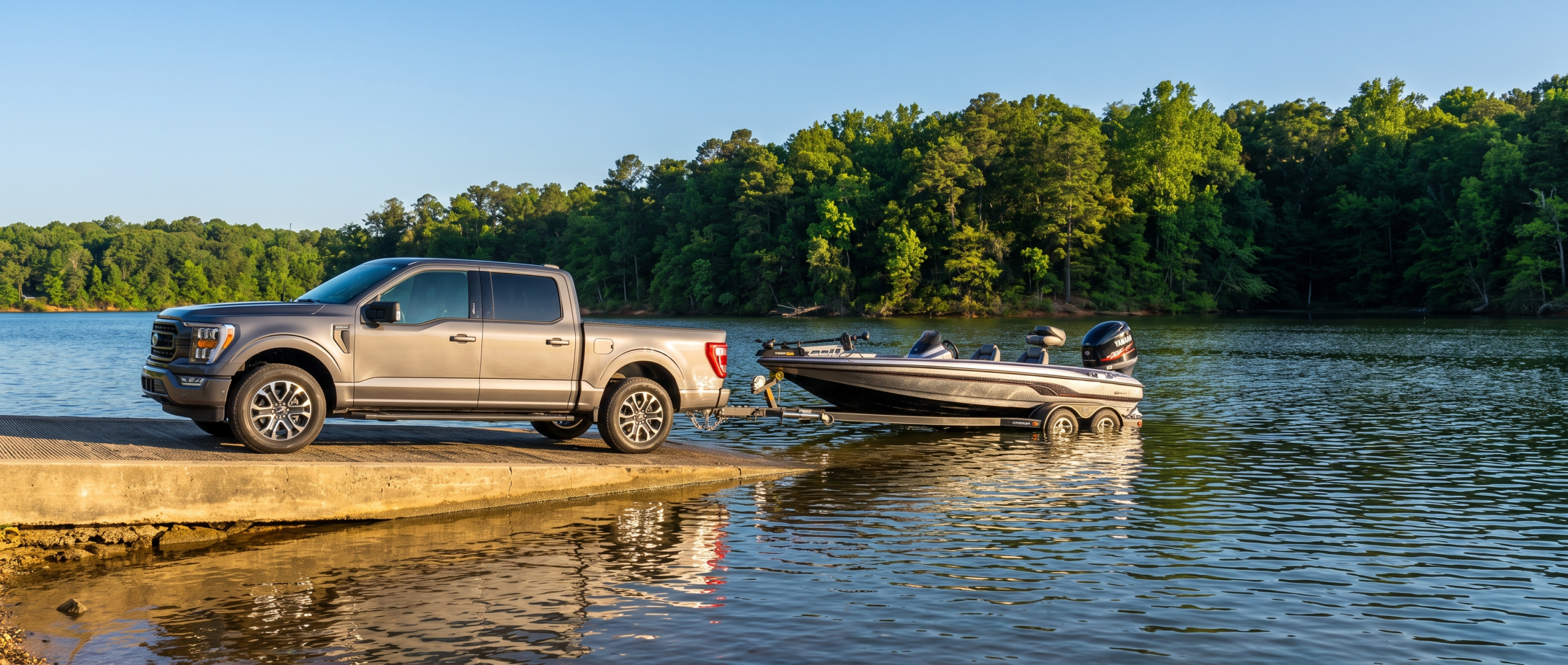
The practical question is what you hook up. A loaded bass boat on a dual-axle trailer, common at Lake Hartwell boat ramps, typically runs 4,000 to 6,500 lbs depending on hull size. A mid-size camper runs 5,000 to 8,500 lbs. A car hauler with a weekend vehicle runs 8,000 to 10,000 lbs. For everything in those ranges, both trucks get there. For a loaded horse trailer or a heavy equipment trailer pushing past 11,000 lbs, the F-150’s ceiling is a genuine advantage. The Tundra starts running thin.
The F-150’s 5.0L V8 offers another angle here. Ford rates it at 12,800 lbs of towing and 2,235 lbs of payload. Think of it as a traditional V8 for buyers who want eight cylinders without apology, splitting the difference between the max-tow EcoBoost and the hybrid’s efficiency.
The Suspension Difference Nobody Talks About
If ride comfort sits at the top of your list, the Tundra’s rear suspension has a clear edge when the bed runs empty, and that edge flips the other way once you load it down for work. Toyota moved to an independent multi-link rear setup with coil springs when it redesigned the truck for the 2022 model year. The F-150 still rides on a leaf-spring rear. Coil springs compress more progressively, offer more travel, and tend to give a noticeably smoother unladen ride. On the Cherokee Foothills Scenic Highway (SC-11) on a Sunday with nothing in the bed, you feel it.
That gap matters more than most comparison articles acknowledge. Empty miles add up around here.
The tradeoff runs the other way with load. Leaf springs are proven for heavy hauling and high-payload work, they’re simpler to service, and they’re broadly supported at shops across Upstate SC. Contractors who load the bed hard every day often prefer them for that reason. The Tundra’s Platinum, 1794 Edition, and Capstone trims add standard automatic load-leveling suspension to compensate at the high end of the lineup, but that’s a trim-level upgrade, not a base feature.
Standing in our service bay, we’d put it plainly. The Tundra rides better empty, the F-150 handles a loaded bed with fewer surprises at work weight. Our service team has straightened leaf-spring packs on hard-worked F-150s, and that’s a pattern we can stand behind. Coil-spring repairs on a Tundra show up less often here in Greer, though parts availability is also thinner at independent shops off East Wade Hampton Boulevard.
The Powertrain That Changes the Math: PowerBoost Hybrid
If your decision hinges on the hybrid, the PowerBoost pulls ahead on efficiency and jobsite power while giving up a little raw torque to Toyota, and that split is worth walking through. The EPA rates the 2026 F-150 PowerBoost at 22 city / 24 highway / 23 combined MPG in 4WD trim. It still tows 11,600 lbs. And it ships with Pro Power Onboard, which delivers up to 7.2 kW of exportable power from the bed. That last point hits differently if you run power tools on job sites, need a generator after a storm, or park at a campsite without a hookup.
The Tundra’s i-FORCE MAX hybrid puts out 437 hp and 583 lb-ft of torque, more than the PowerBoost’s 430 hp and 578 lb-ft. Its off-the-line feel is genuinely strong. But Toyota’s estimated fuel economy for the hybrid runs around 20 city / 24 highway in 4WD trim, and it doesn’t offer an onboard power export function. For buyers whose decision comes down to the hybrid question, the F-150 PowerBoost tows more, returns better city MPG by EPA estimates, and doubles as a mobile generator. The Tundra hybrid rides better empty and carries slightly more raw torque. Call it a tradeoff, not a knockout for either side.
See Current F-150 Offers at D&D Ford
So Which Truck Should You Pick?
Your pick splits cleanly by what you haul and who rides with you, and after nearly 90 years of serving this community in Greer, we’ll lay it out by buyer type. Neither truck is a mistake here. One fits your load better.
Pick the 2026 Ford F-150 if:
- You regularly pull trailers above 10,000 lbs (heavy equipment, large RVs, fully loaded horse trailers).
- You want a choice of six powertrains, including the 5.0L V8 for buyers who want displacement over turbos.
- You need maximum payload, 2,440 lbs, to carry crew plus a fully loaded bed.
- The PowerBoost hybrid’s Pro Power Onboard matters for your work or camping setup.
- Service availability and part depth across Upstate SC is a priority.
Pick the 2026 Toyota Tundra if:
- Your tow loads stay comfortably under 10,000 lbs (boats, campers, mid-size trailers).
- Rear-seat safety for family passengers is a top criterion. The IIHS data is the clearest differentiator in this comparison.
- You want a smoother unladen ride, especially on the Blue Ridge approach roads where you’re running empty half the time.
- The higher-trim load-leveling suspension appeals to you.
We’ll make one honest concession. The Tundra’s IIHS rear-seat result is a finding that matters if you carry kids or adults in the back seat regularly. The F-150 hasn’t addressed that weakness for 2026. If your family fills those rear seats, that test result is worth weighing. What the F-150 brings back is a broader powertrain selection, higher payload ratings, and the deepest service network in the region.
We’ve sold trucks in Greer since 1937. Trucks earn their keep in this market on real work and hard weekends, not on a big number on a window sticker. Value your current truck here, then come see which configuration of the F-150 fits your load, whenever you’re ready.
Frequently Asked Questions
What is the towing difference between the 2026 Ford F-150 and the 2026 Toyota Tundra?
The 2026 Ford F-150 tows up to 13,500 lbs when properly equipped with the 3.5L EcoBoost V6 and the Max Trailer Tow Package, per Ford’s official 2026 towing guide. The 2026 Toyota Tundra tops out at 12,000 lbs on gas-powered models, per Toyota. Both ratings are configuration-specific maximums. Your actual real-world number depends on drivetrain (4×4 adds weight), cab style, passengers, and bed load. A loaded 4×4 SuperCrew F-150 with three passengers tows meaningfully less than 13,500 lbs, so check the door-jamb payload sticker on any specific truck before hitching a heavy trailer.
Which is safer, the 2026 Ford F-150 or the 2026 Toyota Tundra?
For 2026, the Toyota Tundra is the only full-size gas-powered pickup to earn the IIHS Top Safety Pick award. The IIHS gave the 2026 Ford F-150 a Poor


