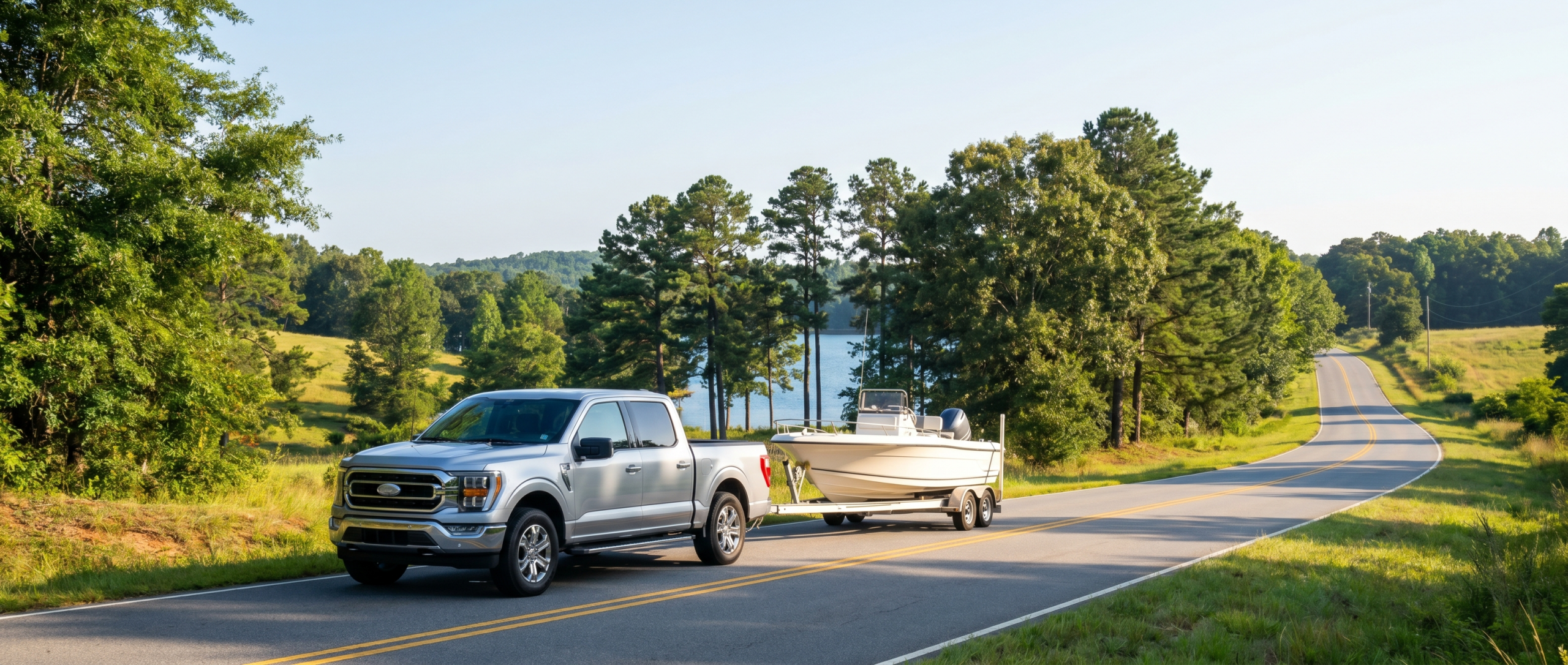
Plenty of truck owners find out the hard way that hauling a boat is a completely different experience than hauling gear – and Lake Keowee has a way of making that lesson feel urgent at the worst possible time. If you’re planning regular trips from Greer, SC out to one of Upstate South Carolina’s most popular lakes, your Ford® F-150™ is more than capable of handling the job. The key is knowing how to set it up correctly before you ever hook up a trailer.
This guide covers what you need to know: towing capacity, trailer setup, driving technique on mountain-grade roads, and what to check before and after every lake run.
Know Your F-150’s Real Towing Capacity Before You Load Up
The F-150’s maximum tow rating and your F-150’s actual tow rating are two different numbers – and confusing them is one of the most common mistakes lake-bound truck owners make. The 2024-2025 F-150 can tow up to 13,500 lbs when properly configured, but that figure depends on your specific engine, axle ratio, cab configuration, and whether you have the Max Trailer Tow Package. A base-trim F-150 with the standard 2.7L EcoBoost and a 3.31 axle ratio will have a noticeably lower rating.
Before you commit to a boat and trailer combination, locate the yellow sticker inside your driver’s door jamb. That sticker lists your truck’s specific Gross Combined Weight Rating (GCWR) and Gross Vehicle Weight Rating (GVWR). These are the numbers that actually govern what your truck can safely handle – not the marketing headline.
Here’s a quick reference for the most common F-150 powertrain configurations and their approximate tow ratings:
| Engine | Approx. Max Tow Rating | Best For |
|---|---|---|
| 2.7L EcoBoost V6 | Up to 8,200 lbs | Smaller fishing boats, jon boats |
| 3.5L EcoBoost V6 | Up to 13,500 lbs | Bass boats, pontoons, ski boats |
| 5.0L Ti-VCT V8 | Up to 11,100 lbs | Mid-size fishing and ski boats |
| 3.5L PowerBoost Full Hybrid | Up to 12,700 lbs | Larger boats with onboard power needs |
If your setup falls close to your truck’s limit, step down – not up. Running at 90-95% of rated capacity on rolling terrain taxes your drivetrain, brakes, and cooling system far harder than flat interstate driving would suggest.
Setting Up Your Trailer Hitch the Right Way
A correct hitch setup makes the difference between a controlled tow and a white-knuckle experience, especially on the grades you’ll encounter heading out of Greer toward Oconee County. The route to Lake Keowee takes you through some of Upstate South Carolina’s hillier terrain, and a poorly loaded trailer will make those grades feel much steeper than they are.
Follow these setup steps before every haul:
- Match your hitch class to your load. A Class III hitch handles up to 8,000 lbs, a Class IV up to 10,000 lbs. Know which is installed on your truck and verify it matches your trailer’s tongue weight requirements.
- Set the ball mount to the right height. Your trailer should ride level when connected – not nose-up or nose-down. A nose-down angle shifts weight off your front axle and reduces steering control.
- Use a weight-distribution hitch if your trailer tongue weight exceeds 600 lbs. Most pontoons and larger bass boats will cross that threshold when fully loaded.
- Check tongue weight. Tongue weight should be 10-15% of total trailer weight. Too little and the trailer sways; too much and your rear axle takes a beating.
- Torque your lug nuts on the trailer after the first 25-50 miles of towing. New trailers and freshly serviced trailers are notorious for loosening up on first use.
- Connect safety chains in a crossed X-pattern under the hitch coupler so they cradle the coupler if it separates.
- Test all trailer lights before leaving your driveway. Burned brake lights or turn signals are a moving violation and a real safety issue on two-lane roads.
How to Drive an F-150 While Towing a Boat on SC Roads
The roads between Greer and Lake Keowee are not freeway-flat. Highway 11, the Cherokee Foothills Scenic Highway, rolls through stretches of genuine hill country, and the approach roads to several Lake Keowee access points involve grade changes that will work your transmission and brakes hard if you’re not prepared.
Engage Tow/Haul Mode every single time. This is not optional. Tow/Haul Mode adjusts your F-150’s transmission shift points, activates engine braking, and when equipped, coordinates trailer sway control. It takes about two seconds to activate and makes a measurable difference in how the truck behaves under load.
On descending grades, use engine braking rather than riding your brake pedal. Repeated brake application on a long downhill with a loaded trailer generates significant heat and can fade your braking effectiveness just when you need it most.
Follow these driving adjustments for towing:
- Increase your following distance to at least 4-6 seconds. A loaded trailer significantly increases stopping distance.
- Avoid abrupt lane changes. Sudden steering inputs at highway speed can initiate trailer sway.
- If trailer sway starts, do not brake suddenly. Gradually reduce throttle and hold the steering wheel firmly straight. The F-150’s Trailer Sway Control will activate automatically to help stabilize.
- Allow extra distance for passing maneuvers. Your combined length with a boat trailer is substantially longer than your truck alone.
- Watch your mirrors constantly. What’s happening at the back of your trailer tells you a lot about how stable your load is.
Speed management matters more than most drivers realize. At 65 mph, stopping a loaded F-150 with a full trailer takes significantly longer than stopping the truck empty. Build time and distance into every maneuver.
Pre-Trip Checklist Before You Leave Greer for the Lake
The boat ramp at Lake Keowee State Park is a popular launch point, and on a busy Saturday morning, the last thing you want is to discover a mechanical issue in the parking lot with six other trucks waiting behind you. Running through a quick pre-trip check at home takes about ten minutes and prevents the majority of common towing problems.
- ✓ Tires inflated to recommended pressure on both truck and trailer (check cold, before driving)
- ✓ Trailer coupler locked and safety latch secured
- ✓ Safety chains connected in X-pattern
- ✓ Trailer lights tested – brake, turn, and running lights
- ✓ Wheel bearings on trailer last serviced within the recommended interval
- ✓ Boat drain plug installed (yes, this one still gets people every year)
- ✓ Boat and motor properly secured – tie-downs tight, prop guard on
- ✓ F-150 coolant and engine oil at proper levels
- ✓ Side mirrors adjusted to clear both sides of the trailer
- ✓ Brake controller calibrated if equipped
If your F-150 hasn’t been serviced recently and you’re planning a full season of Lake Keowee runs, it’s worth getting ahead of it now. Browse our new inventory if you’re also considering upgrading to a better-configured tow rig for the summer ahead.
Backing Down the Boat Ramp Without the Stress
Backing a trailer is a skill that takes practice, and the boat ramps around Lake Keowee – including access points near Keowee-Toxaway State Natural Area – can get crowded on weekends. The good news is that the F-150 has several features specifically designed to reduce the anxiety of this moment.
Pro Backing Tips for F-150 Owners:
- Place your hand at the bottom of the steering wheel when reversing. Moving your hand left moves the trailer left; moving it right moves it right. This inverted logic clicks for most people immediately.
- Use Trailer Backup Assist (if equipped) to let the truck steer automatically – you manage speed with the brake only.
- Use your mirrors, not just your camera. The wide-angle camera helps, but your side mirrors give you the full picture of trailer angle.
- Back in slowly. There’s no award for being fast. Patient, deliberate movements are far easier to correct.
- Stage your approach by pulling forward past the ramp, then reversing in a straight line to minimize correction angles.
- If you overshoot the angle, pull forward and reset. Every experienced boater has done this.
The Ford Expedition and F-250SD are also worth considering if you regularly haul multiple watercraft or larger pontoon setups, but for most recreational fishing boats and ski boats typical at Lake Keowee, a properly configured F-150 is more than enough truck.
Post-Trip Care for Your F-150 After a Day on the Water
What you do after the boat is back on the trailer matters just as much as your pre-trip prep. A day of towing in South Carolina heat puts real stress on your F-150’s drivetrain components, and catching small issues early prevents larger ones later.
After returning from Lake Keowee, take a few minutes to:
- Check your trailer hitch and coupler for wear, play, or loosening hardware
- Inspect your trailer tires for sidewall bulging or uneven wear that developed during the trip
- Let your truck’s transmission cool before parking in a garage – a short idle period after a long tow helps
- Check your brake fluid level if you noticed any sponginess on descending grades
- Rinse the trailer frame and bunks if they contacted the water during launch or retrieval
- Note any new warning lights that appeared during towing – most F-150 systems will flag issues as they develop
If the F-150 you’re currently running has high mileage or hasn’t been through a full service in a while, it’s smart to schedule service before summer towing season kicks into full swing in the Upstate SC area.
Common Questions About F-150 Towing Tips for Boats Near Lake Keowee, SC
What F-150 configuration is best for towing a boat to Lake Keowee from Greer, SC?
The best F-150 configuration for towing a boat to Lake Keowee from Greer, SC is the 3.5L EcoBoost V6 paired with the Max Trailer Tow Package and a 3.55 or higher axle ratio. This configuration unlocks the F-150’s top tow rating of 13,500 lbs and adds equipment like a factory-integrated brake controller and upgraded cooling. For most bass boats and pontoons common on Lake Keowee, this setup provides significant headroom above the typical load weight.
How do I know if my F-150 is rated to tow my boat safely?
Check the yellow Tire and Loading Information sticker inside your driver’s door jamb for your truck’s specific GCWR and payload rating. Weigh your loaded trailer at a certified truck scale, then compare that number to your truck’s configuration-specific tow rating found in your owner’s manual. Never rely solely on the advertised maximum tow rating – it applies only to the most capable configuration.
Is Tow/Haul Mode necessary on the roads between Greer and Lake Keowee?
Yes, Tow/Haul Mode is strongly recommended any time you’re towing, and especially on the hilly terrain of Highway 11 and the approach roads to Lake Keowee in Oconee County. This mode adjusts the F-150’s transmission to hold lower gears on grades, activates engine braking on descents, and coordinates trailer stability systems. It reduces drivetrain stress and significantly improves control on rolling terrain.
What is a safe tongue weight for my F-150’s hitch when towing a boat?
Tongue weight should be 10-15% of your total loaded trailer weight for stable towing. For a 5,000 lb boat and trailer combination, that means 500-750 lbs of tongue weight. Exceeding 600 lbs generally requires a weight-distribution hitch on the F-150 for proper axle loading. Too little tongue weight is equally problematic – it causes trailer sway, particularly at highway speeds on longer open stretches of Upstate SC roads.
How often should I service my F-150 if I tow to Lake Keowee regularly throughout the summer?
If you’re making regular weekend tows throughout the Upstate SC summer, plan to check your F-150’s engine oil, transmission fluid, and coolant at least once mid-season. Ford recommends more frequent oil changes under severe duty conditions, which include regular towing. Have your brakes, hitch components, and trailer wiring inspected at each service visit. A well-maintained F-150 will handle season after season of lake runs without issue.
Can a standard F-150 handle the boat ramp grades at Lake Keowee State Park?
Yes, a standard F-150 handles the boat ramp grades at Lake Keowee State Park without issue when properly configured. The key is engaging Tow/Haul Mode, keeping tires properly inflated, and ensuring your brake controller (if equipped) is calibrated for your trailer’s weight. The ramp surfaces at most Keowee access points are manageable with a capable truck and an operator who controls speed carefully during entry and exit.
Ready to Make Every Lake Run a Confident One
A well-prepared F-150 and a driver who understands their setup can handle every trip from Greer out to Lake Keowee without stress. The lake is only about 45 miles from Upstate SC’s core, and with the right truck configuration and habits in place, it should feel like a straightforward drive rather than a test of nerves. The team at D&D Ford Motors is here to help you figure out which F-150 trim and package makes the most sense for your towing needs – whether you’re hauling a jon boat for a morning of fishing or a full pontoon for a family weekend on the water.


