

Ford Commercial Truck Maintenance for Greer Businesses: What Your Schedule Actually Should Look Like
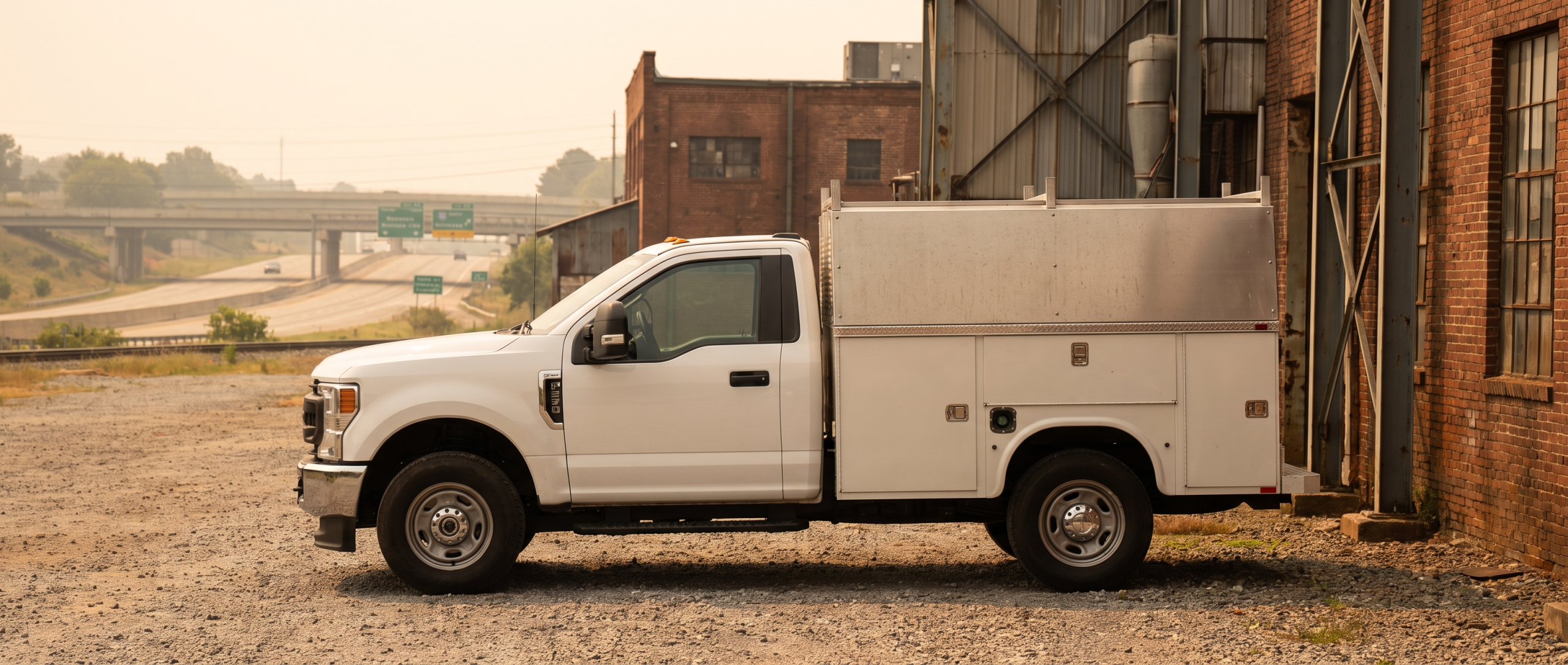
A lot of Ford commercial trucks running the I-85 corridor out of Greer are on the wrong maintenance schedule. The cause isn’t neglect. Ford publishes two distinct service schedules, and the trucks working out of Greer overwhelmingly qualify for the stricter one.
So here’s the straight version. If your Ford F-150 hauls materials to job sites, sits in morning I-85 traffic with a loaded bed, or pulls a trailer to a supplier off Highway 101, Ford classifies that as severe-duty use. The intervals run shorter, the fluid specs differ, and skipping that distinction is what turns a preventable repair into a multi-week downtime bill. We’ve been working on trucks for Upstate SC businesses since 1937, and the gap between what the dashboard says and what this truck actually needs is the conversation that matters most.
How Often Does a Commercial Ford Truck Actually Need Service?
How often a commercial Ford truck needs service depends on which truck you’re running and how hard you run it, and for most Greer operators the honest answer lands more often than the oil life monitor alone suggests, since a loaded bed and highway heat push these trucks toward Ford’s stricter classification.
So is the oil life monitor enough on its own? Not for this kind of work. Ford’s Intelligent Oil Life Monitor calculates oil change intervals on the fly, and it’s genuinely useful. But Ford’s own published severe-duty guidelines recommend oil changes around every 5,000 miles for trucks that routinely tow, haul near max payload, or idle extensively at job sites. That runs meaningfully shorter than the 7,500-mile normal-condition baseline. For 2026 Super Duty 6.7L Power Stroke diesels under severe-duty classification, Ford specifies 5W-40 full synthetic, and the engine holds 15.0 quarts per full change. The spec matters. The wrong oil is no small thing.
The table below maps the trucks we service most for Greer operators against realistic intervals.
| Vehicle | Normal Oil Interval | Severe-Duty Oil Interval | Diesel Fuel Filter | Transmission Fluid (Heavy Tow Use) |
|---|---|---|---|---|
| 2026 Ford F-150 (EcoBoost gas) | 7,500 mi | 5,000 mi | N/A | 60,000 mi |
| 2026 Ford F-150 PowerBoost Hybrid | 7,500 mi | 5,000 mi | N/A | 60,000 mi |
| 2026 Ford Super Duty (gas V8) | 7,500 mi | 5,000 mi | N/A | 60,000 mi |
| 2026 Ford Super Duty (6.7L Power Stroke diesel) | 7,500 mi / 6 mo | 5,000 mi | 15,000-20,000 mi | 60,000 mi |
| 2026 Ford Transit (gas EcoBoost, normal use) | 7,500-10,000 mi | 5,000 mi | N/A | Inspect at 60,000 mi |
Ford’s published severe-duty triggers cover frequent towing, hauling near max payload, sustained idling at work sites, many short trips, and operation in extreme temperatures. A July workday in Upstate SC (sustained heat, loaded bed, stop-and-go on I-85 during BMW Manufacturing Plant shift changes) checks multiple boxes at once.
Where Does Your Greer Fleet Actually Spend Its Miles?
The Ford Super Duty lineup is the backbone of commercial work in this market, and where those trucks spend their miles is exactly what pushes them into severe-duty territory. Think supply routes along I-85, deliveries between the supplier network that clusters around the BMW plant campus, construction hauls across Spartanburg County, loaded and idling and then back on the highway. That pattern is textbook severe-duty operation. Engines see more heat cycles per mile. Transmission fluid degrades faster. Diesel fuel filters on Power Stroke trucks need attention at the closer end of the 15,000-20,000 mile window.
Ford Transit-250 and Transit-350 vans running delivery routes with frequent stops and full cargo floors sit in the same severe-duty category, and Ford’s published guidance for Transit explicitly names frequent stops, heavy payloads, and extended idling as triggers for the tighter schedule. In a dense logistics corridor like ours, a commercial Transit rarely earns the relaxed interval.
- Tire rotations every 7,500 miles reduce uneven wear on load-bearing rear axles
- Brake inspections belong at every oil change interval for trucks hauling near payload limits
- Engine air filters need a check at 30,000 miles, sooner on dusty work sites or gravel access roads
- Battery terminal cleaning at 15,000-20,000 miles prevents hard-start failures on hot Upstate SC mornings
- Diesel Exhaust Fluid levels on Power Stroke trucks should be verified monthly
Schedule Your Commercial Service Appointment
Planning Service Around Your Crew’s Schedule, Not Against It
Planning service around your crew works best when you treat scheduled downtime as cheaper than the breakdown it prevents, because a three-truck operation loses real money the moment one vehicle sits waiting, and a little rhythm keeps all three earning. Here’s how Greer businesses tend to build that rhythm with us.
Use the IOLM as a prompt, not the whole answer. The oil life monitor is useful but doesn’t see the full severe-duty picture. Set your own mileage reminder at 5,000 miles if your F-250SD or F-350SD regularly tows or hauls. Don’t wait for “Oil Change Required” if you know the truck has been running hard all week.
Batch diesel fuel filter service. The Power Stroke fuel filter window runs 15,000-20,000 miles, roughly every second oil change at a severe-duty interval. Scheduling filter service alongside the second oil change cuts the number of separate trips per year.
Document every service visit. A clean, timestamped service history adds real value when you trade up or sell. We log it properly with Motorcraft-spec parts every time.
The downtime you prevent now costs far less than the repair you’re putting off. We’ve held that line since 1937, and it hasn’t changed.
Frequently Asked Questions
Does the oil life monitor tell me when to change oil on a commercial Ford truck?
Ford’s Intelligent Oil Life Monitor tracks engine revolutions and temperature cycles to estimate remaining oil life. It’s a useful tool. For most commercial use in Greer, though, Ford’s published severe-duty guidelines recommend not exceeding 5,000-mile intervals regardless of what the monitor shows.
What exactly qualifies as severe-duty use for a Ford Super Duty or Transit?
Ford’s published definitions include: regular towing, hauling near maximum payload, extended idling at work sites, frequent short trips, and operation in extreme temperatures. A loaded truck running I-85 in July heat qualifies. If your truck does any of these things on a typical workweek, Ford’s recommendation is the shorter severe-duty service intervals across oil, filters, brakes, and drivetrain fluids.
Is transmission fluid on the 2026 Super Duty truly lifetime, or does it need to be changed?
Ford markets the 10-speed TorqShift’s fluid as lifetime under normal commuter-type use. For a Super Duty regularly pulling near its Gross Combined Weight Rating, the heat cycles from that work degrade the fluid considerably faster. Ford dealerships recommend replacing transmission fluid at 60,000 miles for trucks in heavy towing service.


