

Give us about 30 seconds and we’ll settle it. If you’re routinely hauling adults in the back seat, get the SuperCrew. If payload capacity and bed length matter more to you than rear passenger comfort, the SuperCab (or a Regular Cab with an 8-foot bed) earns its keep. What it comes down to is which tradeoff you can live with, and that’s where a lot of comparison articles quit doing their job.
Browse the 2026 Ford F-150 lineup at D&D Ford Motors to see what’s in stock, then come back here to get clear on the configuration before you drive one.
- The 2026 Ford F-150 SuperCrew delivers 43.6 inches of rear legroom versus 33.5 in the SuperCab. That 10-inch gap is everything once car seats and adult passengers are in play.
- Rear-hinged doors on the SuperCab need the front door open first. For anyone loading kids or passengers daily, that’s a real inconvenience.
- Properly equipped, the SuperCrew reaches up to 13,500 lbs of towing capacity. The SuperCab is lighter, which hands it a payload edge of roughly 200-400 lbs in comparable trim levels.
- Neither cab gets an 8-foot bed. Only the Regular Cab does. Make a full 8-foot bed your priority, and the Regular Cab is the configuration to look at.
- Both cabs top out at the same trim levels. King Ranch, Platinum, and Raptor are SuperCrew-only.
What’s the Real Difference Between a SuperCab and a SuperCrew?
The difference lives almost entirely in the back seat, not up front. Ford lists the 2026 F-150 SuperCrew at 43.6 inches of rear legroom against the SuperCab’s 33.5 inches, which is more than 10 full inches, and that single measurement drives most of the family-versus-crew decision. Put a forward-facing car seat behind a six-foot driver in a SuperCab and you’ll feel every one of those inches.
| Feature | SuperCab | SuperCrew |
|---|---|---|
| Rear legroom | 33.5 in | 43.6 in |
| Rear door style | Rear-hinged (requires front door open) | Full-size, forward-hinged |
| Available beds | 6.5-ft only | 5.5-ft or 6.5-ft |
| 8-ft bed available? | No | No |
| Max towing (when equipped) | Up to 13,300 lbs | Up to 13,500 lbs |
| Payload edge | Higher (lighter curb weight) | Lower by ~200-400 lbs |
| Available trims | XL through Lariat | XL through Raptor |
Why fuss over a door? SuperCab rear doors swing backward and only open once the front doors are open, so on a school pickup line, or at a job site where a crew member needs in and out fast, that’s genuine friction, while the SuperCrew rear doors open on their own like any other four-door.
Does the SuperCab Give You More Hauling Muscle?
Yes, the SuperCab out-hauls the SuperCrew on payload, though it gives up a little at the very top of the towing chart. Because it’s lighter (fewer doors, a smaller rear cabin), it can carry about 200-400 more pounds in comparable trim configurations, according to verified specifications, and for a crew running supplies between job sites along I-85, that’s real tonnage in the bed.
See F-150 trim and cab combinations available now to find which payload ratings apply to specific builds.
Ford lists the 2026 F-150’s maximum towing at 13,500 lbs when properly equipped with the 3.5L EcoBoost V6, the Tow/Haul Package, the Max Tow Axle upgrade, and a SuperCrew with a 6.5-foot bed in 4×4 configuration. The SuperCab’s maximum sits slightly lower at 13,300 lbs in top configuration. Both numbers depend on the right axle ratio and tow equipment, and the door sticker on your specific truck is the number that counts.
Talk to our team about financing the right configuration for your workload
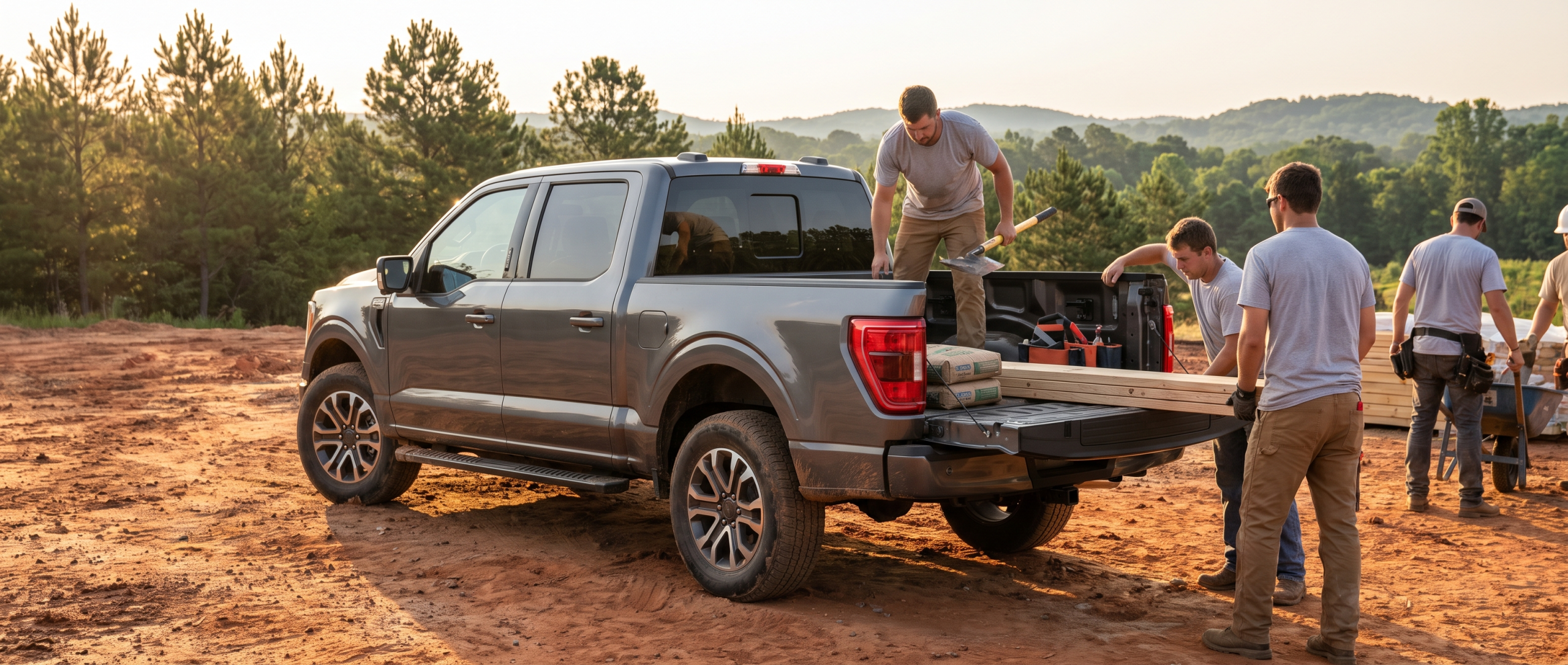
The harder tradeoff for work crews is the bed. Neither the SuperCab nor the SuperCrew offers an 8-foot bed. That’s exclusively a Regular Cab option on the F-150. If your crew hauls full sheets of drywall or 16-foot lumber flat in the bed without an extender, the Regular Cab with an 8-foot box is the straight answer, even if it means giving up rear passenger seating.
Passenger Room as a Day-to-Day Reality
On paper the legroom gap looks like one number, but the daily reality is two things at once, room and access. What we see on our lot, and what customers tell us after they swap a SuperCab for a SuperCrew, is that the rear door setup is the part they wish someone had been blunt about upfront. Adults in the SuperCab back seat will be cramped on any long drive.
The SuperCrew’s 43.6 inches of rear legroom puts it squarely in SUV territory. The width helps. Parents loading rear-facing infant seats get the benefit of the extra door width, and taller crew members get to skip folding themselves in half for a long run up to Paris Mountain or down the Cherokee Foothills Scenic Highway on SC-11 with a full truck.
The SuperCab’s folding rear seats earn their spot for a different reason. Fold those seats up and the rear cab turns into a dry, locked storage area. For a contractor hauling power tools, that beats leaving equipment out in the open bed.
The Trim Level Angle Nobody Talks About
Trim choice can quietly make the cab decision for you, and it runs one direction only. The higher trims (King Ranch, Platinum, and Raptor) come as SuperCrew exclusively, so if you want a Lariat or below you get a genuine cab choice, and if you want King Ranch or Platinum comfort features the SuperCrew isn’t optional, it’s the only way in.
So if you’re eyeing the Max Recline Seats offered on King Ranch and Platinum, or the Raptor’s 37-inch tire package, the SuperCrew is already settled by the trim you want. For those buyers the cab choice isn’t really a choice at all.
So Which Should You Pick?
It splits cleanly by how you use the back of the truck, with one caveat for the trim shoppers. Sort yourself by who or what rides behind the front seats and the cab almost picks itself, though anyone reaching for King Ranch or above has the decision made already.
Pick the SuperCrew if: You have kids, carry adult passengers often, want any trim above the Lariat, or just want the truck to double as a family vehicle without compromise. The 10-inch legroom advantage is the kind of thing you feel on every single drive. See SuperCrew configurations in our inventory
Pick the SuperCab if: Your rear seats mostly carry tools, your crew runs smaller, and you’d rather keep the lighter curb weight working for you on payload. It’s a capable, straight-shooting truck for the job. Just go in clear-eyed about those rear doors and the 6.5-foot bed being your only bed option.
Pick the Regular Cab if: You need an 8-foot bed, you’re running a work fleet, and a rear seat is genuinely irrelevant to your operation. It’s the most cargo-focused F-150 configuration, with the highest payload ceiling in the lineup.
We’ve been selling F-150s in Greer since 1937. When someone sits in the truck before deciding instead of just reading specs, the question that separates SuperCab buyers from SuperCrew buyers is almost always the rear door. Sit in the back seat of both. The 10-inch gap between 33.5 and 43.6 inches answers it faster than any chart.
Frequently Asked Questions
Can adults fit comfortably in the back seat of a SuperCab?
Occasionally, yes. For shorter trips or smaller adults, the SuperCab’s 33.5 inches of rear legroom works fine. For daily use with adults or tall teenagers, it gets tight fast. If adults sit in back more than a couple times a month, the SuperCrew’s 43.6 inches of rear legroom is worth the upgrade.
Does the SuperCrew or SuperCab tow more?
The SuperCrew has the slight edge at the top. Ford lists maximum towing at 13,500 lbs for the 2026 F-150 in a SuperCrew configuration with the 3.5L EcoBoost, 4×4 drivetrain, 6.5-foot bed, Tow/Haul Package, and Max Tow Axle upgrade. The SuperCab tops out at around 13,300 lbs in its best configuration. The bigger practical difference is payload. The lighter SuperCab can carry 200 to 400 more pounds in the bed across comparable trim levels.
What’s the difference in rear doors between the two cabs?
SuperCab rear doors are rear-hinged and need the front door open first. SuperCrew doors open on their own, like a standard four-door vehicle. For families or crews loading passengers often, the SuperCrew’s door design is significantly more convenient.


