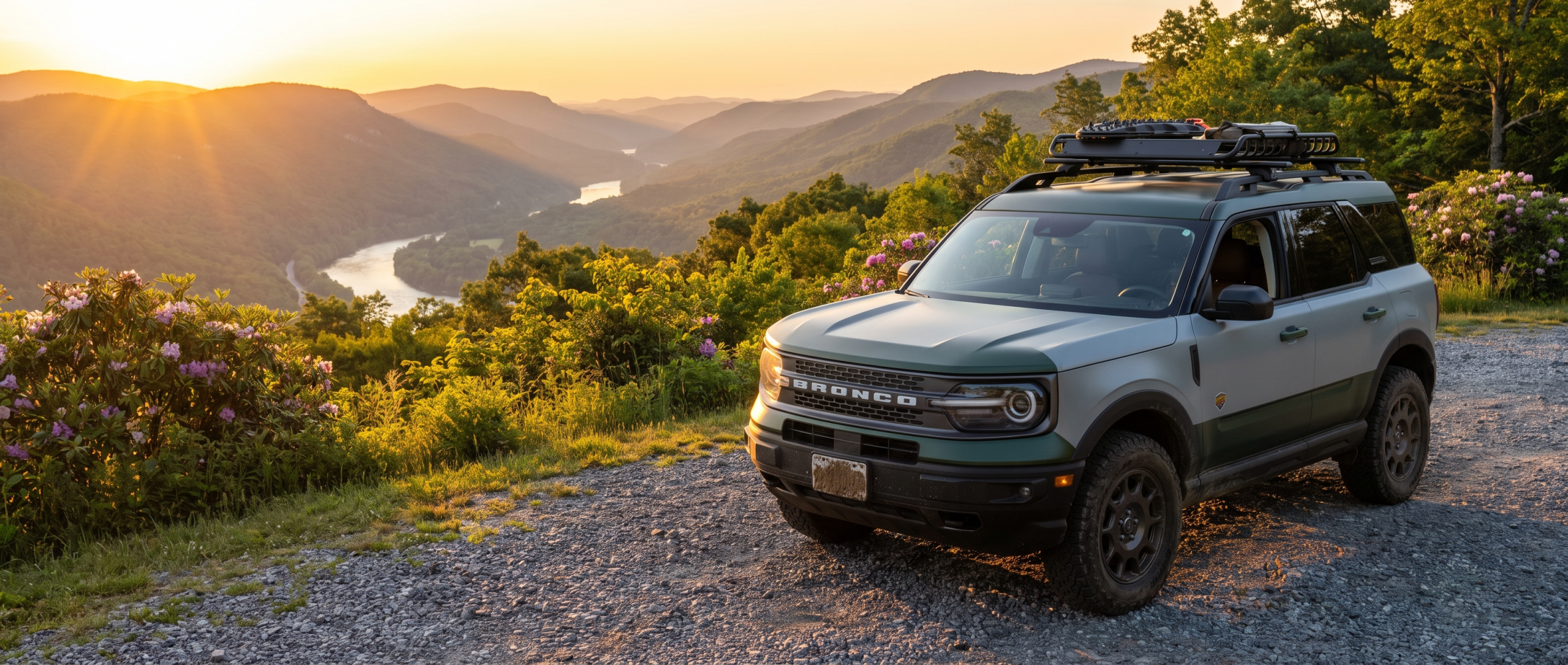
If you’re heading up US-276 from Greer toward Caesars Head State Park and Raven Cliff Falls, the 2026 Ford Bronco Sport is the stronger vehicle for the roads you’ll face on the way up, the tight first-come lot you’ll be maneuvering into, and the gear you need hauled out of the back. The Forester gets close, genuinely close, only when you step up to its Wilderness trim, which is its own separate price tier and its own separate conversation.
That’s our call. We’ll walk you through the reasoning below, spec by spec.
What’s the Plan at a Glance?
The trip from Greer runs roughly 30 miles on US-276, climbing the Blue Ridge Escarpment through sustained grades and tight switchbacks before you reach Caesars Head, so give yourself a real head start because the timing rules up here are strict. Trails close one hour before dark, day-use parking is first-come-first-served with zero roadside overflow allowed, and every trail on the park is rated advanced wilderness. The Raven Cliff Falls trail is 3.9 miles round trip with 754 feet of elevation gain. Plan your start time accordingly.
| Stop | What to Do | Best Time to Arrive | Parking Notes |
|---|---|---|---|
| US-276 from Greer | Sustained mountain grade, wet curves common after summer storms | Morning departure | Road-only, no stops needed |
| Caesars Head State Park Overlook | Blue Ridge Escarpment views, fall hawk-watching season | Before 10 AM on weekends | First-come lot only; no roadside parking |
| Raven Cliff Falls Trailhead | 3.9-mile round trip, 754 ft elevation gain, advanced terrain | Early morning start | Same lot as overlook; fills fast on summer weekends |
| Mountain Bridge Wilderness (Jones Gap link) | Longer loop trails, primitive backcountry camping by reservation | Full-day commitment | Separate Jones Gap access point |
The Capability Numbers That Actually Matter Here
Neither of these vehicles will struggle with a paved state highway, but US-276 gives both AWD systems a real workout on wet grades and tight curves, and that’s where the trim-level differences start to bite if you’re not paying attention. The 2026 Ford Bronco Sport carries 8.8 inches of ground clearance standard across the entire lineup. Every trim. Ford also rates it for up to 24 inches of water fording and builds seven GOAT terrain modes (Goes Over Any Type of Terrain) into every configuration without requiring a package upgrade. The 2026 Subaru Forester runs 8.7 inches of clearance on its standard trims, and X-MODE traction control is available only on higher-grade configurations. At equivalent tier pricing, the Bronco Sport clears slightly more ground and delivers a more complete terrain-management system standard. Browse Bronco Sport trims at D&D Ford to see what’s on the lot right now.
The Forester Wilderness Changes the Equation (for the Right Buyer)
The 2026 Subaru Forester Wilderness genuinely changes this comparison for the right buyer, though it doesn’t move the needle for everyone, so we’ll give you a straight answer on where it wins and where the standard Forester quietly gives that capability back. Subaru increased ground clearance to 9.3 inches for 2026, fitted Yokohama Geolandar all-terrain tires, added Dual-Function X-MODE (Snow/Dirt plus Deep Snow/Mud settings), and rated the Wilderness for 3,500 pounds of towing capacity. The EPA rates standard 2026 Forester models at 26 city and 33 highway miles per gallon with the 2.5-liter flat-four. For longer mountain legs, that’s a genuine efficiency advantage.
The tradeoff is real. You only get those numbers at the Wilderness trim level. Step back to the standard Forester, and clearance drops to 8.7 inches, X-MODE moves behind higher configurations, and the tow rating falls to 1,500 pounds. If your mountain trips involve a loaded cargo trailer or a dedicated overlanding kit, the Wilderness earns its place. If you’re doing day hikes at Caesars Head with gear in the back, the case is weaker. See what’s currently in our Ford inventory to compare configurations side by side.
Why the Bronco Sport Fits This Drive
Cargo capacity is where the Bronco Sport earns the mountain run from Greer, and it does it without asking you to buy up a trim tier, though the Badlands stays the pick if you want the most aggressive off-road hardware. Ford lists 32.5 cubic feet behind the rear seats, and the optional slide-out cargo table turns the tailgate area into a genuine gear-staging platform when you’re swapping trail shoes at the trailhead. The 1.5-liter EcoBoost three-cylinder (180 horsepower, 200 lb-ft of torque) runs in every trim except the Badlands and returns EPA-rated 25 city / 30 highway miles per gallon. A 60-mile round trip to Caesars Head and back, with a decent climb woven into it, is exactly the kind of mixed driving where that efficiency shows up. The Badlands’ 2.0-liter EcoBoost (250 horsepower, 280 lb-ft of torque) is the right call if you want the full Advanced 4×4 system with twin-clutch rear drive and the more aggressive off-road tune. For pavement-plus-parking-lot duty, the 1.5-liter is the honest pick and costs you nothing in capability on this route.
We’ve been serving the Carolinas since 1937, and the Blue Ridge has always been part of what Upstate SC buyers want their vehicles to reach. The Forester is a capable, well-built machine, and it’s the right choice for a specific buyer. But for a typical Greer-to-Caesars-Head run in a compact SUV, the Bronco Sport covers the terrain, hauls the gear, and delivers the terrain modes without requiring you to buy up a trim tier to unlock the capability you actually need. See available Bronco Sports at D&D Ford Motors and let our team walk you through the trims that fit your mountain season.
By the D&D Ford Motors Team | July 2026


