

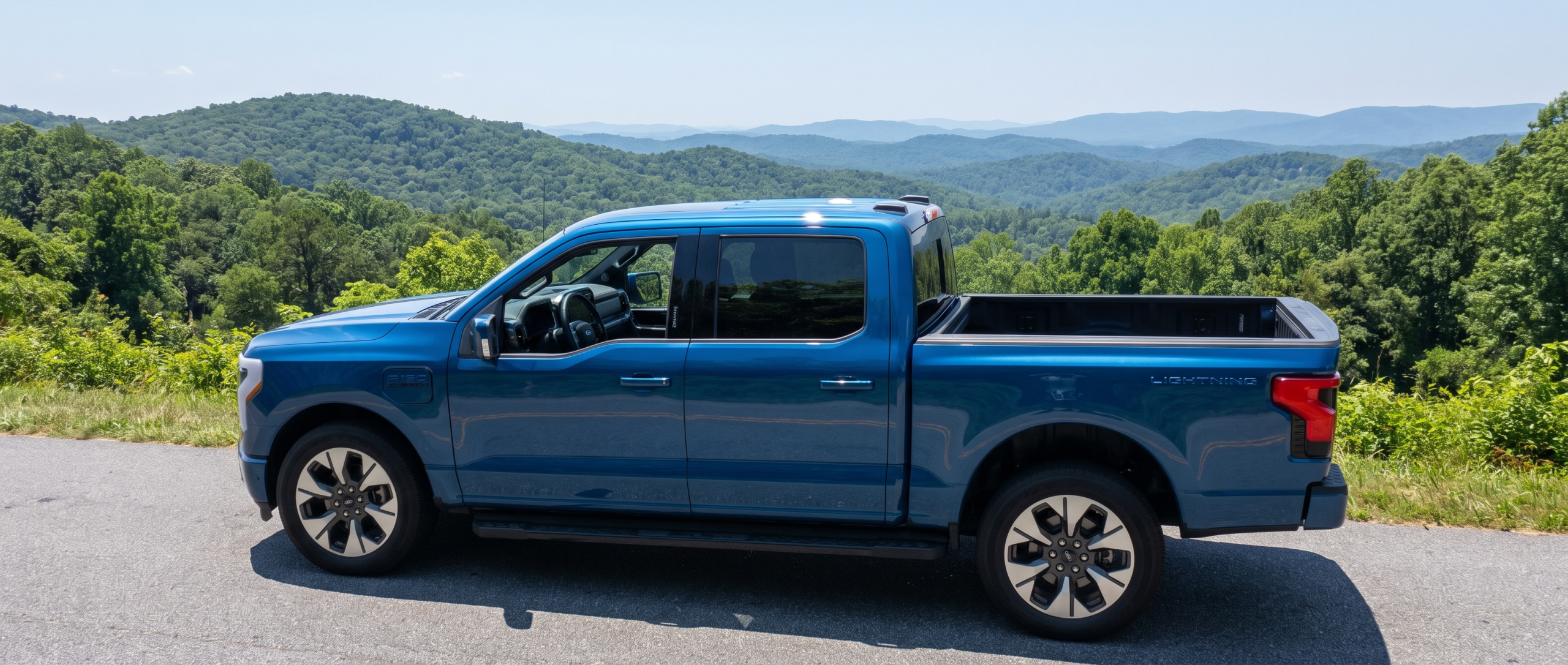
If you’re looking at a 2025 Ford F-150 Lightning right now, here’s the straightforward version of what to expect: it drives like a truck, charges like an appliance, and asks you to think differently about one thing you’ve probably never had to think about before. Specifically, how far you’re going, and whether there’s a fast charger somewhere between here and there.
The 2025 Lightning is the final model year of the all-electric F-150 Lightning. Ford ended production in December 2025 and has announced a future extended-range model. That means the units in the market today, new remaining inventory and a fast-growing used market, are what’s available. For the right Upstate SC buyer, that reality sharpens the decision rather than killing it. We’ve been selling and servicing the Lightning in Greer since it launched, and this guide walks you through what ownership actually looks like around Greenville County.
See our current Ford F-150 inventory at D&D Ford Motors
How Far Will It Really Go Around Here?
The EPA rates the 2025 Lightning at 240 miles (standard-range battery) or up to 320 miles (extended-range battery on the Lariat trim), and those numbers assume no trailer, moderate speeds, and mild weather. On a typical Upstate SC summer day, all three of those assumptions take a hit at once.
Here’s the practical range picture for common Greenville County scenarios, based on EPA-rated figures and Ford’s published towing impact estimates:
| Trip / Leg | Battery Option | Connector / Speed | Charge Dwell | Range Note |
|---|---|---|---|---|
| Daily Greer-Greenville commute (~20 mi round trip) | Standard (240 mi EPA) | Level 2 home overnight | None needed | Covered 10x over; home charge restores trip miles in under 2 hrs |
| Greer to GSP Airport and back (~30 mi round trip) | Standard (240 mi EPA) | Level 2 home overnight | None needed | Trivial; 30 miles is about 12% of rated range |
| Greer to Lake Hartwell with a boat (~80 mi one-way) | Extended (320 mi EPA) | DC fast charge on return if needed | 38 min (15%-80%) | Towing cuts range 40-60%; plan a fast-charge stop if the boat is a tall boxy rig |
| I-85 run to Charlotte (~100 mi one-way, no trailer) | Extended (320 mi EPA) | NACS/DC fast charge at destination or en route | ~38 min | Extended battery handles it without a stop; standard-range is tighter at highway speeds |
| Lake Keowee camping run pulling a camper (~70 mi) | Extended (320 mi EPA) | DC fast charge before return trip | 38 min (15%-80%) | A large camper at 70 mph can cut range in half; add a stop going back |
The gap between the EPA number and real-world highway range matters here. Ford’s own towing impact data shows that pulling near the Lightning’s maximum tow capacity can drop usable range to roughly 34 percent of the rated figure. Internalize that number before you hook up a loaded boat on a 95-degree Greenville County afternoon, because summer heat adds battery cooling load on top of the towing penalty.
Our honest take: for anyone commuting daily on I-85 or making short cross-county runs, the Lightning is effortless. The calculus changes the moment you add a trailer and highway speeds together. That’s not a reason to walk away. It’s a reason to know your trip before you leave the lot.
Where Do You Charge Locally?
Greenville County has 195 public charging ports (Level 2 and DC Level 3) within 15 kilometers of downtown Greenville, per ChargeHub’s network data. That’s a solid public infrastructure footprint for Upstate SC, and it keeps growing. For most Lightning owners here, though, the answer to “where do you charge?” is simpler than the map suggests: your garage, overnight, while you sleep.
Browse available Ford inventory at D&D Ford Motors
The 2025 Lightning accepts Level 2 AC charging at 11.3 kW through the Ford Connected Charge Station. With the extended-range battery, that restores a full charge in roughly 14.6 hours. Plug in after dinner and you’ve got a full truck by sunrise. Ford’s spec sheet shows the 80A Ford Charge Station Pro pushes it even faster, at about 30 miles of range per hour on the extended pack.
For road trips or post-tow top-ups, DC fast charging at a 150 kW station takes the 2025 Lightning’s extended-range battery from 15% to 80% in about 38 minutes, per Ford’s official spec sheet. And as of the 2025 model year, every Lightning comes standard with a NACS Fast Charging Adapter, giving you access to Tesla Supercharger stations. That network adds thousands of additional fast-charge locations across the Southeast corridor and along I-85.
Schedule a service appointment at D&D Ford Motors
Here are the practical things to know about living with home charging in Greenville County:
- An EV charger installation in SC requires an electrical permit, and Duke Energy’s EV Charger Rebate Program requires a licensed, permitted install to qualify
- The 2025 Lightning’s onboard charger accepts up to 48A (11.3 kW) on Level 2; a 50A dedicated circuit is the standard install target
- Level 1 charging (standard 120V outlet) adds about 2 miles of range per hour, workable for top-ups, not for overnight recovery of a depleted extended-range battery
- Ford recommends setting your daily charge limit to 90% to preserve long-term battery health, and charging to 100% only before a longer trip
Plan It This Way
The Lightning is a genuinely useful truck for the right Upstate SC buyer, though it’s worth being clear about where it fits and where it doesn’t. Here’s how to sort yourself before you commit.
It works well if your daily drive is under 80 miles, you can install a Level 2 charger at home (or at a predictable workplace), your towing is moderate and local (boats to Lake Hartwell, utility trailers around Greenville County), and you treat trip planning as normal rather than inconvenient.
It gets harder when you regularly haul heavy trailers over 100 miles of highway, work out of rural areas where fast charging is scarce, or your situation doesn’t support home charging at all (apartment living, no dedicated parking). Those conditions are real friction points, and we’d rather you know them now.
The discontinued-production reality actually matters here. There’s no new 2026 Lightning on the way. If you find a remaining new unit or a low-mileage used one, you’re getting a truck with a known spec sheet, a real-world ownership community, and a parts and service network that isn’t going anywhere. Ford dealers like us support Lightning service regardless of whether new production continues. The next all-electric truck Ford builds will be a different platform with different economics. The Lightning you can buy today is a finished, proven product.
Value Your Trade Toward a Lightning
Talk to our team about what’s in the market right now. We can walk you through what a home charging install actually involves, what the range math looks like for your specific commute, and whether a new remaining unit or a used Lightning fits what you’re trying to do.
Explore financing options at D&D Ford Motors
Frequently Asked Questions
Does the Ford F-150 Lightning lose range in Greenville County summer heat?
Yes, and it’s worth understanding the mechanism. The 2025 Lightning’s battery thermal management system uses energy to keep the pack at safe operating temperature during hot weather. Running the air conditioning simultaneously adds to that load. The practical effect is a modest range reduction on very hot days. Not dramatic, but real. The FordPass app’s pre-conditioning feature lets you cool the cabin while the truck is still plugged in, which protects your rated range before you drive.
How much does towing cut the Lightning’s range?
Significantly, and Ford’s own towing impact estimates put a number on it: pulling near the Lightning’s 10,000-lb maximum capacity can reduce usable range to roughly 34 percent of rated. At more common towing weights (a boat, a utility trailer, a loaded landscape rig), independent tests suggest planning for roughly half your normal highway range with a sizable trailer at speed. The Lightning’s onboard trailer profiles and Intelligent Range system help you monitor this in real time. For regional towing under 100 miles round-trip with access to a Level 2 charger, most owners find it workable.
Can the 2025 Lightning charge at Tesla Superchargers?
Yes. Every 2025 Ford F-150 Lightning comes standard with a NACS Fast Charging Adapter, which enables access to the Tesla Supercharger network, more than 12,000 chargers across North America. The FordPass app integrates charging location data so you can route stops before leaving. This substantially expands the fast-charging options available on I-85 and along Southeast travel corridors, which was a real limitation on earlier Lightning model years.


