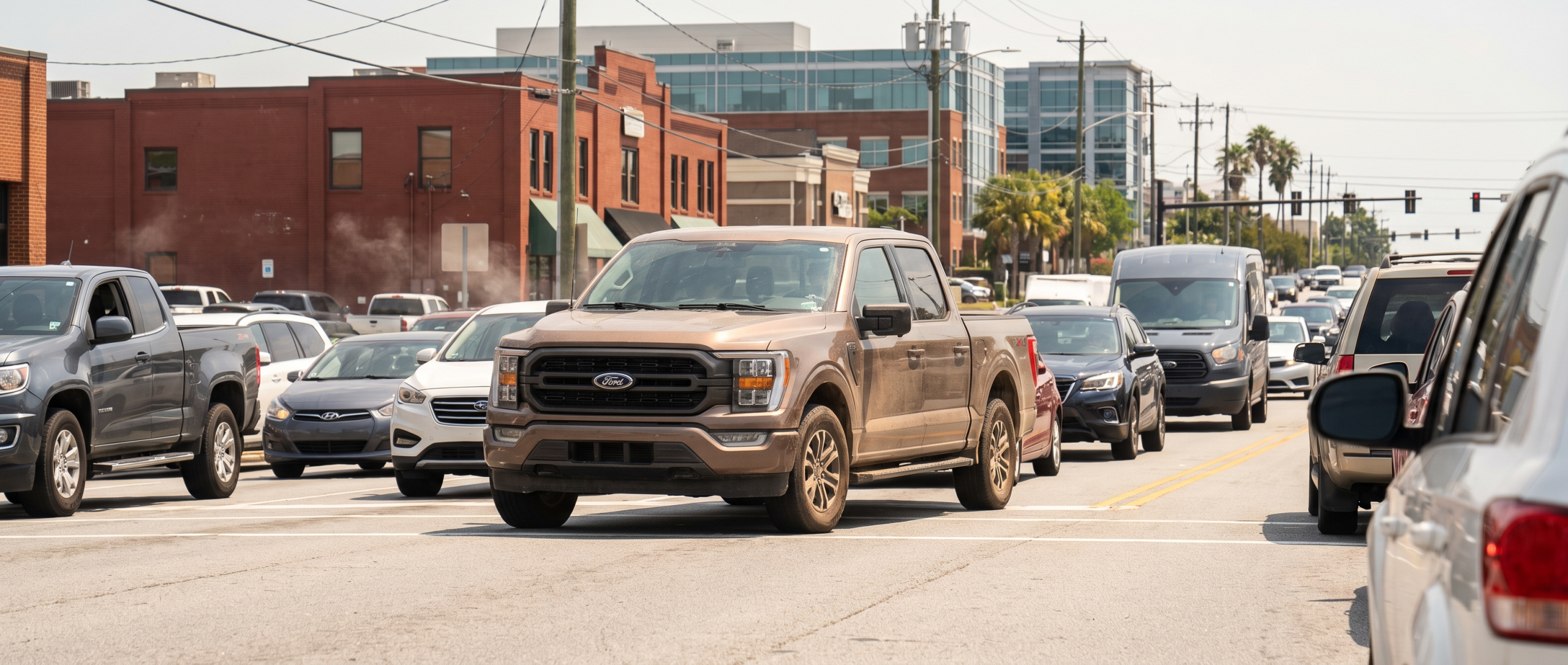
Woodruff Road handles more than 40,000 vehicles a day according to the South Carolina Department of Transportation — and this summer, with a major bypass project still years from completion, every one of those trips is a brake event. Repeated short stops from 35 mph, hot pavement baking the wheel wells, and a truck bed loaded for a Lake Hartwell weekend all add up to one thing: brakes working harder than they were designed to under those combined conditions. Run through this checklist before your next Woodruff run and you will know exactly where you stand.
The 2026 Ford F-150 uses front rotors measuring 350 mm in diameter and 34 mm thick, per Ford’s published specifications — substantial hardware, but hardware that still needs attention when Upstate SC summers push brake temperatures into territory where fluid fade and pad glazing become real risks.
What Goes on the Brake Safety Checklist?
Work through all seven items before your next drive in heavy summer traffic. Each one takes under five minutes to check yourself, and any item that fails the visual test is a clear signal to book a service appointment.
- Brake pad thickness. New Ford pads start around 10-12 mm of friction material. Ford’s service specifications set the minimum at 3.0 mm — at that point, replacement is not optional. If you can see that the pad visible through the wheel spokes looks paper-thin, you are close.
- Rotor surface condition. Look for a visible lip or ridge at the rotor’s outer edge. A deep ridge means the rotor has worn unevenly and may need resurfacing or replacement. The 2026 F-150’s front rotors carry a minimum usable thickness spec — rotors worn past that point cannot safely dissipate summer heat.
- Brake fluid color and level. The reservoir sits under the hood. Fluid should be clear to light amber. Dark, dirty fluid absorbs moisture over time; Ford’s guidance is to follow the owner’s manual interval and replace fluid that has gone dark. Brake fluid is hygroscopic — it pulls moisture from the air — and that moisture lowers the fluid’s boiling point. In summer stop-and-go conditions, degraded fluid can boil inside the caliper and produce a spongy pedal.
- Pedal feel. Press the brake pedal firmly from a slow roll in a parking lot. It should feel firm and consistent. A soft or spongy pedal, one that travels further than usual before resistance builds, or one that pulsates under your foot all point to conditions requiring immediate inspection. Ford’s own guidance lists a soft or squishy pedal as a reason to have your brakes inspected at your dealer right away.
- Warning lights. The solid red brake warning symbol or the ABS indicator on your dashboard are not suggestions. Modern Ford trucks, including the Ford Expedition and F-150, use brake pad wear sensors on some trim levels that trigger a dashboard alert before pads reach the metal-on-metal stage.
- Towing trailer module recall status (critical for tow-capable trucks). NHTSA recall 26C10, issued in early 2026, covers 2021-2026 F-150, 2022-2026 F-250, F-350, F-450, F-550, Maverick, 2024-2026 Ranger, 2022-2027 Expedition, and other Ford models. Per NHTSA, the integrated trailer module may lose communication with the vehicle when a trailer is connected, possibly causing a loss of trailer brake function or trailer lighting. If your Ford is in that range and you tow — a boat to Lake Hartwell, a camper on the Cherokee Foothills National Scenic Highway — check your VIN against the NHTSA recall database before your next trip.
- Pulling or vibration during braking. If your truck drifts left or right during a brake application, or if the steering wheel shudders when you slow from highway speed, a caliper may be sticking or a rotor may be warped from heat cycling. Either condition gets worse in sustained summer traffic.
Why These Items Matter on Woodruff Road Specifically
Stop-and-go traffic is the hardest environment for brakes because the cooling cycle between stops is short. Each brake application generates friction heat at the rotor face. In free-flowing highway driving, airflow carries that heat away between stops. On Woodruff Road in July — creeping through a string of signalized intersections, stopping behind traffic backed up into a shopping center exit — the wheel barely cools before the next pedal press.
The Ford Maverick and full-size trucks like the Ford Super Duty carry different brake system calibrations because their weight and towing loads demand it. A Super Duty towing a loaded trailer through stop-and-go conditions in 95-degree heat is stressing the system far beyond what a light commuter car places on its brakes.
Brake fluid behavior in summer heat is the piece most drivers miss. Brake fluid is hygroscopic, meaning it absorbs moisture from the air over time. That moisture lowers the fluid’s boiling point. In heavy traffic conditions, the caliper temperature can climb enough that degraded fluid boils, forming a vapor pocket — that vapor is compressible in a way that brake fluid is not, and the result is a suddenly spongy pedal at exactly the moment you need firm, predictable stopping.
Why Summer Stop-and-Go Accelerates Pad Wear
| Brake Stressor | Why It Matters in Summer Traffic |
|---|---|
| Repeated short stops from low speed | Minimal cooling time between brake applications; heat builds cumulatively |
| Ambient heat (Upstate SC summer highs) | Raises baseline brake component temperature before any braking begins |
| Loaded vehicle (beach gear, tools, passengers) | Greater vehicle mass requires more friction force to stop; pads wear faster |
| Trailer towing on a hot day | Trailer weight multiplies stopping demand; trailer brakes must also be functional |
| Degraded brake fluid | Lower boiling point increases risk of vapor lock and spongy pedal feel |
| Worn or glazed pads | Reduced friction coefficient means longer stopping distances even before fade |
Your Print-and-Go Recap Before the Next Woodruff Run
Print this list or screenshot it. Walk through it in your driveway before a summer road day.
- [ ] Brake pads visually check thicker than a pencil eraser through the wheel spokes
- [ ] No visible deep ridge or rust lip at the outer rotor edge
- [ ] Brake fluid is clear to light amber in the reservoir (not dark or murky)
- [ ] Pedal feels firm and consistent — no sponginess, no extra travel
- [ ] No red brake warning light or ABS light on the dashboard
- [ ] VIN checked against NHTSA recall 26C10 if your Ford was built 2021 or later and tows
- [ ] No pulling, drift, or steering-wheel shudder when braking from highway speed
If any item on this list raises a question, the right call is a professional brake inspection before your next heavy-traffic or towing day. D&D Ford Motors has been serving Greer and the Carolinas since 1937 — our service team checks pad thickness with precision measuring tools, inspects rotors, verifies fluid condition, and confirms your recall status in one visit.
Frequently Asked Questions
Does summer heat actually make my Ford’s brakes less effective?
Yes, and the mechanism is specific. Brake fluid absorbs moisture from the air over time, which lowers its boiling point. Ford’s guidance identifies a soft or squishy pedal as a sign to get brakes inspected immediately — that spongy feel in heavy traffic is often the early warning of fluid that has been heat-stressed past its effective operating range. Upstate SC summer temperatures push ambient underhood temps high enough that this matters in sustained stop-and-go driving, not just on a track or a mountain descent.
How do I know if my Ford truck is covered by NHTSA recall 26C10?
Recall 26C10 covers a wide range of Ford trucks and SUVs built between 2021 and 2027, including the F-150, F-250, F-350, F-450, F-550, Maverick, Ranger, and Expedition. The defect involves the integrated trailer module losing communication when a trailer is connected, potentially causing a loss of trailer brake function. Check your VIN for free at nhtsa.gov or ask the service team at D&D Ford Motors to run your VIN through the NHTSA database at your next visit. The remedy — a software update — is available at no charge.
Schedule Your Brake Inspection
If your Ford or your family’s vehicle is due for a change altogether, take a look at what is currently available on the lot.


