Blog

Ford Cooling System Tips for South Carolina Heat in Greer, SC

Ford vehicle AC system service in Greer, SC

South Carolina summers push vehicle cooling systems harder than almost anywhere else in the country, with Greer, SC experiencing 90+ degree days from May through September combined with humidity that makes engines work overtime. Your Ford®'s cooling system is the unsung hero that prevents catastrophic engine damage, yet most drivers don't think about it until steam pours from under the hood on I-85. Understanding how to maintain your cooling system before problems arise will save you from roadside breakdowns and expensive repairs, especially if you regularly haul heavy loads to Lake Robinson or climb the grades near Glassy Mountain. This guide provides Ford-specific cooling system insights that help Greer residents protect their investment and avoid the frustration of overheating during our brutal summer months.

Understanding Your Ford's Cooling System Components

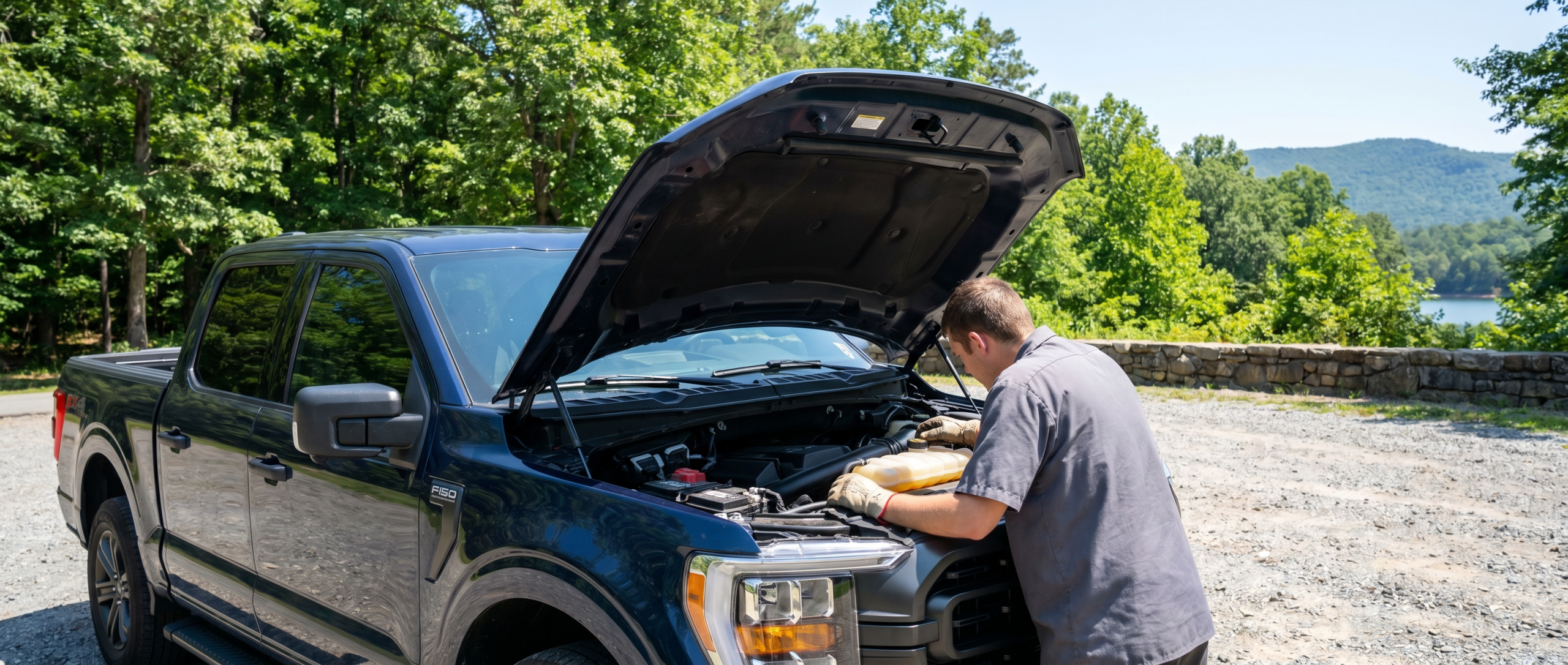
Your Ford F-150 or Explorer uses a sophisticated liquid cooling system with multiple components working together - when one fails, the entire system struggles to keep your engine at the optimal 195-220°F operating temperature.

The heart of the system is your water pump, which circulates 7,350 gallons of coolant per hour at highway speeds. This mechanical pump drives coolant through passages inside your engine block, absorbing heat from combustion. The heated coolant then flows to your radiator, where air passing through the fins removes heat before the cooled liquid returns to the engine.

Did you know? Ford trucks built after 2011 use a specialized orange coolant (Motorcraft Orange) that lasts up to 10 years or 200,000 miles - twice as long as traditional green coolant.

Your thermostat acts as the system's traffic controller, remaining closed when the engine is cold to speed warm-up, then opening at precisely 195°F to allow coolant flow. The radiator cap maintains 16 PSI of pressure, raising the coolant's boiling point to 250°F - critical for preventing boil-over in South Carolina heat.

The cooling fan provides additional airflow when you're stuck in traffic on Wade Hampton Boulevard or climbing steep grades. Modern Ford vehicles use electric fans controlled by the PCM (Powertrain Control Module), which monitors coolant temperature and activates the fan as needed.

Common Cooling Problems in Hot, Humid Climates

The combination of high temperatures and extreme humidity in the Greenville-Spartanburg area creates unique challenges that accelerate cooling system wear beyond what Ford engineers originally anticipated for national averages.

Radiator corrosion occurs faster here due to our humidity levels averaging 70% year-round. Moisture in the air combines with road salt from winter treatments on US-29, creating an electrochemical reaction that eats through aluminum radiator fins. You'll notice reduced cooling efficiency long before visible damage appears.

Signs of humidity-related cooling system damage:

  • White or green crusty deposits on radiator connections
  • Pinhole leaks that appear as dried coolant trails
  • Reduced heat output from your cabin heater
  • Gradual coolant loss without visible puddles
  • Temperature gauge creeping higher in stop-and-go traffic

Coolant degradation happens 30% faster in our climate compared to dry regions. The constant heat cycling and humidity exposure breaks down coolant additives that prevent corrosion and maintain proper pH levels. When these additives deplete, acidic coolant begins attacking gaskets, hoses, and metal components from the inside.

Water pump bearing failure is another regional concern. The humidity creates condensation inside the cooling system during temperature swings, washing away bearing lubricants. F-150 and Super Duty® owners who frequently tow boats to Lake Keowee experience accelerated wear from the additional heat load.

Essential Maintenance Schedule for South Carolina Conditions

Ford's standard maintenance intervals don't account for the extreme conditions we face from Anderson to Simpsonville, requiring adjusted service schedules to prevent failures during peak summer heat.

Service ItemFord RecommendationSC Adjusted IntervalCritical Months
Coolant Level CheckMonthlyWeekly (May-Sept)June-August
Radiator InspectionAnnuallyEvery 6 monthsApril & October
Coolant Flush100k miles60k milesSpring preferred
Hose ReplacementAs neededEvery 4 yearsBefore summer
Thermostat Service150k miles100k milesSpring/Fall

Weekly coolant checks during summer months catch problems before they strand you. Park on level ground and check the translucent overflow tank when the engine is cold - the level should sit between MIN and MAX marks. Low coolant often indicates a slow leak that needs attention.

Pro tip: Schedule cooling system service in April before the heat arrives. Our service technicians see a 40% spike in cooling failures during the first heat wave of summer.

Radiator cleaning twice yearly removes debris that blocks airflow. Bugs, pollen, and road grime accumulate faster here than in other regions. Use a garden hose to gently flush from the engine side outward, being careful not to bend the delicate fins.

DIY Checks vs. Professional Service

Some cooling system maintenance tasks are perfect for handy Mustang or Maverick owners, while others require professional equipment and expertise to perform safely.

Safe DIY maintenance tasks:

  • Visual coolant level checks
  • Inspecting hoses for cracks or soft spots
  • Cleaning debris from radiator fins
  • Testing radiator cap pressure with a rental tool
  • Checking belt tension on older models

Leave these to professionals:

  • Coolant system pressure testing
  • Water pump replacement
  • Radiator core repair or replacement
  • Head gasket diagnosis
  • Cooling fan motor testing

The most overlooked DIY check is hose condition. Squeeze the upper and lower radiator hoses when cool - they should feel firm but flexible. Soft, spongy hoses indicate internal deterioration that isn't visible externally. Replace any hose showing cracks, swelling, or excessive softness.

Professional service becomes essential when dealing with pressurized systems or internal engine components. Modern Ford engines like the 3.5L EcoBoost in the F-150 have complex cooling systems with multiple thermostats and intricate coolant routing that require specialized knowledge.

Summer Driving Strategies to Prevent Overheating

How you drive during South Carolina summers directly impacts cooling system stress, especially when navigating the steep grades around Caesar's Head State Park or sitting in Columbia traffic.

When climbing long hills with a loaded Expedition Max, downshift to maintain steady RPMs rather than flooring the accelerator. Higher RPMs increase water pump flow and cooling fan speed, providing better heat dissipation than lugging the engine in a high gear. Watch your temperature gauge closely - if it rises above the normal midpoint, pull over before it reaches the red zone.

Traffic jam cooling strategies:

  • Shift to neutral when stopped to reduce engine load
  • Turn off AC if temperature rises (AC adds heat load)
  • Crack windows and use fresh air ventilation
  • Avoid riding the brakes - heat transfers to the engine bay
  • Leave extra following distance to minimize stop-and-go

Towing requires special attention during summer months. Your Super Duty's cooling system works 40% harder when pulling heavy loads. Engage tow/haul mode to activate enhanced cooling programs, and consider installing an auxiliary transmission cooler if you regularly pull boats or RVs. Monitor both engine and transmission temperatures, as either can cause the other to overheat.

Pre-trip preparation prevents most summer breakdowns. Check your coolant level before any trip longer than 50 miles, and carry an extra gallon of properly mixed coolant. If your Ranger sits for extended periods, run it for 10 minutes weekly to circulate fluids and prevent seal deterioration.

Warning Signs Your Ford Needs Immediate Attention

Recognizing early warning signs prevents minor cooling issues from becoming major repairs that sideline your vehicle during peak summer travel season.

Temperature gauge fluctuations indicate air pockets or low coolant before complete failure occurs. If your gauge swings between normal and hot, or drops to cold while driving, stop immediately and check coolant levels. Air in the system prevents proper heat transfer and can cause localized hot spots that damage head gaskets.

Sweet antifreeze smell inside your cabin means heater core leakage - a $600-1,200 repair if caught early, or potential dashboard removal if ignored. This smell is distinctly different from moldy AC odors and usually accompanies foggy windshield conditions that won't clear.

Critical warning signs requiring immediate shutdown:

  • ✓ Steam from under the hood
  • ✓ Temperature gauge in the red zone
  • ✓ Knocking or pinging sounds from engine
  • ✓ Loss of power with high temperature
  • ✓ Coolant puddles under the vehicle

White exhaust smoke that smells sweet indicates coolant entering combustion chambers through a blown head gasket or cracked head. This requires immediate attention as continued driving will destroy the engine. A slight puff of white smoke on cold starts is normal condensation, but continuous white clouds spell trouble.

Hood surface temperature provides a quick diagnostic. If you can't hold your hand on the hood after driving, internal temperatures are excessive. This often indicates fan failure or severely restricted radiator flow that needs professional diagnosis.

Common Questions About Ford Cooling Systems in Greer, SC

How often should I flush my Ford's coolant in South Carolina's climate?

Flush your Ford's coolant every 60,000 miles in South Carolina, compared to the standard 100,000-mile interval recommended nationally. The intense heat cycles and humidity in Greer accelerate coolant breakdown, making more frequent service essential for preventing corrosion and maintaining proper heat transfer through the system.

Why does my F-150 run hotter when towing in summer around Greer?

Your F-150 runs hotter when towing because the additional weight increases engine load by 30-50%, generating more heat than the stock cooling system was designed to dissipate continuously. The hills around Greer and highways like I-385 compound this effect, making auxiliary cooling upgrades recommended for frequent towers.

What's the normal operating temperature for Ford vehicles in SC heat?

Normal operating temperature for Ford vehicles ranges from 195-220°F, even in South Carolina summer heat. Your temperature gauge should stay near the center position; if it regularly reads above the midpoint during normal driving around Spartanburg, have your cooling system inspected for restrictions or degraded coolant.

Can I use any coolant brand in my Ford truck?

Use only Motorcraft Orange coolant or exact equivalent in 2011+ Ford trucks, as mixing coolant types causes chemical reactions that form sludge and destroy water pump seals. Earlier models use Motorcraft Gold, and using the wrong type voids warranty coverage while potentially causing thousands in damage to your cooling system.

Where can I get my Ford's cooling system checked in Greer, SC?

Schedule service at a certified Ford dealership in Greer for cooling system inspection, as factory-trained technicians understand model-specific requirements and use proper Motorcraft parts. Professional pressure testing and diagnostic equipment identify problems before they cause breakdowns on hot days traveling I-85 or Highway 101.

Does running the AC affect my Ford's cooling system performance?

Running your AC adds 10-15% more heat load to your Ford's cooling system because the condenser sits directly in front of the radiator, preheating incoming air. In extreme heat above 95°F common in Greer summers, temporarily switching off AC when climbing steep grades helps prevent overheating in older vehicles.

Protecting Your Ford Through Every Season

Your Ford's cooling system works hardest during South Carolina summers, but year-round attention prevents those frustrating breakdowns that always seem to happen at the worst possible moment. Regular maintenance costs far less than emergency repairs, and staying ahead of problems means never worrying about steam clouds while merging onto I-26.

Taking care of your cooling system protects your entire engine investment. Whether you drive a hardworking F-250SD around construction sites or commute in an Escape through downtown Greenville, these maintenance practices ensure reliable performance when temperatures soar. The team at D&D Ford Motors understands how our local climate challenges cooling systems and can help keep your Ford running strong through the hottest days ahead.

Remember that prevention beats repair every time - especially when you depend on your vehicle for work or family obligations throughout the Upstate.

D&D Ford Motors

13655 E Wade Hampton Blvd, Greer, SC 29651

(864) 877-0711

Recommended Posts

2026 Ford F-150 towing a travel trailer through Upstate South Carolina fall foliage toward the Blue Ridge

5 Ford F-150 Configurations That Actually Work for Fall Camping Trips

{ "@context": "https://schema.org", "@type": "AutoDealer", "name": "D&D Ford Motors", "url": "https://www.ddmotors.com", "telephone": "(864) 877-0711", "address": { "@type": "PostalAddress", "streetAddress": "13655 E Wade Hampton Blvd", "addressLocality": "Greer", "addressRegion": "SC", "postalCode": "29651" } } { "@context": "https://schema.org", "@type": "Article", "headline": "5 Ford F-150 Configurations That Actually Work for Fall Camping Trips", "publisher": { "@type": "Organization", "name": "D&D Ford Motors" }, "datePublished": "2026-09-15", "dateModified": "2026-09-15" } #just-private-label * { box-sizing: border-box; } #just-private-label { font-family: inherit; line-height: 1.7; color: #333333; max-width: 800px; margin: 0 auto; padding: 20px; } #just-private-label h2 { font-size: 1.5em; font-weight: 600; margin-top: 1.5em; margin-bottom: 0.75em; color: #000000; } #just-private-label h3 { font-size: 1.2em; font-weight: 600; margin-top: 1.2em; margin-bottom: 0.5em; color: #000000; } #just-private-label p { margin-bottom: 1em; font-size: 1em; } #just-private-label a { color: #000000; text-decoration: underline; } #just-private-label a:hover { text-decoration: none; } #just-private-label strong { font-weight: 600; } #just-private-label ul, #just-private-label ol { margin-bottom: 1em; padding-left: 1.5em; } #just-private-label li { margin-bottom: 0.5em; } #just-private-label .tip-box { background-color: #f9f9f9; border-left: 4px solid #333333; padding: 15px; margin: 1.5em 0; } #just-private-label .cta-section { margin-top: 2em; padding: 20px; text-align: center; } #just-private-label .cta-button { display: inline-block; padding: 12px 24px; margin: 10px; background-color: #1b376a; color: #ffffff !important; text-decoration: none; font-weight: 600; } #just-private-label .cta-button:hover { opacity: 0.9; text-decoration: none; } #just-private-label .dealer-footer { margin-top: 40px; padding-top: 20px; border-top: 1px solid #e0e0e0; text-align: center; font-size: 14px; color: #666666; } #just-private-label .dealer-footer p { margin: 5px 0; } @media (max-width: 600px) { #just-private-label { padding: 15px; } #just-private-label h2 { font-size: 1.3em; } #just-private-label h3 { font-size: 1.1em; } #just-private-label .cta-button { display: block; margin: 10px 0; } } In this article The 2026 Ford F-150 Fall Camping Tow Rankings The 3.5L EcoBoost with the Tow/Haul Package and Max Tow Axle The 5.0L V8 for Grade-Climbing Confidence The PowerBoost Hybrid for Camp-Ready Power The 2.7L EcoBoost for Lighter Rigs Three Things to Confirm Before You Hitch Up This Fall Why the 3.5L EcoBoost Earns the Top Spot Every Fall Fall camping in Upstate South Carolina is not flat. The grades climbing toward Caesars Head State Park and the Cherokee Foothills Scenic Highway will sort out a properly equipped F-150 from one somebody bought without thinking through the packages. If you're hitching up a travel trailer for the first time this season, our top pick is the 3.5L EcoBoost V6 paired with the Tow/Haul Package and Max Tow Axle. Full stop. That setup unlocks up to 13,500 lbs of tow capacity on the 2026 Ford F-150 and gives you the transmission behavior and trailer brake coordination you need on a real mountain descent. Every other configuration on this list is legitimate for the right trailer and the right family. We'll walk through the rankings, and why the numbers on the window sticker only tell part of the story. The 2026 Ford F-150 Fall Camping Tow Rankings The table below ranks by real-world utility for an Upstate SC fall camping trip, weighing rated capacity, the specific configuration that gets you there, and the one standout feature that earns each spot. Rank Configuration Max Tow (Properly Equipped) Best For 1 3.5L EcoBoost + Tow/Haul Package + Max Tow Axle 13,500 lbs Heavy travel trailers, 5th-wheel setups 2 5.0L V8 + Tow/Haul Package 12,900 lbs Campers who want a naturally aspirated V8 feel on grades 3 PowerBoost Full Hybrid (3.5L) 11,200 lbs Campers who want onboard power (7.2 kW Pro Power Onboard) 4 2.7L EcoBoost + standard Tow/Haul 8,400 lbs Lightweight trailers, pop-ups, camper shells 5 Raptor (High-Output 3.5L) 8,200 lbs Off-road camp access where pavement ends Ford publishes these figures in the 2026 F-150 Towing Guide. They are configuration-dependent (meaning cab size, bed length, drivetrain, and axle ratio all shift the final number). The 13,500-lb peak requires a SuperCrew cab, 6.5-foot box, 4x4, the Tow/Haul Package, and the Max Tow Axle specifically. Browse our current F-150 inventory The 3.5L EcoBoost with the Tow/Haul Package and Max Tow Axle We steer most fall campers toward this configuration, and raw capacity is only part of why. The Tow/Haul Package on the 2026 F-150 bundles an integrated Trailer Brake Controller and the Max Tow Axle upgrade, and that pairing is what makes a loaded descent manageable. The Trailer Brake Controller coordinates the truck's ABS logic with your trailer's electric brakes, balancing the two so that descending a grade on the Cherokee Foothills Scenic Highway doesn't mean white-knuckle brake pedal work. Ford lists the 3.5L EcoBoost at up to 13,500 lbs of tow capacity when properly configured. Plenty of towing guides skip the piece that bites you, though. Tongue weight counts against your payload, on top of your tow rating. With a travel trailer pushing 10,000 lbs loaded, a typical tongue weight of 10-15 percent of the trailer's loaded weight means 1,000 to 1,500 lbs landing on the hitch ball. Add four adults and gear in the cab and bed, and you can eat through your available payload in a hurry. Ford rates the 2026 F-150's maximum payload at up to 2,440 lbs, but that figure belongs to the lightest, simplest configuration, nothing like a loaded camping rig. Your specific truck's payload limit is on the yellow sticker inside the driver's door jamb. Check it before you load, not after. If your math comes back tight, that's when a Ford F-250 Super Duty becomes the honest conversation. We'll have that conversation straight with you on the lot. The F-150 is the right truck for a huge range of campers, though it can't cover every one. Buying Caution: The Max Tow Axle Is an Order-Desk Item You cannot always find the specific Tow/Haul Package and Max Tow Axle combination sitting on a dealer lot. In our experience, fall campers who need the full 13,500-lb rating often discover in September that they should have ordered in the spring. Check the yellow door-jamb payload sticker and the window sticker build sheet carefully on any lot truck (or ask us about an order). See Current F-150 Offers The 5.0L V8 for Grade-Climbing Confidence The 5.0L V8 tows up to 12,900 lbs and makes 400 hp from a naturally aspirated setup, so it gives up a little peak capacity to the top EcoBoost while handing you a delivery a lot of grade-climbers prefer. Caesars Head sits at 3,215 feet above sea level, according to the South Carolina Parks system, and the climb up US-276 involves sustained grades that a turbo engine and a naturally aspirated V8 manage differently. The V8 doesn't rely on boost pressure building at altitude (gasoline engines lose roughly 3-4 percent of power per 1,000 feet of elevation, per Ford's own towing guidance). The 5.0L feels linear on a long pull in a way that some drivers strongly prefer, particularly on sustained mountain climbs. One honest concession comes with it. The 5.0L is no longer available on the King Ranch and Platinum trims for 2026. Ford made that change this model year. If you want the V8, your path runs through the XLT or Lariat builds. The PowerBoost Hybrid for Camp-Ready Power Ford's 3.5L PowerBoost Full Hybrid V6 tows up to 11,200 lbs, a step below the gas engines on paper, and it carries something none of them offer, namely the available 7.2 kW Pro Power Onboard that works as a generator at your campsite. For a camper who wants to run a CPAP, charge tools, or skip a noisy portable generator entirely, that's a genuine functional advantage (not a marketing bullet). The tradeoff is real. Ford pairs every PowerBoost with a 3.73 axle and 4x4 as standard, which is good for towing but means it's not available in every cab and box combination. And at around 11,200 lbs max, it's not the truck for a loaded fifth-wheel. Match it to a mid-size travel trailer and let it earn its keep at the campsite. The 2.7L EcoBoost for Lighter Rigs The 2.7L EcoBoost puts down 325 hp and 400 lb-ft of torque and tows up to 8,400 lbs, which won't move a fifth-wheel but covers most of the lighter rigs heading up into the foothills. Call it enough for a pop-up camper, a teardrop, a shorter travel trailer, or most truck campers that mount in the bed. The 2.7L is the entry engine, and it's genuinely capable in that window. The weight savings over the 3.5L and V8 also works in your favor on payload math, especially when you're loading camp gear in the bed. What it won't do is carry a big family in a SuperCrew plus a 7,000-lb loaded trailer without getting close to its limits. Run the numbers from your trailer's loaded weight and your cab's payload sticker before you commit. Three Things to Confirm Before You Hitch Up This Fall Trust the door-jamb sticker over the window sticker. The payload number on the window sticker is the maximum for any configuration; the yellow sticker is your specific truck. Tongue weight is payload. Budget 10-15 percent of your trailer's loaded weight as the tongue load landing on the hitch ball, and subtract it from your available payload before adding any gear or passengers. Tow/Haul Mode is always on when towing. The button on the gear selector adjusts shift points and activates engine braking on descents. Use it every time you tow, mountain roads or flat. Why the 3.5L EcoBoost Earns the Top Spot Every Fall Thirteen thousand five hundred pounds of verified tow capacity is the ceiling for any half-ton pickup sold in the United States right now, and it works for you even when your trailer weighs far less. That headroom matters even if your trailer weighs half that, because a truck working at 50 percent of its tow rating is a truck that runs cooler, shifts smoother, and brakes more confidently than one that's gasping near its limit. We've been serving Upstate SC truck buyers since 1937, and the pattern we see fall after fall runs like this. Campers who buy based on tow rating alone, then skip the Tow/Haul Package and Max Tow Axle combination, end up with a truck that's technically capable and still underprepared for real mountain terrain. The Cherokee Foothills Scenic Highway and the grades coming down off the Blue Ridge Escarpment will tell the difference. Get the packages, read the door-jamb sticker, and do the payload math before you load. That's the whole guide. Explore financing options for your next F-150 Value Your Trade D&D Ford Motors 13655 E Wade Hampton Blvd, Greer, SC 29651 (864) 877-0711

2026 Ford F-150 battery load test on a cold morning at D&D Ford Motors service center in Greer SC

Does Your Ford's Battery Actually Have Enough Power for a Cold Greer Morning?

{ "@context": "https://schema.org", "@type": "AutoDealer", "name": "D&D Ford Motors", "url": "https://www.ddmotors.com", "telephone": "(864) 877-0711", "address": { "@type": "PostalAddress", "streetAddress": "13655 E Wade Hampton Blvd", "addressLocality": "Greer", "addressRegion": "SC", "postalCode": "29651" } } { "@context": "https://schema.org", "@type": "Article", "headline": "Does Your Ford's Battery Actually Have Enough Power for a Cold Greer Morning?", "publisher": { "@type": "Organization", "name": "D&D Ford Motors" }, "datePublished": "2026-09-14", "dateModified": "2026-09-14" } #just-private-label * { box-sizing: border-box; } #just-private-label { font-family: inherit; line-height: 1.7; color: #333333; max-width: 800px; margin: 0 auto; padding: 20px; } #just-private-label h2 { font-size: 1.5em; font-weight: 600; margin-top: 1.5em; margin-bottom: 0.75em; color: #000000; } #just-private-label h3 { font-size: 1.2em; font-weight: 600; margin-top: 1.2em; margin-bottom: 0.5em; color: #000000; } #just-private-label p { margin-bottom: 1em; font-size: 1em; } #just-private-label a { color: #000000; text-decoration: underline; } #just-private-label a:hover { text-decoration: none; } #just-private-label strong { font-weight: 600; } #just-private-label ul, #just-private-label ol { margin-bottom: 1em; padding-left: 1.5em; } #just-private-label li { margin-bottom: 0.5em; } #just-private-label .faq-section { background-color: #f5f5f5; padding: 30px; margin: 2em 0; } #just-private-label .faq-section h2 { margin-top: 0; margin-bottom: 1em; padding-bottom: 15px; border-bottom: 2px solid #333333; } #just-private-label .faq-item { margin-bottom: 1.5em; padding-bottom: 1.5em; border-bottom: 1px solid #e0e0e0; } #just-private-label .faq-item:last-child { margin-bottom: 0; padding-bottom: 0; border-bottom: none; } #just-private-label .faq-item h3 { color: #000000; margin-top: 0; margin-bottom: 0.5em; font-size: 1.1em; } #just-private-label .faq-item p { margin-bottom: 0; color: #333333; } #just-private-label .cta-section { margin-top: 2em; padding: 20px; text-align: center; } #just-private-label .cta-button { display: inline-block; padding: 12px 24px; margin: 10px; background-color: #1b376a; color: #ffffff !important; text-decoration: none; font-weight: 600; } #just-private-label .cta-button:hover { opacity: 0.9; text-decoration: none; } #just-private-label .dealer-footer { margin-top: 40px; padding-top: 20px; border-top: 1px solid #e0e0e0; text-align: center; font-size: 14px; color: #666666; } #just-private-label .dealer-footer p { margin: 5px 0; } @media (max-width: 600px) { #just-private-label { padding: 15px; } #just-private-label h2 { font-size: 1.3em; } #just-private-label h3 { font-size: 1.1em; } #just-private-label .cta-button { display: block; margin: 10px 0; } } September in Greer still feels like summer. But the cold mornings that expose weak batteries sit only about ten weeks out, and by the time you feel that first real chill, the quiet window to act has already closed. The straight answer is a little uncomfortable. A Ford battery that cranked fine all summer may not have enough reserve power for a 28-degree January morning. Heat is what physically degrades a battery. Cold just reveals the damage. If yours sat through another Upstate SC summer, now's the right time to test it, before the mornings turn. Cold Cranking Amps (CCA) is the one number that tells you whether your Ford will start when temperatures drop. A battery that tests at full CCA on a warm day can lose 40 to 60 percent of that figure once the thermometer hits 0 degrees F. The Ford F-150 shows up in our service lane for battery work as fall approaches, and the reason tends to be the same. A battery that quietly weakened through July and August, then met its first real cold snap. How Does a Car Battery Actually Fail in Cold Weather? Cold weather doesn't actually kill a healthy battery, it exposes one that summer already weakened, because low temperatures slow the chemistry that produces cranking power while thickening the oil the starter has to fight. So the failure looks sudden, though the wear built up months earlier. The mechanism is straightforward. A 12V lead-acid or AGM battery generates electricity through a chemical reaction between lead plates and sulfuric acid electrolyte. Cold temperatures slow that chemical reaction significantly. Battery Council International testing standards show that a 12V battery can lose up to 60 percent of its cranking output at 0 degrees F compared to room temperature. At the same time, cold engine oil thickens and creates more internal resistance, so the starter motor has to work harder to turn the engine over (right at the exact moment the battery has the least to give). The result is a double squeeze. Your battery is weaker. The engine works harder against thick oil, and that's the gap where Ford trucks end up stranded on cold mornings. What makes this worse in Greer specifically is that summer heat did the real damage first. Sustained high heat accelerates plate corrosion and electrolyte loss inside the battery. Our summers here regularly push into the 90s from June through September, and the humidity keeps the heat trapped overnight. A battery that made it through that season entered fall already carrying wear it didn't have in the spring. East Wade Hampton Boulevard in July is genuinely hard on batteries. The January cold snap doesn't create the problem. It just asks the battery to prove itself, and a weakened battery can't. Battery Spec Comparison: What These Numbers Actually Mean for Your Ford Term What it measures Why it matters for Greer Ford owners CCA (Cold Cranking Amps) Amps a 12V battery delivers at 0 degrees F for 30 seconds while holding at least 7.2V The direct cold-start benchmark; your Ford's spec is the floor, not a suggestion CA (Cranking Amps) Amps delivered at 32 degrees F for 30 seconds Always runs 20-25% higher than CCA; don't let a battery label trick you here RC (Reserve Capacity) Minutes a charged battery sustains 25 amps before dropping below 10.5V Matters for trucks with high accessory loads (job site lighting, winches, trailer wiring) AGM Absorbed Glass Mat construction; acid immobilized in fiberglass mats Required for start-stop systems on most 2021+ F-150s; handles deep cycling that destroys flooded batteries Flooded (lead-acid) Traditional liquid electrolyte design Correct for older F-150s and certain non-start-stop configurations when OEM-specified BCI Group Size Physical battery dimensions and terminal position Must match your truck's tray; wrong group size means poor fit and potential electrical contact problems Schedule a Battery Test at D&D Ford Which Battery Type Does Your Ford Actually Need Here? The battery type your Ford needs comes down to whether it runs Auto Start-Stop, and that single fact decides between AGM and flooded well before price ever enters the picture. Get it right and the battery lasts its full service life, get it wrong and you'll likely be back for another one much sooner. The Ford Ranger and the F-150 illustrate the split clearly. Most 2021 and newer F-150s come with Auto Start-Stop as standard equipment. That system kills the engine at stoplights and restarts it when you lift off the brake, cycling dozens of times on a typical Greer commute down I-85. A conventional flooded lead-acid battery isn't built for that. Industry engineering sources note that a flooded battery used in a start-stop truck can fail within 18 months of installation, while an AGM unit in the same application lasts the expected four to five years. The battery management system on newer F-150s monitors AGM-specific charging curves and will set warning codes if it senses a flooded battery in its place. Check your door jamb sticker or owner's manual for the simpler answer. If your F-150 has start-stop, AGM isn't optional. If you've got an older truck or a configuration without start-stop, a quality flooded battery at the correct CCA and group size is a reasonable and appropriate choice. Ford F-250 Super Duty diesel owners face a separate requirement. The Power Stroke diesel's higher compression and displacement demand substantially more cranking output at a cold start than a gas engine of equivalent size. Ford specifies an H8 (Group 49) battery for the Power Stroke configuration. If you're running a diesel on Greer roads, confirming that group size and the correct CCA before winter matters more than it does for gas truck owners. The honest tradeoff is real. AGM batteries do cost more upfront. But in a start-stop truck, a flooded battery isn't actually the cheaper choice, not when it needs replacing in 18 months. Signs your Ford's battery may be running short: Slow or labored crank on cool mornings, where the engine turns over but hesitates before catching The truck entering "deep sleep mode," losing presets, or locking up electronics unexpectedly SYNC or infotainment glitches not tied to a known software update Headlights visibly dimmer than they were six months ago Battery warning light appearing on the instrument cluster Needing a jump more than once in a season What This Means for Your Ford Going Into Fall Going into fall, the Greer calendar quietly works against waiting, because fall isn't the warning season so much as the season a weakened battery meets its first real cold challenge. You can still act in comfort now, though that window narrows every week the mornings get colder. Fall isn't the warning season. Fall is already the season when a weakened battery meets its first real challenge. The time to find out is now. Our service team runs a load test using Ford-compatible diagnostic equipment that reads both state of charge and actual cranking capacity under draw. A multimeter gives you a surface voltage reading. A load test tells you what the battery does when the starter fires. That distinction matters, and F-150 forum discussions from long-term owners confirm that a battery can hold acceptable resting voltage and still fail a load test, because a dead cell often doesn't reveal itself at rest. Booking a service appointment now means we can test your battery, confirm the correct group size and battery type for your specific Ford's engine and trim, and replace it if needed (all while you're not doing it in 30-degree weather at 6 a.m. in a Greer parking lot). We've been serving the Carolinas since 1937, which is a lot of Upstate SC winters. We know what the fall-to-January transition does to batteries that didn't get tested when there was still time. Frequently Asked Questions { "@context": "https://schema.org", "@type": "FAQPage", "mainEntity": [ { "@type": "Question", "name": "Does Greer, SC get cold enough to really affect a car battery?", "acceptedAnswer": { "@type": "Answer", "text": "Yes, it does. Greer's winters bring regular cold snaps into the upper 20s and low 30s degrees F, with the coldest mornings historically dipping below 20 degrees F. A battery that's already lost capacity through summer heat stress can struggle to deliver full cranking power even at 28 degrees F (well above the 0 degrees F benchmark used to define CCA). The more accurate way to think about it is that cold magnifies weakness that already exists. A battery at 70 percent of original capacity may start your Ford without complaint on a 60-degree F morning and refuse at 28 degrees F. Testing in early fall, before the demand comes, is the window that actually helps you." } }, { "@type": "Question", "name": "Do I need an AGM battery or can I use a standard flooded battery in my Ford?", "acceptedAnswer": { "@type": "Answer", "text": "It depends on your specific Ford and how it's configured. F-150 models from 2021 forward that've got the Auto Start-Stop system require AGM. Using a flooded battery in a start-stop truck causes premature failure (typically within 18 months) and can trip battery management system warning codes. Older F-150s without start-stop, and certain other Ford models, can use a quality flooded battery at the correct CCA and group size. The right call is to check your owner's manual or bring the truck in. Our service team identifies the correct battery type from your VIN and installed equipment before recommending anything, so you don't end up replacing the wrong battery twice." } } ] } Does Greer, SC get cold enough to really affect a car battery? Yes, it does. Greer's winters bring regular cold snaps into the upper 20s and low 30s degrees F, with the coldest mornings historically dipping below 20 degrees F. A battery that's already lost capacity through summer heat stress can struggle to deliver full cranking power even at 28 degrees F (well above the 0 degrees F benchmark used to define CCA). The more accurate way to think about it is that cold magnifies weakness that already exists. A battery at 70 percent of original capacity may start your Ford without complaint on a 60-degree F morning and refuse at 28 degrees F. Testing in early fall, before the demand comes, is the window that actually helps you. Do I need an AGM battery or can I use a standard flooded battery in my Ford? It depends on your specific Ford and how it's configured. F-150 models from 2021 forward that've got the Auto Start-Stop system require AGM. Using a flooded battery in a start-stop truck causes premature failure (typically within 18 months) and can trip battery management system warning codes. Older F-150s without start-stop, and certain other Ford models, can use a quality flooded battery at the correct CCA and group size. The right call is to check your owner's manual or bring the truck in. Our service team identifies the correct battery type from your VIN and installed equipment before recommending anything, so you don't end up replacing the wrong battery twice. Book Your Fall Battery Inspection D&D Ford Motors 13655 E Wade Hampton Blvd, Greer, SC 29651 (864) 877-0711

2026 Ford F-150 tire tread on wet fall road in Greer, South Carolina

How to Pick the Right Tire Tread Depth for Rainy Fall Roads in Greer

{ "@context": "https://schema.org", "@type": "AutoDealer", "name": "D&D Ford Motors", "url": "https://www.ddmotors.com", "telephone": "(864) 877-0711", "address": { "@type": "PostalAddress", "streetAddress": "13655 E Wade Hampton Blvd", "addressLocality": "Greer", "addressRegion": "SC", "postalCode": "29651" } } { "@context": "https://schema.org", "@type": "Article", "headline": "How to Pick the Right Tire Tread Depth for Rainy Fall Roads in Greer", "publisher": { "@type": "Organization", "name": "D&D Ford Motors" }, "datePublished": "2026-09-11", "dateModified": "2026-09-11" } #just-private-label * { box-sizing: border-box; } #just-private-label { font-family: inherit; line-height: 1.7; color: #333333; max-width: 800px; margin: 0 auto; padding: 20px; } #just-private-label h2 { font-size: 1.5em; font-weight: 600; margin-top: 1.5em; margin-bottom: 0.75em; color: #000000; } #just-private-label h3 { font-size: 1.2em; font-weight: 600; margin-top: 1.2em; margin-bottom: 0.5em; color: #000000; } #just-private-label p { margin-bottom: 1em; font-size: 1em; } #just-private-label a { color: #000000; text-decoration: underline; } #just-private-label a:hover { text-decoration: none; } #just-private-label strong { font-weight: 600; } #just-private-label ul, #just-private-label ol { margin-bottom: 1em; padding-left: 1.5em; } #just-private-label li { margin-bottom: 0.5em; } #just-private-label .tip-box { background-color: #f9f9f9; border-left: 4px solid #333333; padding: 15px; margin: 1.5em 0; } #just-private-label .faq-section { background-color: #f5f5f5; padding: 30px; margin: 2em 0; } #just-private-label .faq-section h2 { margin-top: 0; margin-bottom: 1em; padding-bottom: 15px; border-bottom: 2px solid #333333; } #just-private-label .faq-item { margin-bottom: 1.5em; padding-bottom: 1.5em; border-bottom: 1px solid #e0e0e0; } #just-private-label .faq-item:last-child { margin-bottom: 0; padding-bottom: 0; border-bottom: none; } #just-private-label .faq-item h3 { color: #000000; margin-top: 0; margin-bottom: 0.5em; font-size: 1.1em; } #just-private-label .faq-item p { margin-bottom: 0; color: #333333; } #just-private-label .cta-section { margin-top: 2em; padding: 20px; text-align: center; } #just-private-label .cta-button { display: inline-block; padding: 12px 24px; margin: 10px; background-color: #1b376a; color: #ffffff !important; text-decoration: none; font-weight: 600; } #just-private-label .cta-button:hover { opacity: 0.9; text-decoration: none; } #just-private-label .dealer-footer { margin-top: 40px; padding-top: 20px; border-top: 1px solid #e0e0e0; text-align: center; font-size: 14px; color: #666666; } #just-private-label .dealer-footer p { margin: 5px 0; } @media (max-width: 600px) { #just-private-label { padding: 15px; } #just-private-label h2 { font-size: 1.3em; } #just-private-label h3 { font-size: 1.1em; } #just-private-label .cta-button { display: block; margin: 10px 0; } } In this article What Actually Matters When Choosing Tread Depth for Wet Roads? Tread Wear Pattern Tells You More Than Depth Alone Pros and Cons: Quarter Test vs. Penny Test for Fall Rain Driving Match the Gear to How You Actually Drive in Upstate SC October in Greer isn't monsoon season, but it isn't dry either. Weather records put the area at about 8.5 rain days in October alone, and November turns that into steady, heavier showers as temperatures slide from the low 70s down toward the low 50s. Sitting at the legal minimum right now means you're heading into the worst two months of the year on the wrong side of a measurable safety gap. Schedule a tire check at D&D Ford Motors before the rains really settle in. The variables that matter are simpler than most guides make them (tread depth, meaning the difference between the legal floor and the practical wet-road threshold, plus wear pattern and tire age). Get those three right and fall driving in Upstate SC is a non-event. The short version Quarter test, not penny test: 4/32" is the wet-road action point for Greer's rainy fall. The penny only confirms you're at the legal minimum. That's too late. F-150, Explorer, and Super Duty owners: Ford lists new light-truck and SUV tires starting at 11/32" to 12/32" of tread. By 4/32", you've lost more than half your original groove depth. The "yellow zone" is real: Between 4/32" and 2/32", stopping distance on wet pavement grows. Research from AAA testing measured tires with 4/32" of tread requiring roughly 90 additional feet to stop compared to new tires at highway speed. That's not a small margin. Uneven wear changes everything: A tire that reads fine in the center groove may be dangerously shallow at the shoulder. Check multiple spots. Fall is the right time to act: Scheduling service in September or early October beats waiting until December, when wet weather peaks in Greer. What Actually Matters When Choosing Tread Depth for Wet Roads? The two numbers that drive every decision here are 4/32" and 2/32", and although they sound almost identical, the space between them is where wet-road grip actually slips away, so one number is your cue to start shopping while the other is the legal floor you never want under you in the rain. They sound close. They aren't. Tread Depth Condition Wet-Road Status Action 10/32" to 12/32" New tire (passenger/light truck) Full water-evacuation capacity None needed 6/32" to 9/32" Mid-life, good shape Solid wet-road grip Monitor regularly 4/32" Quarter test threshold Grip declining; stopping distance growing Start shopping now 2/32" to 3/32" Penny test / legal minimum Water evacuation seriously compromised Replace immediately Below 2/32" Worn out Grooves can no longer channel water reliably Do not drive in rain Why the gap between those two numbers matters so much here. Ford's own guidance says new tires generally ship with 10/32" or 11/32" of tread depth, with some truck, SUV, and off-road tires running deeper. By the time you're down to 4/32", you've burned through more than half your starting groove. The grooves have one job, which is moving water out from under the contact patch at speed, and as they shallow out that capacity drops. AAA testing found that tires worn to approximately 4/32" of tread depth required roughly 90 additional feet to stop on wet pavement compared to new tires at highway speed. Ninety feet. On I-85 at 65 mph, that's a gap that turns a close call into something worse. The penny test only confirms 2/32" (the legal floor). By the time Lincoln's whole head is showing, stopping distances on wet pavement have roughly doubled against a new tire. Every generic guide leads with that number, and it's the wrong target for anyone driving through Upstate SC's fall rain season. Run the quarter test instead. Insert a Washington quarter upside down into the deepest tread groove. If the tread covers part of Washington's head, you're at or above 4/32". Once his entire head is visible, start shopping. See the 2026 Ford F-150 inventory at D&D Ford Motors and check your current truck's tires while you're at it. Both the F-150's stock all-season and all-terrain fitments start with more groove depth than a passenger car, so you've got more to work with. You've also got more room to wear down to the threshold without noticing. Tread Wear Pattern Tells You More Than Depth Alone Tread wear pattern tells you more than a single depth number does, since a tire can read perfectly healthy in the center groove and still be dangerously shallow at the shoulder, and that gap is exactly how the quarter test fools drivers who only check one convenient spot. The easy move is to check the center of the most visible tread rib on the outside front tire. The center groove is rarely the tire's worst point. More often, it's the best reading on the whole tire. Bridgestone's tire guidance is blunt about this. Check multiple spots across the inner, center, and outer grooves of each tire. A tire showing 6/32" in the center and 3/32" at the shoulder is a 3/32" tire for practical purposes, because the contact patch under a cornering or braking load doesn't live only in the middle. Uneven wear also flags something mechanical. Center-heavy wear points to a tire that's been running overinflated. Edge wear (both shoulders worn, center fine) points to chronic underinflation. One-sided wear usually traces back to an alignment issue. In our service bays, alignment problems show up on Ford trucks that have been off-road or that spend time hauling on uneven surfaces. The tread is telling you something about the suspension or inflation history, not just about the rubber itself. Tread wear indicator bars are your secondary check. Every passenger and light-truck tire built to U.S. federal standards has small raised bars molded into the grooves. When those bars are flush with the tread surface, the tire is at exactly 2/32". Visible bars mean replace immediately, full stop. Use the quarter test as your early-warning system and the bars as your hard deadline. Browse Ford Explorer inventory at D&D Ford Schedule a Tire Inspection at D&D Ford Pros and Cons: Quarter Test vs. Penny Test for Fall Rain Driving Pros Cons Quarter test (4/32" threshold): Catches wear before wet-road grip is seriously compromised Requires actually carrying a quarter (minor) Gives you shopping time without an emergency Won't tell you about sidewall damage or age-related cracking Matches AAA's and Ford's recommended wet-weather replacement standard Still a go/no-go check, not a precise measurement Penny test (2/32" threshold): Confirms legal minimums By the time it fails, stopping distance has already increased dramatically Easy to remember and universally known Gives false confidence at depths of 3/32" to 4/32" where wet grip is already declining Here's the honest tradeoff. Neither coin test tells you whether sidewall cracking, bubbling, or age-related rubber degradation has compromised a tire that still shows legal tread depth. Both are blind to it. A tire sitting at 5/32" that's eight years old and showing sidewall crazing is a problem the quarter test won't catch. We recommend eyeballing the sidewalls at the same time you run the depth check, and we look at manufacture date codes during service inspections because tread alone isn't the whole story. Match the Gear to How You Actually Drive in Upstate SC For Greer and the surrounding Upstate SC market, October and November are the months to act: October averages 8.5 rain days and about 2 inches of rainfall; November showers tend to be heavier, with some sources recording more than 3.5 inches in a month. Your tires don't know the calendar. They just perform on the road that's in front of them. The Federal Highway Administration reports that 77% of weather-related crashes happen on wet roads, not in snow or ice. Upstate SC fits that pattern. We don't get buried in winter, but we do get persistent fall and winter rain on roads that cool down fast overnight. A tire that feels fine in September can be the wrong tool for a wet I-85 on-ramp in November, and it hasn't changed one bit. The conditions have. We'd frame it this way for the different Ford vehicles we work on most. F-150 and Super Duty owners: Light-truck tires often start with 11/32" to 12/32" of new tread. That extra depth is genuinely useful, and it can also hand truck drivers a false sense of runway. Check tread depth across all four corners, since heavy loads and towing wear the rear tires faster than the fronts. Rotate on schedule and you'll wear more evenly. Bronco and Bronco Sport owners: If you're running all-terrain tires for trails around the Blue Ridge, those deeper lugs do give you extra wet-road depth initially, but the knobby pattern channels water differently than a highway all-season does. Performance in standing water on pavement doesn't follow the same rules as grip on a muddy trail. Explorer and Escape owners: Standard all-season passenger and CUV tires start out at 10/32" to 11/32". At 4/32" remaining, you've lost more than half your original groove capacity. The quarter test is your go/no-go check. Don't wait for the wear indicator bars. See Bronco models at D&D Ford Motors At our service center, one thing we watch is tire age alongside tread depth. Ford's guidance points to the DOT date code on the sidewall as the starting point, where the last four digits tell you the week and year of manufacture. Rubber compounds degrade over time no matter how much tread is left, so a six-year-old tire at 5/32" warrants a closer look than a two-year-old tire at the same depth. Don't wait until you feel the slide to figure out where your tires stand. A quick inspection now, before Greer's rainy season hits its stride, is the move. Frequently Asked Questions { "@context": "https://schema.org", "@type": "FAQPage", "mainEntity": [ { "@type": "Question", "name": "Does my Ford F-150 need different tread depth guidelines than a car?", "acceptedAnswer": { "@type": "Answer", "text": "The thresholds are the same: 4/32\" for wet-road confidence, 2/32\" as the legal minimum. What differs is where you start. Ford notes that new truck, SUV, and off-road tires often come with 11/32\" or more of tread depth, compared to 10/32\" on most passenger car tires. That means more total life before you hit the threshold, but it also means you can wear a significant amount of tread and still feel like the tire is fine. Check the grooves with a quarter at every oil change, and rotate on the interval Ford specifies for your truck so all four corners wear evenly." } }, { "@type": "Question", "name": "Is the penny test enough for fall driving in Greer, SC?", "acceptedAnswer": { "@type": "Answer", "text": "For legal compliance, yes. For actual wet-road performance heading into October and November, no. The penny test confirms you're at or above 2/32\" (the point at which the federal standard marks a tire as worn out). But research from AAA testing shows that wet stopping distance begins to increase meaningfully well before you reach that level. By 4/32\" of remaining tread, a tire at highway speed can need roughly 90 more feet to stop on a wet road compared to a new tire. The quarter test catches that earlier and gives you time to shop before you're in an emergency replacement situation." } } ] } Does my Ford F-150 need different tread depth guidelines than a car? The thresholds are the same: 4/32" for wet-road confidence, 2/32" as the legal minimum. What differs is where you start. Ford notes that new truck, SUV, and off-road tires often come with 11/32" or more of tread depth, compared to 10/32" on most passenger car tires. That means more total life before you hit the threshold, but it also means you can wear a significant amount of tread and still feel like the tire is fine. Check the grooves with a quarter at every oil change, and rotate on the interval Ford specifies for your truck so all four corners wear evenly. Is the penny test enough for fall driving in Greer, SC? For legal compliance, yes. For actual wet-road performance heading into October and November, no. The penny test confirms you're at or above 2/32" (the point at which the federal standard marks a tire as worn out). But research from AAA testing shows that wet stopping distance begins to increase meaningfully well before you reach that level. By 4/32" of remaining tread, a tire at highway speed can need roughly 90 more feet to stop on a wet road compared to a new tire. The quarter test catches that earlier and gives you time to shop before you're in an emergency replacement situation. Book Your Fall Tire Inspection D&D Ford Motors 13655 E Wade Hampton Blvd, Greer, SC 29651 (864) 877-0711