Blog

A New Driver's Day in Greer: 4 Stops, One Ford Escape

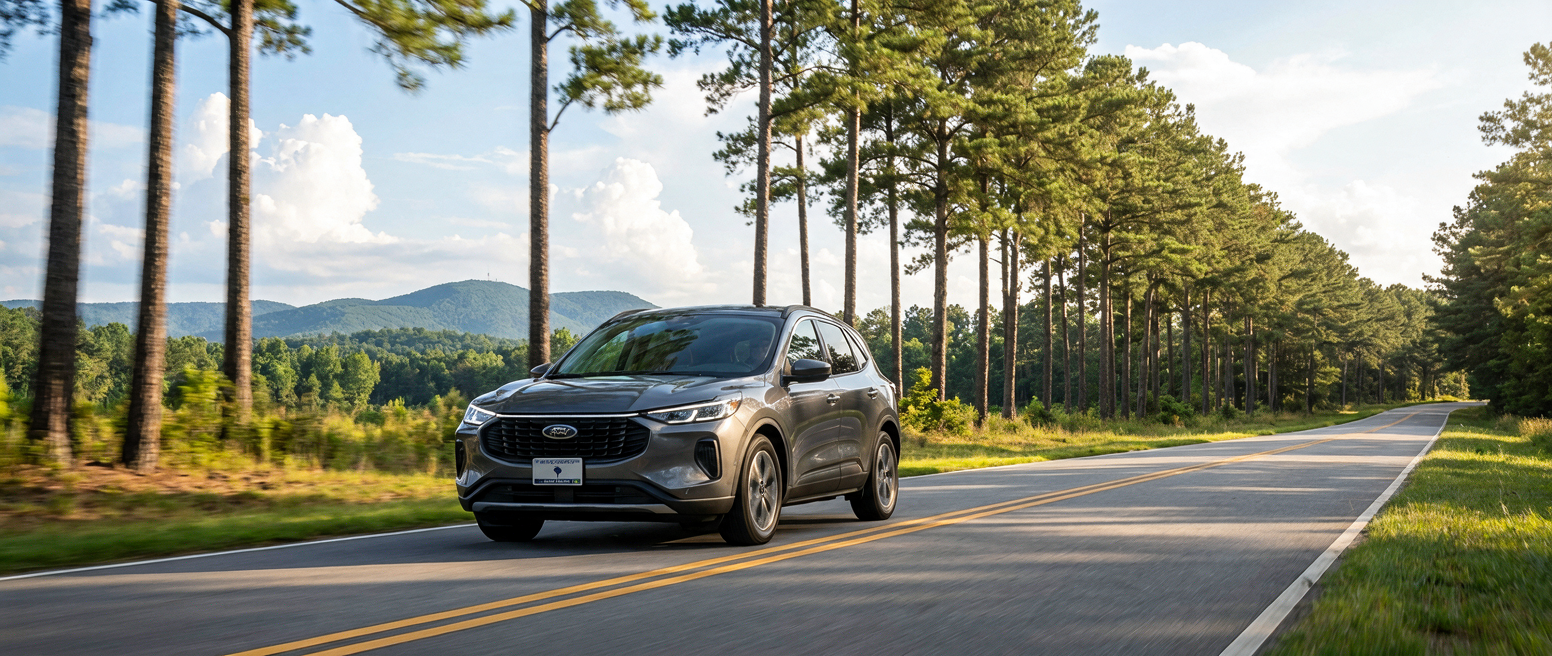
2026 Ford Escape driving a tree-lined two-lane road near Paris Mountain State Park in Greer, SC on a summer morning

Start on East Wade Hampton Boulevard, work up to I-85, wind through Paris Mountain, and finish with a real-world parking challenge downtown. Four stops. Each one earns its place because it puts a specific piece of the Ford Escape's safety technology right where it belongs. By the time you park, the new driver in your family will have practiced every feature Co-Pilot360 offers, in the conditions it was built for.

Before this trip, a fair question to settle at D&D Ford is which Escape trim is "the safe one." The answer's refreshingly plain. Every 2026 Escape trim ships with the same core Co-Pilot360 suite standard, no upsell required. The tech differences between trims are real, but the foundation you need for a new driver is already there at the base level.

One tradeoff is worth saying plainly. These systems are aids, not replacements. The IIHS has found that automatic emergency braking, lane departure prevention, and blind spot monitoring together could be relevant to roughly a third of teen driver fatalities. Relevant, not preventive of all of them. The Escape's job is to buy your new driver a half-second they didn't have before. Your new driver's job is everything else.

What's the Route?

Four stops span roughly two hours of total driving, and the sequence climbs from familiar surface streets to highway merging to winding curves on purpose. The table below maps each leg.

StopDrive from previousWhat you're practicingWhat to pack
1. D&D Ford, East Wade Hampton BlvdStarting pointSurface street starts, rearview camera, Auto High-BeamWater, sunscreen (August sun is real)
2. I-85 on-ramp / Greer corridor5 minHighway merge, BLIS blind spot alerts, following distanceComfortable shoes
3. Paris Mountain State Park20 minWinding curves, Lane-Keeping, low-speed pedestrian alertDay-use fee (bring a card), trail snacks
4. Downtown Greer parking25 minReverse camera, tight parking, Cross-Traffic AlertPatience and a small appetite for lunch

The Four Stops

Stop 1: East Wade Hampton Boulevard

D&D Ford Motors sits right on US-29, which makes it the perfect zero-pressure starting point. Surface streets in this stretch run 35-45 mph, there's real traffic, and the summer glare off the pavement at midday is legitimately bright. Glare is where this matters. The Escape's Auto High-Beam Headlamps adjust on their own as oncoming cars approach, so a new driver learns to stop fighting the brights-versus-darks decision on a busy commercial road. Let them drive the first mile or two back toward Greer's neighborhoods before getting on anything faster, no rush.

Pre-Collision Assist with Automatic Emergency Braking stays active the whole time, but on a surface street at 40 mph it works quietly in the background. And that quiet is the point. New drivers get comfortable while the system watches the gap ahead for them.

Stop 2: The I-85 On-Ramp

Highway merging is the scenario new drivers fear, and for good reason. The CDC reports that teen drivers are nearly three times as likely as drivers 20 and older to be involved in a fatal crash per mile driven, and lane changes on limited-access highways are a known pressure point.

On I-85 entering from the Greer corridor, the Escape's BLIS (Blind Spot Information System) with Cross-Traffic Alert puts a solid amber indicator in the side mirror the moment a car enters the no-see zone. It doesn't honk. It doesn't grab the wheel. It shows up reliably every time, which is what a 17-year-old already white-knuckling the merge needs. An alert they learn to trust beats an alarm they start ignoring.

If your Escape has Co-Pilot360 Assist+ (standard on the PHEV and higher trims; available as a package on the base Active), Adaptive Cruise Control with Stop-and-Go can hold following distance on its own once the new driver is settled into a lane. Let them drive without it first. Then let them feel the difference. That comparison is its own lesson.

See Current Ford Escape Offers

Stop 3: Paris Mountain State Park

Paris Mountain is the stop we look forward to most with families. The climb up State Park Road twists through the trees in a way that flat Upstate roads simply don't prepare you for. Curves arrive faster than they look on the approach. Speed drops. Other drivers come down the hill toward you.

Lane-Keeping System is doing real work here. When the Escape detects drift toward the center line, it applies a gentle corrective steering input rather than just sounding a warning. The difference matters on a narrow two-lane with a drop-off shoulder. It doesn't fight the driver; it nudges. A new driver feels it, learns what it means, and over time stops needing it.

August afternoons in Upstate SC bring another variable, the afternoon thunderstorm. We've seen them roll in off the Blue Ridge in under 20 minutes. If the sky clouds up while you're at the park, treat it as the best classroom moment you'll get. Wet pavement on a winding descent is where lane discipline habits form. The Escape's available Intelligent AWD (on AWD-configured trims) sends torque where it's needed to hold traction when traction gets interesting.

Pedestrian detection matters at this stop. The park has trail crossings where hikers step from the tree line without much warning, and Pre-Collision Assist with pedestrian detection scans ahead continuously.

Stop 4: Downtown Greer Parking

Downtown Greer gives you small parking lots, right-angle reverse spaces, and people pushing strollers across the lane at a pace that defies any logical speed. In August the place is alive, and that suits the last leg.

Browse our current Escape inventory if you want to check which trims include the 360-Degree Camera with Split View (available on the Platinum through the Premium Technology Package). The system gives a top-down perspective on the vehicle's relationship to curbs, cars, and the occasional shopping cart. Even without it, the standard rearview camera plus BLIS Cross-Traffic Alert handles the moment another car rolls behind you while you're backing out of a space.

Set your new driver the task of finding their own space and parking unassisted. Watch. Then talk through what they noticed. That conversation's worth three YouTube tutorials.

Timing note: Go earlier rather than later on a summer weekend. Paris Mountain's day-use area fills up by 10 a.m. in August, and the afternoon thunderstorm window typically opens between 2 and 4 p.m. Aim to hit the park between 8:30 and 10:00 a.m., then head downtown for lunch after the weather decides what it's doing.

Before you hand over the keys, set up Ford MyKey. Setup runs a few minutes through the SYNC 4 touchscreen. Ford's system lets you cap the Escape's top speed (65, 70, 75, or 80 mph are the options), limit audio volume to a maximum of 45%, and turn on Belt-Minder, which mutes the audio system until front seatbelts are buckled. Lane Departure Warning also resets at every vehicle restart under MyKey, so a new driver can't switch it off before a solo trip and forget they did it. You keep the Admin Key with full access; they drive with the MyKey. Start this route with MyKey active so your new driver knows how it feels from the first mile.

Print-and-Go Checklist

  • Set up Ford MyKey before leaving the dealer lot (takes under 5 minutes via SYNC 4 settings)
  • Confirm BLIS indicators are visible in both side mirrors before rolling
  • Drive Stop 1 in silence. No music until the new driver is settled
  • On the I-85 on-ramp, call out the BLIS amber light together as it activates
  • At Paris Mountain, narrate the Lane-Keeping nudge the first time it happens
  • Check the afternoon weather before committing to Stop 3 after noon
  • Bring exact change or a card for Paris Mountain day-use access
  • At Stop 4, let the new driver park completely unassisted
  • After the route, talk through one moment that surprised them

Tweak It to Your Crew

Not every new driver is a 16-year-old, and this route works the same whether you're coaching a teen, an adult who never owned a car, or a returning driver after a long gap, because the features respond to how the car's being driven. Some are adults who just never had a car. Some are returning drivers after a gap. The features read the driving situation, whatever your age.

If someone wants more highway time, extend the I-85 leg north toward Spartanburg before looping back. If a new driver isn't ready for Paris Mountain's curves yet, a look at our pre-owned Escape inventory might point you toward a more modest starting vehicle while they build hours, or you can simply save Stop 3 for a second session. Nothing says you've got to complete all four stops in one day. Graduated exposure is the whole logic of this route.

We've been serving the Carolinas since 1937. A lot of new drivers have pulled off East Wade Hampton Boulevard for the first time in that time. The safety tech in a 2026 Ford Escape is genuinely different from anything that existed when most of their parents learned to drive. Use it intentionally, and this route gives you and your new driver a real first chapter.

D&D Ford Motors

13655 E Wade Hampton Blvd, Greer, SC 29651

(864) 877-0711

Recommended Posts

2026 Ford Transit-350 Passenger Van in white, doors open, ready for church or school shuttle use in Greenville, SC

Your Greenville Organization Is Hauling People in the Wrong Setup (Here's How to Fix It)

In this article What's Actually Going On? A Configuration Breakdown by Use Case The Engine Question Most Buyers Get Wrong XL vs. XLT: The Honest Tradeoff DIY Decision vs. Talking to Our Commercial Team Schools, churches, and shuttle operators around Greenville rarely pick the wrong van on purpose. They pick the wrong *configuration* of the right van, and they don't notice until about three months into ownership, when the rear seats feel punishing on a 40-minute run or a coordinator realizes the group plus gear is bumping the payload limit. The fix is almost always the 2026 Ford Transit-350, but the version you order matters more than the badge on it suggests. For organizations moving 12 to 15 people in the Greenville area, the Transit-350 Passenger Van is the platform that makes sense. The roof height and wheelbase you order decide whether those passengers ride comfortable or just technically get there, and it's the part that trips people up. Spec that part with care. See Current Ford Transit Deals What's Actually Going On? A Configuration Breakdown by Use Case The 2026 Ford Transit-350 Passenger Van offers up to 15-passenger seating, two trims, XL and XLT, three roof heights, and two body lengths, which sounds like flexibility but can feel like paralysis when you're on the hook for a budget. The table below maps the organizational needs we see at the counter to the configuration that fits them. Organization Type Recommended Config Why It Fits What to Watch School field-trip shuttle (short runs) Transit-350 XL, Medium Roof, Long Wheelbase Max 15 seats, 52-inch headroom, lower acquisition cost Rear seats are functional, not plush; fine for 30-45 min trips Church van (mixed age, weekly runs) Transit-350 XLT, Medium or High Roof, Long Wheelbase XLT adds comfort trim; 52-56.6 in. headroom for older adults Budget step-up vs XL; plan for it Airport/hotel shuttle (GSP corridor) Transit-350 XLT, High Roof, Extended Wheelbase 56.6-inch stand-up headroom; cargo space for luggage behind row 5 Extended length needs a wider parking plan Nonprofit or multi-purpose fleet Transit-350 XL, Long Wheelbase, your roof choice Lowest operating cost, easiest to maintain at scale Cloth seats; upgrade to vinyl if spill risk is high Ford lists the passenger van's max payload at 3,401 pounds across its 2026 Passenger Van lineup. Run that against a full load of 15 adults plus gear, and you can see why leaving headroom in the configuration spec isn't optional. The Transit-150 and Transit-250 are genuine options for smaller groups, think 8 to 10 passengers in a converted cargo configuration, but for a true 12-to-15-seat passenger van, the Transit-350 is the one Ford actually rates for that job. The smaller two won't earn it. The Engine Question Most Buyers Get Wrong The 2026 Transit-350 Passenger Van's standard powertrain is a naturally aspirated 3.5-liter V6 producing 275 horsepower, paired with a 10-speed SelectShift automatic. You get that engine in a Long Wheelbase configuration, and it handles I-85 highway speeds and the rolling grades between Greer and Greenville without drama. For most organizations, it's plenty. The 3.5-liter EcoBoost V6, rated at 300 horsepower, becomes standard when you step up to the Extended Wheelbase body. So if your route stays relatively flat and you're not hauling luggage regularly, the base V6 with a Long Wheelbase config is a capable, sensible choice. If your shuttle covers more ground (say, airport runs that occasionally head toward the Blue Ridge foothills on I-26), the EcoBoost on an Extended body gives you the reserve you'll appreciate. A note worth flagging comes from our commercial team. The Transit Passenger Van exceeds the 8,500-pound GVWR threshold, which means it isn't subject to EPA fuel economy testing. Real-world estimates run roughly 15 to 20 mpg depending on load and route, per published industry data. Skip the car-like number. Budget on the higher-load end of that range and call it a realistic plan. Fleet Note: The 2026 Transit includes Ford's Remote Acceleration Limiter and Fleet Start Inhibit as standard features on XLT, allowing fleet administrators to manage vehicle use remotely. That matters when the van is shared across multiple drivers in a school or church setting. Ford lists the 2026 Transit-350 Passenger Van's maximum payload at 3,401 pounds, and its standard Intelligent AWD is available across both XL and XLT trims without raising the load floor or reducing seating capacity. XL vs. XLT: The Honest Tradeoff The Transit-350's XL trim is built for durability and lower total acquisition cost, with cloth seats and commercial-grade interior surfaces focused on function. For a school district running a defined route on a defined replacement schedule, XL is usually the call. You're putting high miles on it over several years. The service simplicity earns its keep. XLT adds better interior materials, more comfort features, and the standard Ford Co-Pilot360 2.0 with Advanced Driver Assist features including the Remote Acceleration Limiter. For a church van that carries older adults, or a shuttle that doubles as a guest-experience vehicle, you'll feel where the XLT trim's added cabin refinement earns its step up. Both trims share one downside worth saying out loud. The rear seats in the 2026 Transit Passenger Van are functional, not luxurious. Multiple real-world owners note that 30 to 45 minutes is the sweet spot for rear passengers, and longer trips call for deliberate seat upgrades or aftermarket cushioning. For a Greenville school running 20-minute route legs or a church running weekly Sunday routes, it's a non-issue. For an organization doing 90-minute charter runs, factor seat comfort into the plan. DIY Decision vs. Talking to Our Commercial Team You can make a version of this call on your own, and you'll want a quick conversation before ordering on another version entirely. The split comes down to how standard your use case is. Handle it yourself if: Your use case is straightforward: fixed 15-passenger route, known group weight, regular short hops around Greenville County You know you want XL for budget and long-wheelbase for the seat count You're replacing an existing Transit and the current config has worked well Bring it to us if: You're spec'ing for the first time and aren't sure whether your full passenger load plus equipment stays inside the 3,401-pound payload limit You need upfitter guidance (privacy glass, fleet graphics, step rails, or interior surface changes) You're deciding between the Transit Passenger Van and the E-350SD cutaway for a custom shuttle body Your organization qualifies for fleet or commercial purchasing support through Ford Pro Our team on East Wade Hampton Boulevard works with commercial and fleet buyers regularly. We can run a payload calc with you before you order, not after the van shows up in your lot. That's where we catch the configuration mismatches that would otherwise surface at month three. Frequently Asked Questions Does driving a 15-passenger Ford Transit require a special driver's license in South Carolina? No CDL, or Commercial Driver's License, is required in South Carolina to operate a Ford Transit Passenger Van carrying up to 15 passengers when it's used for non-commercial purposes such as church or school trips. However, organizations should verify their specific use case with their insurance carrier and legal counsel, as requirements can vary depending on whether compensation is involved and who the passengers are. Ford's fleet team and our commercial staff can point you toward the right questions to ask before your first driver gets behind the wheel. What's the difference between the Transit-350 Passenger Van and the E-350SD for a shuttle operation? The Transit-350 Passenger Van is a factory-configured passenger hauler seating up to 15, with the structure, airbags, and safety systems already in place. The E-350SD is a cutaway chassis that typically gets a custom shuttle body installed by an upfitter, which lets you run higher seating counts or specialized interior layouts. For most church and school applications in the Greenville area where 12 to 15 seats is the target and budget matters, the Transit-350 Passenger Van is simpler to acquire and it's easier to maintain. The E-350SD cutaway makes more sense when you need a purpose-built body, a wheelchair lift, or seating beyond what the Transit Passenger Van supports. Explore Financing Options for Your Fleet D&D Ford Motors 13655 E Wade Hampton Blvd, Greer, SC 29651 (864) 877-0711

2026 Ford F-150 SuperCrew cab at an Upstate South Carolina job site with tailgate down

Ford F-150 SuperCab vs SuperCrew: Which One Actually Fits Your Life in Greer?

In this article What's the Real Difference Between a SuperCab and a SuperCrew? Does the SuperCab Give You More Hauling Muscle? Passenger Room as a Day-to-Day Reality The Trim Level Angle Nobody Talks About So Which Should You Pick? Give us about 30 seconds and we'll settle it. If you're routinely hauling adults in the back seat, get the SuperCrew. If payload capacity and bed length matter more to you than rear passenger comfort, the SuperCab (or a Regular Cab with an 8-foot bed) earns its keep. What it comes down to is which tradeoff you can live with, and that's where a lot of comparison articles quit doing their job. Browse the 2026 Ford F-150 lineup at D&D Ford Motors to see what's in stock, then come back here to get clear on the configuration before you drive one. The short version The 2026 Ford F-150 SuperCrew delivers 43.6 inches of rear legroom versus 33.5 in the SuperCab. That 10-inch gap is everything once car seats and adult passengers are in play. Rear-hinged doors on the SuperCab need the front door open first. For anyone loading kids or passengers daily, that's a real inconvenience. Properly equipped, the SuperCrew reaches up to 13,500 lbs of towing capacity. The SuperCab is lighter, which hands it a payload edge of roughly 200-400 lbs in comparable trim levels. Neither cab gets an 8-foot bed. Only the Regular Cab does. Make a full 8-foot bed your priority, and the Regular Cab is the configuration to look at. Both cabs top out at the same trim levels. King Ranch, Platinum, and Raptor are SuperCrew-only. What's the Real Difference Between a SuperCab and a SuperCrew? The difference lives almost entirely in the back seat, not up front. Ford lists the 2026 F-150 SuperCrew at 43.6 inches of rear legroom against the SuperCab's 33.5 inches, which is more than 10 full inches, and that single measurement drives most of the family-versus-crew decision. Put a forward-facing car seat behind a six-foot driver in a SuperCab and you'll feel every one of those inches. Feature SuperCab SuperCrew Rear legroom 33.5 in 43.6 in Rear door style Rear-hinged (requires front door open) Full-size, forward-hinged Available beds 6.5-ft only 5.5-ft or 6.5-ft 8-ft bed available? No No Max towing (when equipped) Up to 13,300 lbs Up to 13,500 lbs Payload edge Higher (lighter curb weight) Lower by ~200-400 lbs Available trims XL through Lariat XL through Raptor Why fuss over a door? SuperCab rear doors swing backward and only open once the front doors are open, so on a school pickup line, or at a job site where a crew member needs in and out fast, that's genuine friction, while the SuperCrew rear doors open on their own like any other four-door. One factor decides it. If adults or car-seat children ride in the back seat most days, the SuperCrew's 43.6 inches of rear legroom isn't a luxury. It's the baseline. Does the SuperCab Give You More Hauling Muscle? Yes, the SuperCab out-hauls the SuperCrew on payload, though it gives up a little at the very top of the towing chart. Because it's lighter (fewer doors, a smaller rear cabin), it can carry about 200-400 more pounds in comparable trim configurations, according to verified specifications, and for a crew running supplies between job sites along I-85, that's real tonnage in the bed. See F-150 trim and cab combinations available now to find which payload ratings apply to specific builds. Ford lists the 2026 F-150's maximum towing at 13,500 lbs when properly equipped with the 3.5L EcoBoost V6, the Tow/Haul Package, the Max Tow Axle upgrade, and a SuperCrew with a 6.5-foot bed in 4x4 configuration. The SuperCab's maximum sits slightly lower at 13,300 lbs in top configuration. Both numbers depend on the right axle ratio and tow equipment, and the door sticker on your specific truck is the number that counts. Talk to our team about financing the right configuration for your workload The harder tradeoff for work crews is the bed. Neither the SuperCab nor the SuperCrew offers an 8-foot bed. That's exclusively a Regular Cab option on the F-150. If your crew hauls full sheets of drywall or 16-foot lumber flat in the bed without an extender, the Regular Cab with an 8-foot box is the straight answer, even if it means giving up rear passenger seating. Passenger Room as a Day-to-Day Reality On paper the legroom gap looks like one number, but the daily reality is two things at once, room and access. What we see on our lot, and what customers tell us after they swap a SuperCab for a SuperCrew, is that the rear door setup is the part they wish someone had been blunt about upfront. Adults in the SuperCab back seat will be cramped on any long drive. "The SuperCrew cab provides the most spacious cabin, especially in the second row, making it ideal for families or crews who need maximum comfort." (Ford's published 2026 F-150 specifications) The SuperCrew's 43.6 inches of rear legroom puts it squarely in SUV territory. The width helps. Parents loading rear-facing infant seats get the benefit of the extra door width, and taller crew members get to skip folding themselves in half for a long run up to Paris Mountain or down the Cherokee Foothills Scenic Highway on SC-11 with a full truck. The SuperCab's folding rear seats earn their spot for a different reason. Fold those seats up and the rear cab turns into a dry, locked storage area. For a contractor hauling power tools, that beats leaving equipment out in the open bed. The Trim Level Angle Nobody Talks About Trim choice can quietly make the cab decision for you, and it runs one direction only. The higher trims (King Ranch, Platinum, and Raptor) come as SuperCrew exclusively, so if you want a Lariat or below you get a genuine cab choice, and if you want King Ranch or Platinum comfort features the SuperCrew isn't optional, it's the only way in. So if you're eyeing the Max Recline Seats offered on King Ranch and Platinum, or the Raptor's 37-inch tire package, the SuperCrew is already settled by the trim you want. For those buyers the cab choice isn't really a choice at all. View Current F-150 Offers So Which Should You Pick? It splits cleanly by how you use the back of the truck, with one caveat for the trim shoppers. Sort yourself by who or what rides behind the front seats and the cab almost picks itself, though anyone reaching for King Ranch or above has the decision made already. Pick the SuperCrew if: You have kids, carry adult passengers often, want any trim above the Lariat, or just want the truck to double as a family vehicle without compromise. The 10-inch legroom advantage is the kind of thing you feel on every single drive. See SuperCrew configurations in our inventory Pick the SuperCab if: Your rear seats mostly carry tools, your crew runs smaller, and you'd rather keep the lighter curb weight working for you on payload. It's a capable, straight-shooting truck for the job. Just go in clear-eyed about those rear doors and the 6.5-foot bed being your only bed option. Pick the Regular Cab if: You need an 8-foot bed, you're running a work fleet, and a rear seat is genuinely irrelevant to your operation. It's the most cargo-focused F-150 configuration, with the highest payload ceiling in the lineup. We've been selling F-150s in Greer since 1937. When someone sits in the truck before deciding instead of just reading specs, the question that separates SuperCab buyers from SuperCrew buyers is almost always the rear door. Sit in the back seat of both. The 10-inch gap between 33.5 and 43.6 inches answers it faster than any chart. Frequently Asked Questions Can adults fit comfortably in the back seat of a SuperCab? Occasionally, yes. For shorter trips or smaller adults, the SuperCab's 33.5 inches of rear legroom works fine. For daily use with adults or tall teenagers, it gets tight fast. If adults sit in back more than a couple times a month, the SuperCrew's 43.6 inches of rear legroom is worth the upgrade. Does the SuperCrew or SuperCab tow more? The SuperCrew has the slight edge at the top. Ford lists maximum towing at 13,500 lbs for the 2026 F-150 in a SuperCrew configuration with the 3.5L EcoBoost, 4x4 drivetrain, 6.5-foot bed, Tow/Haul Package, and Max Tow Axle upgrade. The SuperCab tops out at around 13,300 lbs in its best configuration. The bigger practical difference is payload. The lighter SuperCab can carry 200 to 400 more pounds in the bed across comparable trim levels. What's the difference in rear doors between the two cabs? SuperCab rear doors are rear-hinged and need the front door open first. SuperCrew doors open on their own, like a standard four-door vehicle. For families or crews loading passengers often, the SuperCrew's door design is significantly more convenient. Value Your Trade and Build Toward Your Next F-150 D&D Ford Motors 13655 E Wade Hampton Blvd, Greer, SC 29651 (864) 877-0711

2026 Ford Maverick truck bed and cab storage setup for students and commuters in Greer, SC

The Ford Maverick Storage Playbook for Students and Commuters

In this article Where Does Everything Actually Go? Planning the Commute Load The Student Move-In Setup You're Ready. Go Get It Done. Pressed for time? The 2026 Ford Maverick gives you more usable, organized storage than most compact pickups its size, and it splits into distinct zones that actually map to how a student or daily commuter lives. Use the cab for valuables and daily-grab items. Use the FLEXBED bed for larger hauls. Know the one real tradeoff before you load up. Everything below tells you where to put what. Where Does Everything Actually Go? The Maverick packs storage into five distinct zones, and while five sounds like a lot to track, each one carries a single clear purpose, so once you assign your gear to a zone the whole thing stops feeling complicated. Think of it like packing a well-organized carry-on. Zone What It Holds Dimensions / Specs Best Use Rear under-seat bin Secured valuables, shoes, gear Factory bin, lockable with cab Laptop bag, textbooks, cleats FLEXBED bed (closed tailgate) Bulky cargo up to 33.3 cu ft 54.4 in long, 42.6 in wide (between wells) Dorm boxes, backpacks, equipment FLEXBED sidewall pockets Small tools, straps, extras Built-in stamped slots Bungees, charging cables, snacks Door pockets Bottles, phone, wallet Ford-designed for most water bottles Hydration, keys, everyday carry Center console / front storage Phone, cords, small personal items Standard bin Chargers, earbuds, sunglasses The tradeoff worth knowing about shows up with three people in the cab, because that rear under-seat bin effectively becomes off-limits mid-trip. Call it a design choice more than a flaw (the Maverick is a five-seater first, cargo hauler second). For a solo commuter or a student who rarely fills all four seats, it's genuinely excellent. Carpooling daily with a full back seat? Shift your valuables to the cab center console and let the bed do more of the work. Planning the Commute Load Planning your daily load-out takes only a couple of minutes, and it pays back every morning by keeping your valuables cool and the bed clear, though even an efficient commute still asks for a little thought about what rides where. Greer sits right on I-85, which means a lot of our customers are running that Greenville-to-Spartanburg corridor every single day. The Maverick Hybrid's EPA-rated 42 city / 35 highway / 38 combined mpg makes that commute lighter on your wallet than a conventional truck. Efficient commuting still wants a smart daily setup, though. See 2026 Maverick configurations on our lot We'd load it like this for a typical I-85 work commute. Center console: phone, charger, parking badge, earbuds Driver-side door pocket: 1.5-liter water bottle, sunglasses case (Ford designed these pockets to fit most standard water bottles) Rear under-seat bin: laptop, lunch bag, work shoes (anything you don't want in the summer heat of the bed) FLEXBED: reusable grocery bags folded flat, a pop-up umbrella, a collapsible crate for hardware store runs That last detail matters in August around here. The bed sits in full sun all afternoon, and it gets hot in there. Keep temperature-sensitive items (electronics, lunch) in the under-seat bin, protected inside the cab's climate-controlled space. That keeps them safe. Tip: The two pre-wired 12-volt outlets built into the FLEXBED bed let you run a small fan or inflator without draining your cab outlets. Add the available 400-watt 110V outlet upgrade, and you can run a laptop straight from the bed on a tailgate work session. Tip: The multi-position tailgate isn't just for loading. Lock it at the mid position when you want a bench without dropping the gate to full open. That helps in tight Greenville parking decks, where a fully dropped gate sticks out further than you'd expect. Explore financing options for the 2026 Maverick Next step: Stop by D&D Ford Motors on East Wade Hampton Boulevard in Greer and physically load your gear into a Maverick. It's the only way to verify your backpack, equipment bag, or work kit actually fits the way you need it to. The Student Move-In Setup Move-in weekend usually lands in the hottest stretch of August, and the Maverick suits it because at roughly 199.8 inches long it slots into most standard campus parking spaces without the "is this going to work?" anxiety of a full-size truck. Add the parking crunch, the endless trips between truck and dorm room, and the need to stay organized while you're tired and it's 90 degrees, and a truck that parks easy earns its keep. Wheel it into a lot, drop the FLEXBED tailgate, and you've got a 54.4-inch-long bed (that's 4.5 feet) at a maximum 42.6 inches wide between the wheel wells. Fold a mini-fridge onto its side, set two large dorm-storage bins beside each other, and drop a duvet bag on top. Everything fits. Check the sidewalls and you'll find the FLEXBED pockets keeping straps and cords from disappearing under everything else. The built-in slots take 2x4 lumber, so you can slide in a pair of boards as improvised dividers and stop boxes from sliding into each other on the drive. Keep your Maverick road-ready at our service center Move-In Day Checklist Load the largest items first (mini-fridge, storage bins) flat in the FLEXBED Use 2x4s in the sidewall slots to create dividers between boxes Secure everything with the FLEXBED's six tie-down cleats before hitting the road Pack laptop, chargers, and documents in the rear under-seat bin (out of the heat and out of sight) Keep your parking pass and key fob in the center console, not loose in a bag Use the split-fold rear seat flat as an overflow surface for soft items like pillows and backpacks Check tailgate clearance before backing into a tight spot (remember: mid-position saves about 18 inches) See Current Maverick Offers at D&D Ford You're Ready. Go Get It Done. The 2026 Maverick won't make you choose between being a truck person and a practical, efficient daily driver, and that dual nature is the reason it works so well for this crowd. Our team at D&D Ford Motors has been fitting Upstate SC families into the right Ford for nearly 90 years, and we'd tell you straight if the Maverick wasn't the answer for your situation. For a student hauling gear across campus or a commuter grinding I-85 five days a week, it usually is. Come see what's on the lot, open the tailgate, and load your actual stuff. Value Your Trade Toward a New Maverick D&D Ford Motors 13655 E Wade Hampton Blvd, Greer, SC 29651 (864) 877-0711